
Pulp Fiction, 1922 · page 89 of 196
Adventure, January 20, 1922 — page 89: what you’re looking at
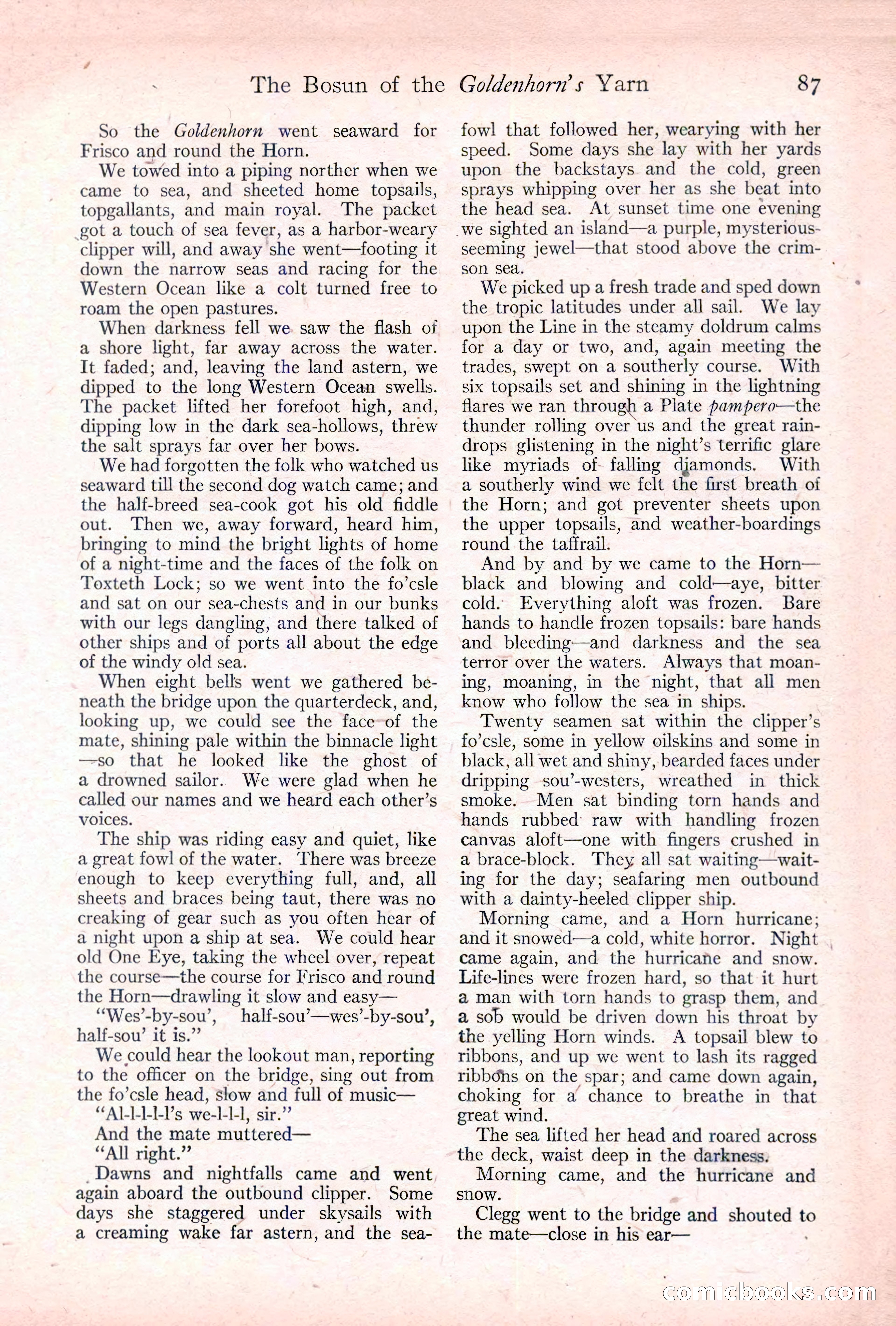
A restored page from Pulp Fiction, 1922. Page through the whole issue in the reader above.
📄 Transcribed text from this page (OCR, searchable)
Machine-transcribed from the original scan — historical spelling and the odd misread are preserved.
The Bosun of the So the Goldenhorn went seaward for Frisco and round the Horn. We towed into a piping norther when we came to sea, and sheeted home topsails, topgallants, and main royal. The packet got a touch of sea fever, as a harbor-weary clipper will, and away she went—footing it down the narrow seas and racing for the Western Ocean like a colt turned free to roam the open pastures. When darkness fell we saw the flash of a shore light, far away across the water. It faded; and, leaving the land astern, we dipped to the long Western Ocean swells. The packet lifted her forefoot high, and, dipping low in the dark sea-hollows, threw the salt sprays far over her bows. We had forgotten the folk who watched us seaward till the second dog watch came; and the half-breed sea-cook got his old fiddle out. Then we, away forward, heard him, bringing to mind the bright lights of home of a night-time and the faces of the folk on Toxteth Lock; so we went into the fo’csle and sat on our sea-chests and in our bunks with our legs dangling, and there talked of other ships and of ports all about the edge of the windy old sea. When eight bells went we gathered be- neath the bridge upon the quarterdeck, and, looking up, we could see the face~of the mate, shining pale within the binnacle light —-so that he looked like the ghost of a drowned sailor. We were glad when he called our names and we heard each other’s voices. The ship was riding easy and quiet, like a great fowl of the water. There was breeze enough to keep everything full, and, all sheets and braces being taut, there was no creaking of gear such as you often hear of a night upon a ship at sea. We could hear old One Eye, taking the wheel over, repeat the course—the course for Frisco and round the Horn—drawling it slow and easy— ‘“‘Wes’-by-sou’, half-sou’—wes’-by-sou’, half-sou’ it is.” We could hear the lookout man, reporting to the officer on the bridge, sing out from the fo’csle head, slow and full of music— “*Al-I-I-I-l’s we-l-I-l, sir.” And the mate muttered— “All right.” Dawns and nightfalls came and went again aboard the outbound clipper. Some days she staggered under skysails with a creaming wake far astern, and the sea- Goldenhorn’s Yarn 87 fowl that followed her, wearying with her speed. Some days she lay with her yards upon the backstays. and the cold, green sprays whipping over her as she beat into the head sea. At sunset time one evening -we sighted an island—a purple, mysterious- seeming jewel—that stood above the crim- son sea. We picked up a fresh trade and sped down the tropic latitudes under all sail. We lay upon the Line in the steamy doldrum calms for a day or two, and, again meeting the trades, swept on a southerly course. With six topsails set and shining in the lightning flares we ran through a Plate pampero—the thunder rolling over us and the great rain- drops glistening in the night’s terrific glare like myriads of- falling djamonds. With a southerly wind we felt the first breath of the Horn; and got preventer sheets upon the upper topsails, and weather-boardings round the taffrail. And by and by we came to the Horn— black and blowing and cold—aye, bitter cold. Everything aloft was frozen. Bare hands to handle frozen topsails: bare hands and bleeding—and darkness and the sea terror over the waters. Always that moan- ing, moaning, in the night, that all men know who follow the sea in ships. Twenty seamen sat within the clipper’s fo’csle, some in yellow oilskins and some in black, all wet and shiny, bearded faces under dripping sou’-westers, wreathed in thick smoke. Men sat binding torn hands and hands rubbed raw with handling frozen canvas aloft—one with fingers crushed in a brace-block. They all sat waiting—wait- ing for the day; seafaring men outbound with a dainty-heeled clipper ship. Morning came, and a Horn hurricane; and it snowed—a cold, white horror. came again, and the hurricane and snow. Life-lines were frozen hard, so that it hurt @ man with torn hands to grasp them, and a sob would be driven down his throat by the yelling Horn winds. A topsail blew to ribbons, and up we went to lash its ragged ribbohs on the spar; and came down again, choking for a chance to breathe in that great wind. The sea lifted her head and roared across the deck, waist deep in the darkness. Morning came, and the hurricane and snow. Clegg went to the bridge and paoutet to the mate—close in his ear— econnichook = Night , (C@