
Pulp Fiction, 1922 · page 135 of 200
Adventure Magazine Cover — page 135: what you’re looking at
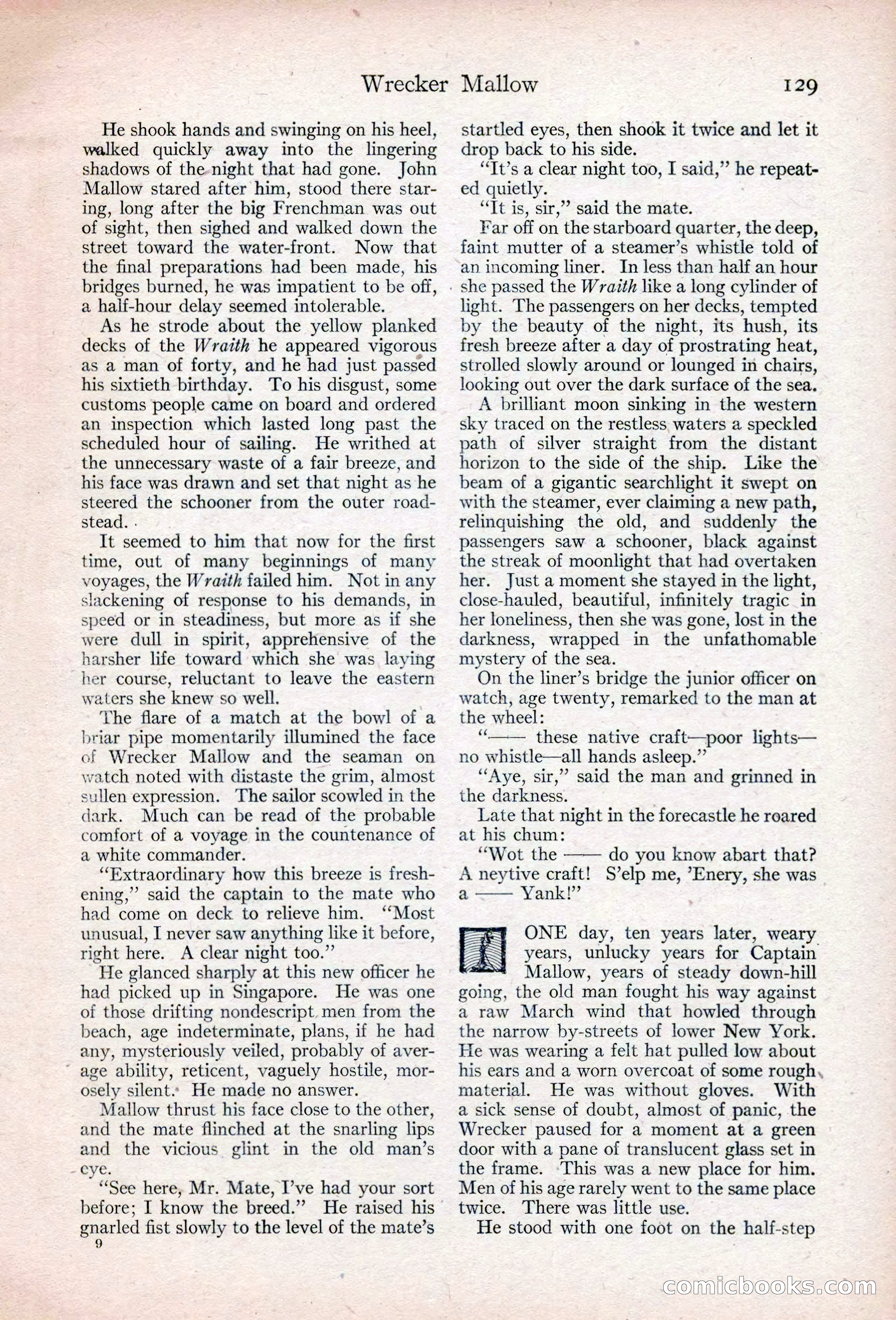
A restored page from Pulp Fiction, 1922. Page through the whole issue in the reader above.
📄 Transcribed text from this page (OCR, searchable)
Machine-transcribed from the original scan — historical spelling and the odd misread are preserved.
Wrecker Mallow He shook hands and swinging on his heel, walked quickly away into the lingering shadows of the night that had gone. John Mallow stared after him, stood there star- ing, long after the big Frenchman was out of sight, then sighed and walked down the street toward the water-front. Now that the final preparations had been made, his bridges burned, he was impatient to be off, a half-hour delay seemed intolerable. As he strode about the yellow planked decks of the Wraith he appeared vigorous as a man of forty, and he had just passed his sixtieth birthday. To his disgust, some customs people came on board and ordered an inspection which lasted long past the scheduled hour of sailing. He writhed at the unnecessary waste of a fair breeze, and his face was drawn and set that night as he steered the schooner from the outer road- stead. . It seemed to him that now for the first time, out of many beginnings of many voyages, the Wraith failed him. Not in any slackening of response to his demands, in speed or in steadiness, but more as if she were dull in spirit, apprehensive of the harsher life toward which she was laying her course, reluctant to leave the eastern waters she knew so well. The flare of a match at the bowl of a briar pipe momentarily illumined the face of Wrecker Mallow and the seaman on watch noted with distaste the grim, almost sullen expression. The sailor scowled in the dark. Much can be read of the probable comfort of a voyage in the countenance of a white commander. “Extraordinary how this breeze is fresh- ening,” said the captain to the mate who had come on deck to relieve him. ‘‘Most unusual, I never saw anything like it before, right here. A clear night too.” He glanced sharply at this new officer he had picked up in Singapore. He was one of those drifting nondescript.men from the beach, age indeterminate, plans, if he had any, mysteriously veiled, probably of aver- ' age ability, reticent, vaguely hostile, mor- osely silent. He made no answer. Mallow thrust his face close to the other, and the mate flinched at the snarling lips and the vicious glint in the old man’s -eye. “See here, Mr. Mate, I’ve had your sort before; I know the breed.” gnarled fist slowly to the level of the mate’s 9 He raised his 129 startled eyes, then shook it twice and let it drop back to his side. “Tt’s a clear night too, I said,” he repeat- ed quietly. “Tt is, sir,” said the mate. Far off on the starboard quarter, the deep, faint mutter of a steamer’s whistle told of an incoming liner. In less than half an hour . she passed the Wraith like a long cylinder of light. The passengers on her decks, tempted by the beauty of the night, its hush, its fresh breeze after a day of prostrating heat, strolled slowly around or lounged in chairs, looking out over the dark surface of the sea. A brilliant moon sinking in the western sky traced on the restless waters a speckled path of silver straight from the distant horizon to the side of the ship. Like the beam of a gigantic searchlight it swept on with the steamer, ever claiming a new path, relinquishing the old, and suddenly the passengers saw a schooner, black against the streak of moonlight that had overtaken her. Just a moment she stayed in the light, close-hauled, beautiful, infinitely tragic in her loneliness, then she was gone, lost in the darkness, wrapped in the unfathomable mystery of the sea. On the liner’s bridge the junior officer on watch, age twenty, remarked to the man at the wheel: = these native craft—poor lights— no whistle—all hands asleep.” ‘Aye, sir,” said the man and grinned in the darkness. Late that night in the forecastle he roared at his chum: “Wot the do you know abart that? A neytive craft! S’elp me, ’Enery, she was a Yank!’’ years, unlucky years for Captain Mallow, years of steady down-hill going, the old man fought his way against a raw March wind that howled through the narrow by-streets of lower New York. He was wearing a felt hat pulled low about his ears and a worn overcoat of some rough, material. He was without gloves. With a sick sense of doubt, almost of panic, the Wrecker paused for a moment at a green door with a pane of translucent glass set in the frame. ‘This was a new place for him. Men of his age rarely went to the same place twice. There was little use. He stood with one foot on the half-step COMmMicoooks ONE day, ten years later, weary (C@