
Pulp Fiction, 1922 · page 165 of 200
Adventure Magazine Cover — page 165: what you’re looking at
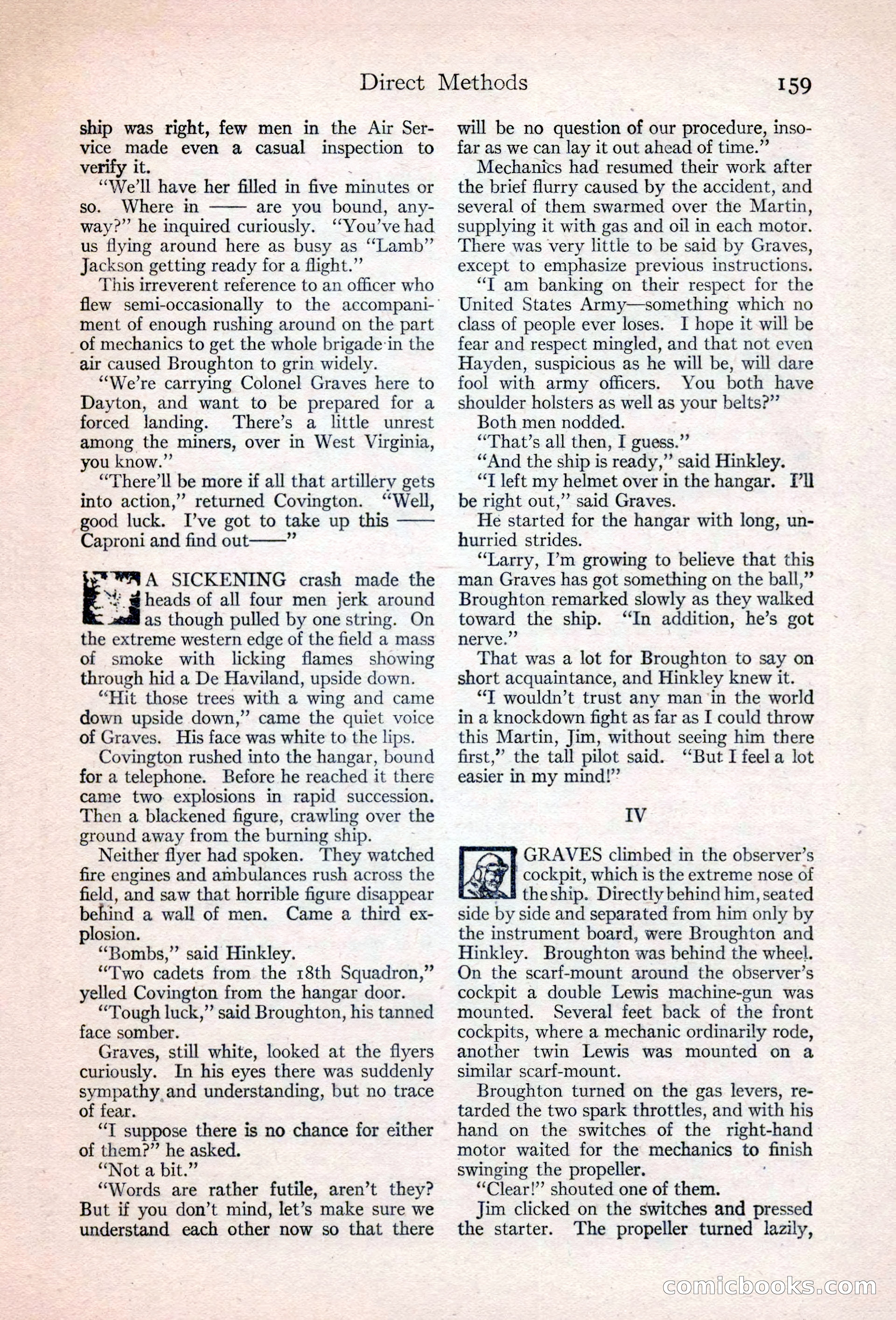
A restored page from Pulp Fiction, 1922. Page through the whole issue in the reader above.
📄 Transcribed text from this page (OCR, searchable)
Machine-transcribed from the original scan — historical spelling and the odd misread are preserved.
Direct Methods ship was right, few men in the Air Ser- a made even a casual inspection to it. We'll have her filled in five minutes or so. Where in are you bound, any- way?” he inquired curiously. “You've had us flying around here as busy as “Lamb” Jackson getting ready for a flight.” This irreverent reference to an officer who flew semi-occasionally to the accompani-’ ment of enough rushing around on the part _of mechanics to get the whole brigade-in the air caused Broughton to grin widely. ‘“‘We’re carrying Colonel Graves here to Dayton, and want to be prepared for a forced landing. There’s a little unrest among the miners, over in West Virginia, you know.” “There’ll be more if all that artillery gets into action,” returned Covington. ‘Well, good luck. I’ve got to take up this —— Caproni and find out-——” ss WA A SICKENING crash made the heads of all four men jerk around as though pulled by one string. On the extreme western edge of the field a mass of smoke with licking flames showing through hid a De Haviland, upside down. “Hit those trees with a wing and came down upside down,” came the quiet voice of Graves. His face was white to the lips. Covington rushed into the hangar, bound for a telephone. Before he reached it there came two explosions in rapid succession. Then a blackened figure, crawling over the ground away from the burning ship. Neither flyer had spoken. They watched fire engines and ambulances rush across the field, and saw that horrible figure disappear behind a wall of men. Came a third ex- plosion. “Bombs,” said Hinkley. “Two cadets from the 18th Squadron,” yelled Covington from the hangar door. “Tough luck,” said Broughton, his tanned face somber. Graves, still white, looked at the flyers curiously. In his eyes there was suddenly sympathy and understanding, but no trace of fear. “T suppose there is no chance for either of them?” he asked. “Not a bit.” “Words are rather futile, aren’t they? But if you don’t mind, let’s make sure we understand each other now so that there 159 will be no question of our procedure, inso- far as we can lay it out ahead of time.” Mechanics had resumed their work after the brief flurry caused by the accident, and several of them swarmed over the Martin, supplying it with gas and oil in each motor. There was very little to be said by Graves, except to emphasize previous instructions. “T am banking on their respect for the United States Army—something which no class of people ever loses. I hope it will be fear and respect mingled, and that not even Hayden, suspicious as he will be, will dare fool with army officers. You both have shoulder holsters as well as your belts?” Both men nodded. “That’s all then, I guess.” “‘And the ship is ready,” said Hinkley. “T left my helmet over in the hangar. Pll be right out,” said Graves. He started for the hangar with long, un- hurried strides. “Larry, ’m growing to believe that this man Graves has got something on the ball,” Broughton remarked slowly as they walked toward the ship. “In addition, he’s got nerve.” That was a lot for Broughton to say on short acquaintance, and Hinkley knew it. “T wouldn’t trust any man ‘in the world in a knockdown fight as far as I could throw this Martin, Jim, without seeing him there first,” the tall pilot said. ‘But I feela lot easier in my mind!” IV GRAVES climbed in the observer’s ‘ cockpit, which is the extreme nose of St.3 theship. Directly behind him, seated aie by side and separated from him only by the instrument board, were Broughton and Hinkley. Broughton was behind the wheel. On the scarf-mount around the observer’s cockpit a double Lewis machine-gun was mounted. Several feet back of the front cockpits, where a mechanic ordinarily rode, another twin Lewis was mounted on a similar scarf-mount. Broughton turned on the gas levers, re- tarded the two spark throttles, and with his hand on the switches of the right-hand motor waited for the mechanics to finish swinging the propeller. “Clear!’”’ shouted one of them. Jim clicked on the switches and pressed the starter. The propeller turned lazily, CORIICLOO S (C@