
Pulp Fiction, 1922 · page 176 of 200
Adventure Magazine Cover — page 176: what you’re looking at
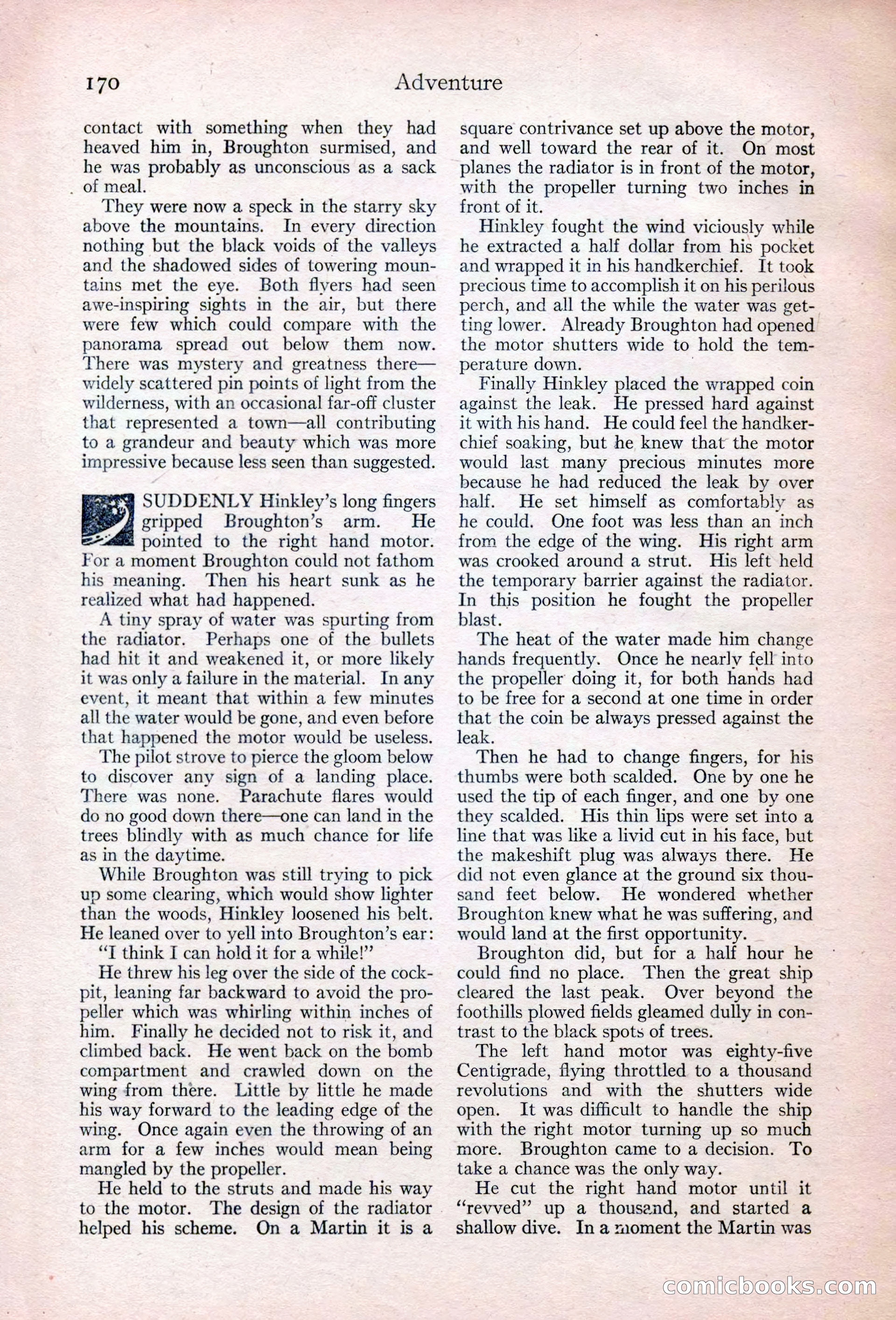
A restored page from Pulp Fiction, 1922. Page through the whole issue in the reader above.
📄 Transcribed text from this page (OCR, searchable)
Machine-transcribed from the original scan — historical spelling and the odd misread are preserved.
170 contact with something when they had heaved him in, Broughton surmised, and he was probably as unconscious as a sack _ of meal. They were now a speck in the starry sky above the mountains. In every direction nothing but the black voids of the valleys and the shadowed sides of towering moun- tains met the eye. Both flvers had seen awe-inspiring sights in the air, but there were few which could compare with the panorama spread out below them now. There was mystery and greatness there— widely scattered pin points of light from the wilderness, with an occasional far-off cluster that represented a town—all contributing to a grandeur and beauty which was more impressive because less seen than suggested. SUDDENLY Hinkley’s long fingers bee) gripped Broughton’s arm. He 488 pointed to the right hand motor. For a moment Broughton could not fathom his meaning. Then his heart sunk as he realized what had happened. A tiny spray of water was spurting from the radiator. Perhaps one of the bullets had hit it and weakened it, or more likely it was only a failure in the material. In any event, it meant that within a few minutes all the water would be gone, and even before that happened the motor would be useless. The pilot strove to pierce the gloom below to discover any sign of a landing place. There was none. Parachute flares would do no good down there—one can land in the trees blindly with as much chance for life as in the daytime. While Broughton was still trying to pick up some clearing, which would show lighter than the woods, Hinkley loosened his belt. He leaned over to yell into Broughton’s ear: “T think I can hold it for a while!” He threw his leg over the side of the cock- pit, leaning far backward to avoid the pro- peller which was whirling within inches of him. Finally he decided not to risk it, and climbed back. He went back on the bomb compartment and crawled down on the wing from there. Little by little he made his way forward to the leading edge of the wing. Once again even the throwing of an arm for a few inches would mean being mangled by the propeller. He held to the struts and made his way to the motor. helped his scheme. On a Martin it is a The design of the radiator . Adventure square contrivance set up above the motor, and well toward the rear of it. On most planes the radiator is in front of the motor, with the propeller turning two inches in front of it. Hinkley fought the wind viciously while he extracted a half dollar from his pocket and wrapped it in his handkerchief. It took precious time to accomplish it on his perilous perch, and all the while the water was get- ting lower. Already Broughton had opened the motor shutters wide to hold the tem- perature down. Finally Hinkley placed the wrapped coin against the leak. He pressed hard against it with his hand. He could feel the handker- chief soaking, but he knew that the motor would last many precious minutes more because he had reduced the leak by over half. He set himself as comfortably as he could. One foot was less than an inch from the edge of the wing. His right arm was crooked around a strut. His left held the temporary barrier against the radiator. In this position he fought the propeller blast. The heat of the water made him change hands frequently. Once he nearly fell into the propeller doing it, for both hands had to be free for a second at one time in order that the coin be always pressed against the leak. Then he had to change fingers, for his thumbs were both scalded. One by one he used the tip of each finger, and one by one they scalded. His thin lips were set into a line that was like a livid cut in his face, but the makeshift plug was always there. He did not even glance at the ground six thou- sand feet below. He wondered whether Broughton knew what he was suffering, and would land at the first opportunity. Broughton did, but for a half hour he could find no place. Then the great ship cleared the last peak. Over beyond the foothills plowed fields gleamed dully in con- trast to the black spots of trees. The left hand motor was eighty-five Centigrade, flying throttled to a thousand revolutions and with the shutters wide open. It was difficult to handle the ship with the right motor turning up so much more. Broughton came to a decision. To take a chance was the only way. He cut the right hand motor until it “revved” up a thousand, and started a shallow dive. In a moment the Martin was COMMICLOOOKS (E@