
Pulp Fiction, 1922 · page 181 of 200
Adventure Magazine Cover — page 181: what you’re looking at
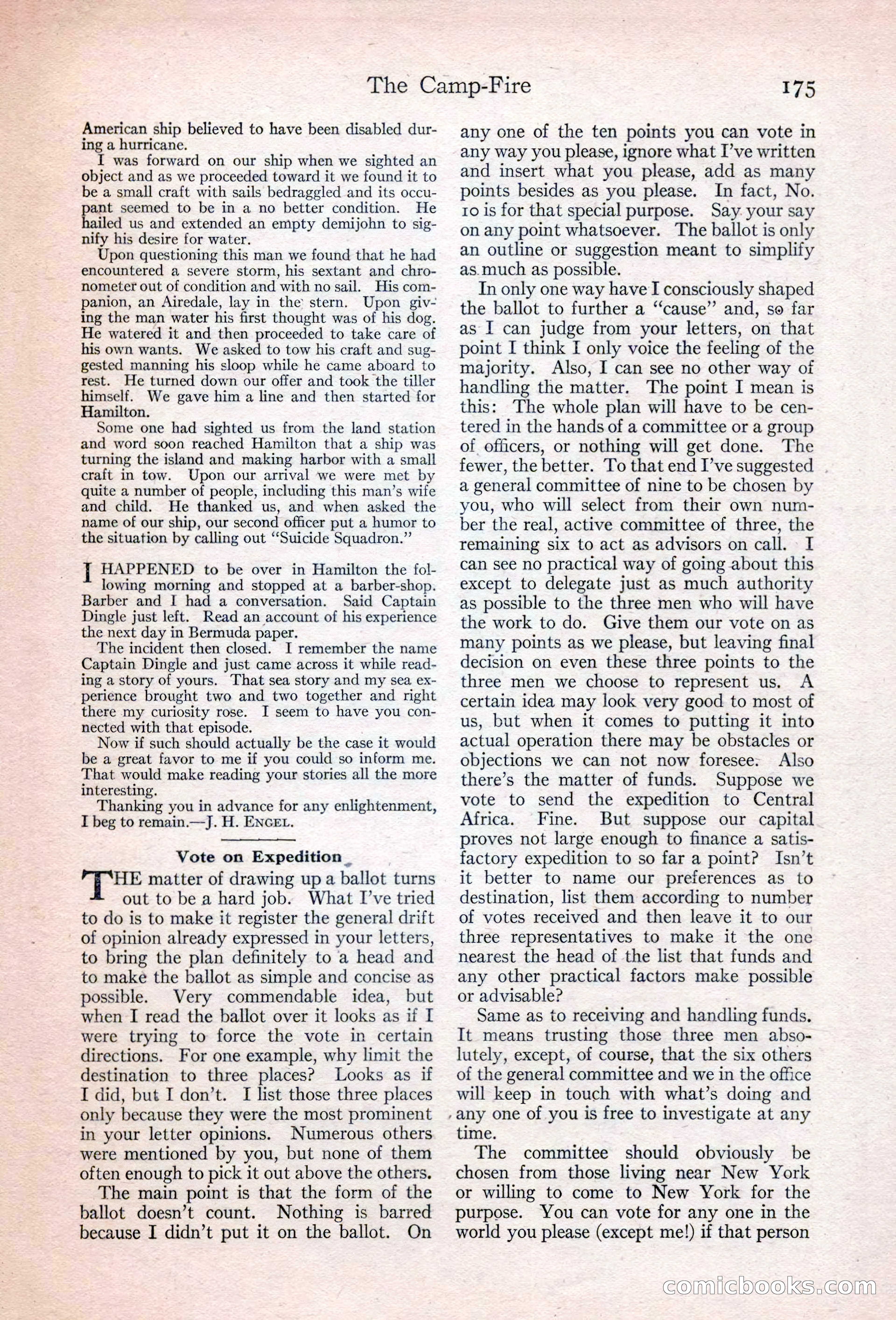
A restored page from Pulp Fiction, 1922. Page through the whole issue in the reader above.
📄 Transcribed text from this page (OCR, searchable)
Machine-transcribed from the original scan — historical spelling and the odd misread are preserved.
The Camp-Fire American ship believed to have been disabled dur- ing a hurricane. I was forward on our ship when we sighted an object and as we proceeded toward it we found it to be a small craft with sails bedraggled and its occu- pars seemed to be in a no better condition. He iled us and extended an empty demijohn to sig- nify his desire for water. Upon questioning this man we found that he had encountered a severe storm, his sextant and chro- nometer out of condition and with no sail. His com- panion, an Airedale, lay in the stern. Upon giv- ing the man water his first thought was of his dog. He watered it and then proceeded to take care of his own wants. We asked to tow his craft and sug- gested manning his sloop while he came aboard to rest. He turned down our offer and took the tiller himself. We gave him a line and then started for Hamilton. Some one had sighted us from the land station and word soon reached Hamilton that a ship was turning the island and making harbor with a small craft in tow. Upon our arrival we were met by quite a number of people, including this man’s wife and child. He thanked us, and when asked the name of our ship, our second officer put a humor to the situation by calling out “Suicide Squadron.”’ i HAPPENED to be over in Hamilton the fol- lowing morning and stopped at a barber-shop. Barber and I had a conversation. Said Captain Dingle just left. Read an account of his experience the next day in Bermuda paper. The incident then closed. I remember the name Captain Dingle and just came across it while read- ing a story of yours. That sea story and my sea ex- perience brought two and two together and right there my curiosity rose. I seem to have you con- nected with that episode. Now if such should actually be the case it would be a great favor to me if you could so inform me. That would make reading your stories all the more interesting. Thanking you in advance for any enlightenment, I beg to remain.—J. H. ENGEL. Vote on Expedition _ ‘Tre matter of drawing up a ballot turns out to be a hard job. What I’ve tried to do is to make it register the general drift of opinion already expressed in your letters, to bring the plan definitely to a head and to make the ballot as simple and concise as possible. Very commendable idea, but when I read the ballot over it looks as tf I were trying to force the vote in certain directions. For one example, why limit the destination to three places? Looks as if I did, but I don’t. I list those three places only because they were the most prominent in your letter opinions. Numerous others were mentioned by you, but none of them often enough to pick it out above the others. The main point is that the form of the ballot doesn’t count. Nothing is barred because I didn’t put it on the ballot. On 175 any one of the ten points you can vote in any way you please, ignore what I’ve written and insert what you please, add as many points besides as you please. In fact, No. ro is for that special purpose. Say. your say on any point whatsoever. The ballot is only an outline or suggestion meant to simplify as.much as possible. In only one way have I consciously shaped the ballot to further a “cause” and, so far as I can judge from your letters, on that point I think I only voice the feeling of the majority. Also, I can see no other way of handling the matter. The point I mean is this: The whole plan will have to be cen- tered in the hands of a committee or a group of officers, or nothing will get done. The fewer, the better. To that end I’ve suggested a general committee of nine to be chosen by you, who will select from their own num- ber the real, active committee of three, the remaining six to act as advisors on call. I can see no practical way of going about this except to delegate just as much authority as possible to the three men who will have the work to do. Give them our vote on as many points as we please, but leaving final decision on even these three points to the three men we choose to represent us. A certain idea may look very good to most of us, but when it comes to putting it into actual operation there may be obstacles or objections we can not now foresee: Also there’s the matter of funds. Suppose we vote to send the expedition to Central Africa. Fine. But suppose our capital proves not large enough to finance a satis- factory expedition to so far a point? Isn’t it better to name our preferences as to destination, list them according to number of votes received and then leave it to our three representatives to make it the one nearest the head of the list that funds and any other practical factors make possible or advisable? | Same as to receiving and handling funds. It means trusting those three men abso- lutely, except, of course, that the six others of the general committee and we in the office will keep in touch with what’s doing and ,any one of you is free to investigate at any time. The committee should obviously be chosen from those living near New York or willing to come to New York for the purpose. You can vote for any one in the world you please (except me!) if that person S CORNICLO©O© (C@