
Pulp Fiction, 1922 · page 186 of 200
Adventure Magazine Cover — page 186: what you’re looking at
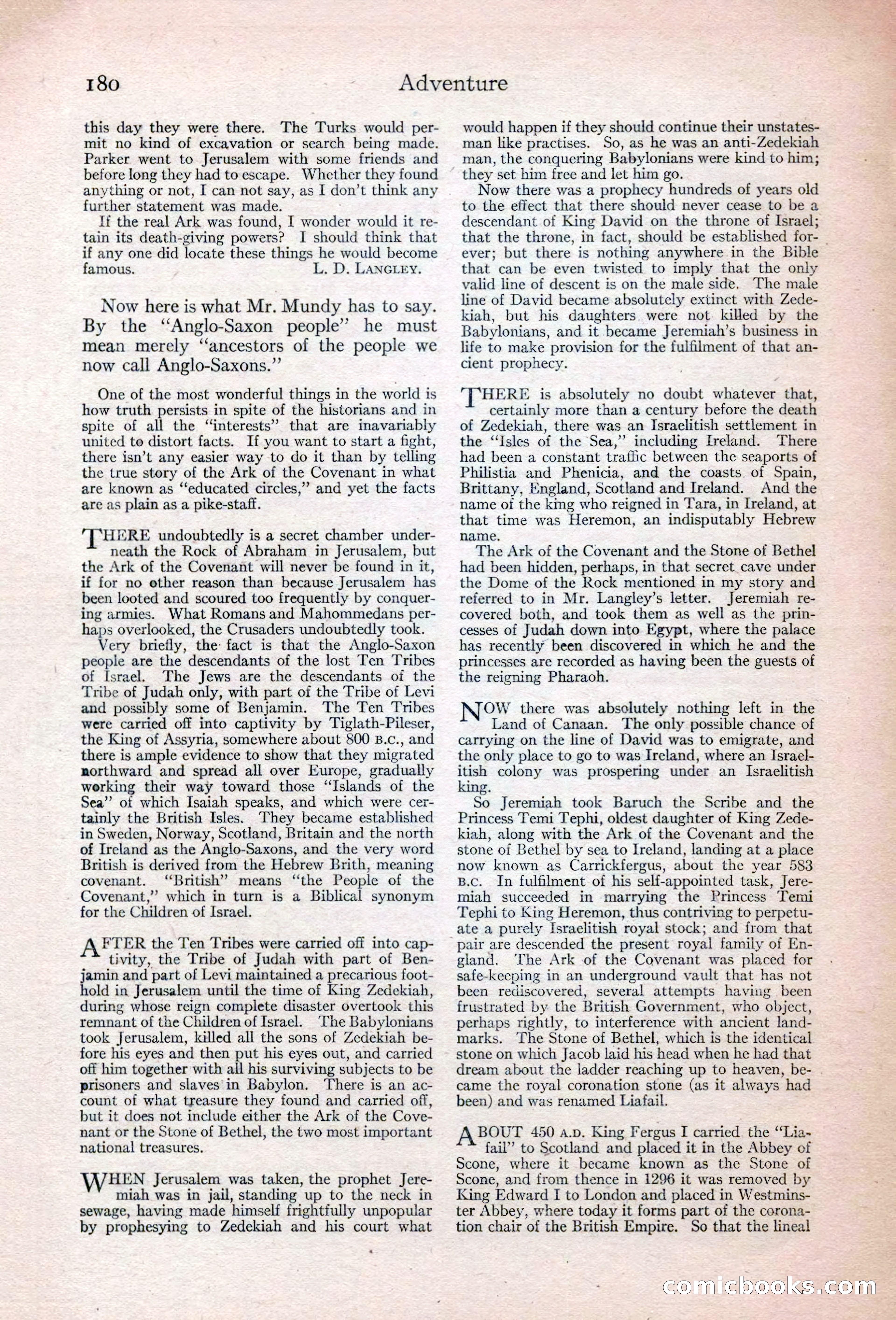
A restored page from Pulp Fiction, 1922. Page through the whole issue in the reader above.
📄 Transcribed text from this page (OCR, searchable)
Machine-transcribed from the original scan — historical spelling and the odd misread are preserved.
180 this day they were there. The Turks would per- mit no kind of excavation or search being made. Parker went to Jerusalem with some friends and before long they had to escape. Whether they found anything or not, I can not say, as I don’t think any further statement was made. If the real Ark was found, I wonder would it re- tain its death-giving powers? I should think that if any one did locate these things he would become famous. L. D. LANGLEY. Now here is what Mr. Mundy has to say. By the “Anglo-Saxon people’ he must mean merely ‘‘ancestors of the people we now call Anglo-Saxons.”’ One of the most wonderful things in the world is how truth persists in spite of the historians and in spite of all the “interests” that are inavariably united to distort facts. If you want to start a fight, there isn’t any easier way to do it than by telling the true story of the Ark of the Covenant in what are known as ‘educated circles,’ and yet the facts are as plain as a pike-staff. HERE undoubtedly is a secret chamber under- neath the Rock of Abraham in Jerusalem, but the Ark of the Covenant will never be found in it, if for no ether reason than because Jerusalem has been looted and scoured too frequently by conquer- ing armies. What Romans and Mahommedans per- haps overlooked, the Crusaders undoubtedly took. Very briefly, the: fact is that the Anglo-Saxon people are the descendants of the lost Ten Tribes of Israel. The Jews are the descendants of the Tribe of Judah only, with part of the Tribe of Levi and possibly some of Benjamin. The Ten Tribes were carried off into captivity by Tiglath-Pileser, the King of Assyria, somewhere about 800 B.c., and there is ample evidence to show that they migrated northward and spread all over Europe, gradually working their way toward those “Islands of the Sea” of which Isaiah speaks, and which were cer- tainly the British Isles. They became established in Sweden, Norway, Scotland, Britain and the north of Ireland as the Anglo-Saxons, and the very word British is derived from the Hebrew Brith, meaning covenant. “British” means “the People of the Covenant,” which in turn is a Biblical synonym for the Children of Israel. AF TER the Ten Tribes were carried off into cap- tivity, the Tribe of Judah with part of Ben- jamin and part of Levi maintained a precarious foot- hold in Jerusalem until the time of King Zedekiah, during whose reign complete disaster overtook this remnant of the Children of Israel. The Babylonians took Jerusalem, killed all the sons of Zedekiah be- fore his eyes and then put his eyes out, and carried off him together with all his surviving subjects to be prisoners and slaves in Babylon. There is an ac- count of what treasure they found and carried off, but it does not include either the Ark of the Cove- nant or the Stone of Bethel, the two most important national treasures. WHEN Jerusalem was taken, the prophet Jere- miah was in jail, standing up to the neck in sewage, having made himself frightfully unpopular by prophesying to Zedekiah and his court what Adventure would happen if they should continue their unstates- man like practises. So, as he was an anti-Zedekiah man, the conquering Babylonians were kind to him; they set him free and let him go. Now there was a prophecy hundreds of years old to the effect that there should never cease to be a descendant of King David on the throne of Israel; that the throne, in fact, should be established for- _ ever; but there is nothing anywhere in the Bible that can be even twisted to imply that the only valid line of descent is on the male side. The male line of David became absolutely extinct with Zede- kiah, but his daughters were not killed by the Babylonians, and it became Jeremiah’s business in life to make provision for the fulfilment of that an- cient prophecy. HERE is absolutely no doubt whatever that, certainly more than a century before the death of Zedekiah, there was an Israelitish settlement in the “Isles of the Sea,’ including Ireland. There had been a constant traffic between the seaports of Philistia and Phenicia, and the coasts. of Spain, Brittany, England, Scotland and Ireland. And the name of the king who reigned in Tara, in Ireland, at that time was Heremon, an indisputably Hebrew name. The Ark of the Covenant and the Stone of Bethel had been hidden, perhaps, in that secret. cave under the Dome of the Rock mentioned in my story and referred to in Mr. Langley’s letter. Jeremiah re- covered both, and took them as well as the prin- cesses of Judah down into Egypt, where the palace has recently been discovered in which he and the princesses are recorded as having been the guests of the reigning Pharaoh. Now there was absolutely nothing left in the Land of Canaan. The only possible chance of carrying on the line of David was to emigrate, and the only place to go to was Ireland, where an Israel- itish colony was prospering under an Israelitish So Jeremiah took Baruch the Scribe and the Princess Temi Tephi, oldest daughter of King Zede- kiah, along with the Ark of the Covenant and the stone of Bethel by sea to Ireland, landing at a place now known as Carrickfergus, about the year 583 B.c. In fulfilment of his self-appointed task, Jere- miah succeeded in marrying the Princess Temi Tephi to King Heremon, thus contriving to perpetu- ate a purely Israelitish royal stock; and from that pair are descended the present royal family of En- gland. The Ark of the Covenant was placed for safe-keeping in an underground vault that has not been rediscovered, several attempts having been frustrated by the British Government, who object, perhaps rightly, to interference with ancient land- marks. ‘The Stone of Bethel, which is the identical stone on which Jacob laid his head when he had that dream about the ladder reaching up to heaven, be- . came the royal coronation stone (as it always had been) and was renamed Liafail. A Bout 450 a.p. King Fergus I carried. the “‘Lia- fail” to Scotland and placed it in the Abbey of Scone, where it became known as the Stone of Scone, and from thence in 1296 it was removed by King Edward I to London and placed in Westmins- ter Abbey, where today it forms part of the corona- tion chair of the British Empire. So that the lineal CORNICLOOOKS (E@)