
Pulp Fiction, 1922 · page 29 of 200
Adventure Magazine Cover — page 29: what you’re looking at
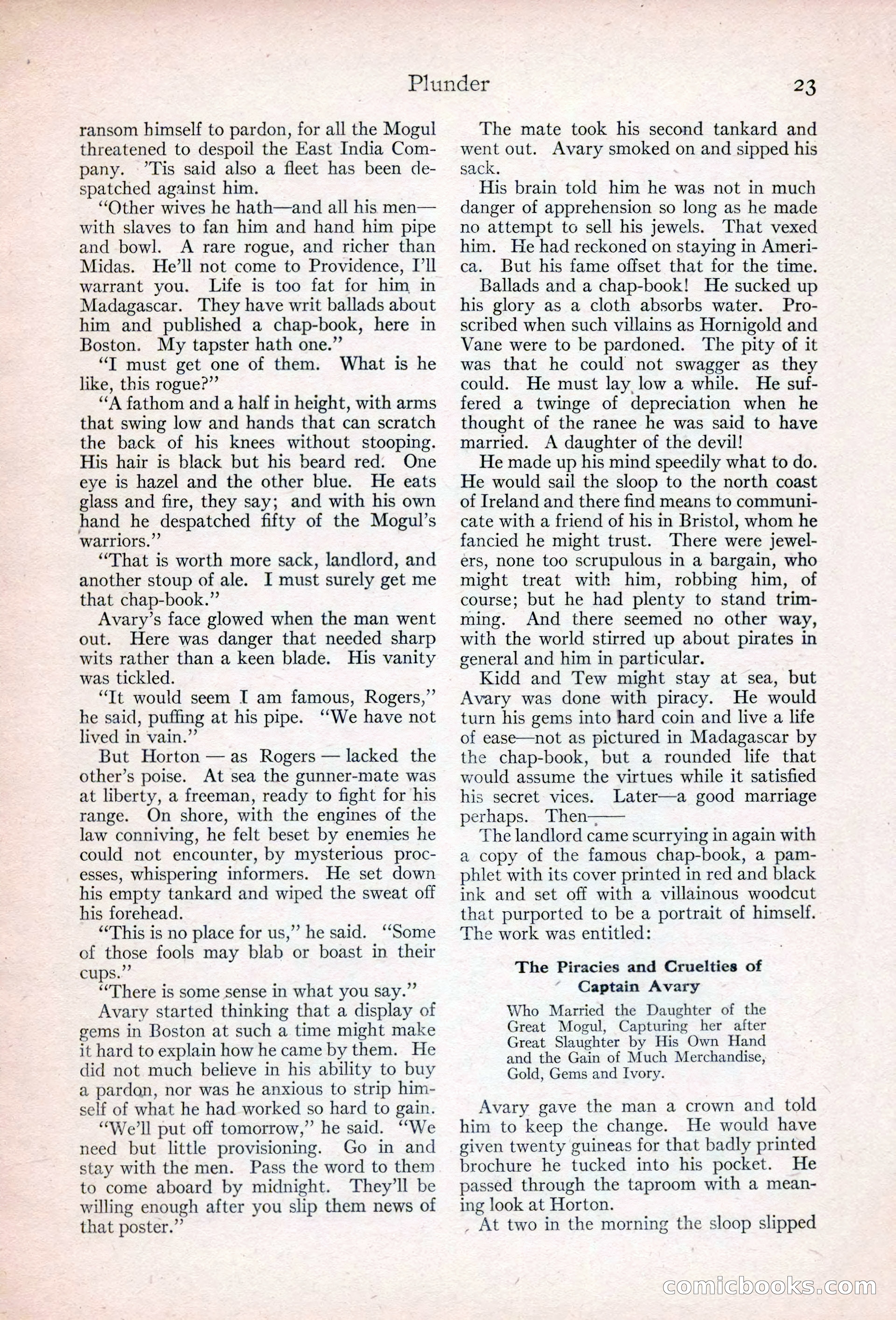
A restored page from Pulp Fiction, 1922. Page through the whole issue in the reader above.
📄 Transcribed text from this page (OCR, searchable)
Machine-transcribed from the original scan — historical spelling and the odd misread are preserved.
Plunder ransom himself to pardon, for all the Mogul threatened to despoil the East India Com- pany. Tis said also a fleet has been de- spatched against him. “Other wives he hath—and all his men— with slaves to fan him and hand him pipe and bowl. A rare rogue, and richer than Midas. He’ll not come to Providence, [ll warrant you. Life is too fat for him in Madagascar. They have writ ballads about him and published a chap-book, here in Boston. My tapster hath one.” “T must get one of them. What is he like, this rogue?” “‘A fathom and a half in height, with arms that swing low and hands that can scratch the back of his knees without stooping. His hair is black but his beard red. One eye is hazel and the other blue. He eats glass and fire, they say; and with his own hand he despatched fifty of the Mogul’s warriors.” “That is worth more sack, landlord, and another stoup of ale. I must surely get me that chap-book.” Avary’s face glowed when the man went out. Here was danger that needed sharp wits rather than a keen blade. His vanity was tickled. “Tt would seem I am famous, Rogers,” he said, puffing at his pipe. ‘‘We have not lived in vain.” But Horton — as Rogers — lacked the other’s poise. At sea the gunner-mate was at liberty, a freeman, ready to fight for his range. On shore, with the engines of the law conniving, he felt beset by enemies he could not encounter, by mysterious proc- esses, whispering informers. He set down his empty tankard and wiped the sweat off his forehead. ‘“This is no place for us,” he said. ‘Some of those fools may blab or boast in their cups.” ‘There is some sense in what you say.” Avary started thinking that a display of gems in Boston at such a time might make it hard to explain how he came by them. He did not much believe in his ability to buy a pardon, nor was he anxious to strip him- self of what he had worked so hard to gain. “We'll put off tomorrow,” he said. “We need but little provisioning. Go in and stay with the men. Pass the word to them to come aboard by midnight. They'll be willing enough after you slip them news of that poster.” 23 The mate took his second tankard and went out. Avary smoked on and sipped his sack. His brain told him he was not in much danger of apprehension so long as he made no attempt to sell his jewels. That vexed him. He had reckoned on staying in Ameri- ca. But his fame offset that for the time. Ballads and a chap-book! He sucked up his glory as a cloth absorbs water. Pro- scribed when such villains as Hornigold and Vane were to be pardoned. The pity of it was that he could not swagger as they could. He must lay low a while. He suf- fered a twinge of depreciation when he thought of the ranee he was said to have married. A daughter of the devil! He made up his mind speedily what to do. He would sail the sloop to the north coast of Ireland and there find means to communi- cate with a friend of his in Bristol, whom he fancied he might trust. There were jewel- ers, none too scrupulous in a bargain, who might treat with him, robbing him, of course; but he had plenty to stand trim- ming. And there seemed no other way, with the world stirred up about pirates in general and him in particular. Kidd and Tew might stay at sea, but Avary was done with piracy. He would turn his gems into hard coin and live a life of ease—not as pictured in Madagascar by the chap-book, but a rounded life that would assume the virtues while it satisfied his secret vices. Later—a good marriage perhaps. Then- The landlord came scurrying in again with a copy of the famous chap-book, a pam- phlet with its cover printed in red and black ink and set off with a villainous woodcut that purported to be a portrait of himself. The work was entitled: The Piracies and Cruelties of Captain Avary Who Married the Daughter of the Great Mogul, Capturing her after Great Slaughter by His Own Hand and the Gain of Much Merchandise, Gold, Gems and Ivory. Avary gave the man a crown and told him to keep the change. He would have given twenty guineas for that badly printed brochure he tucked into his pocket. He passed through the taproom with a mean- ing look at Horton. _ At two in the morning the sloop slipped Comicbdoo C <S (C@ S|