
Pulp Fiction, 1922 · page 39 of 200
Adventure Magazine Cover — page 39: what you’re looking at
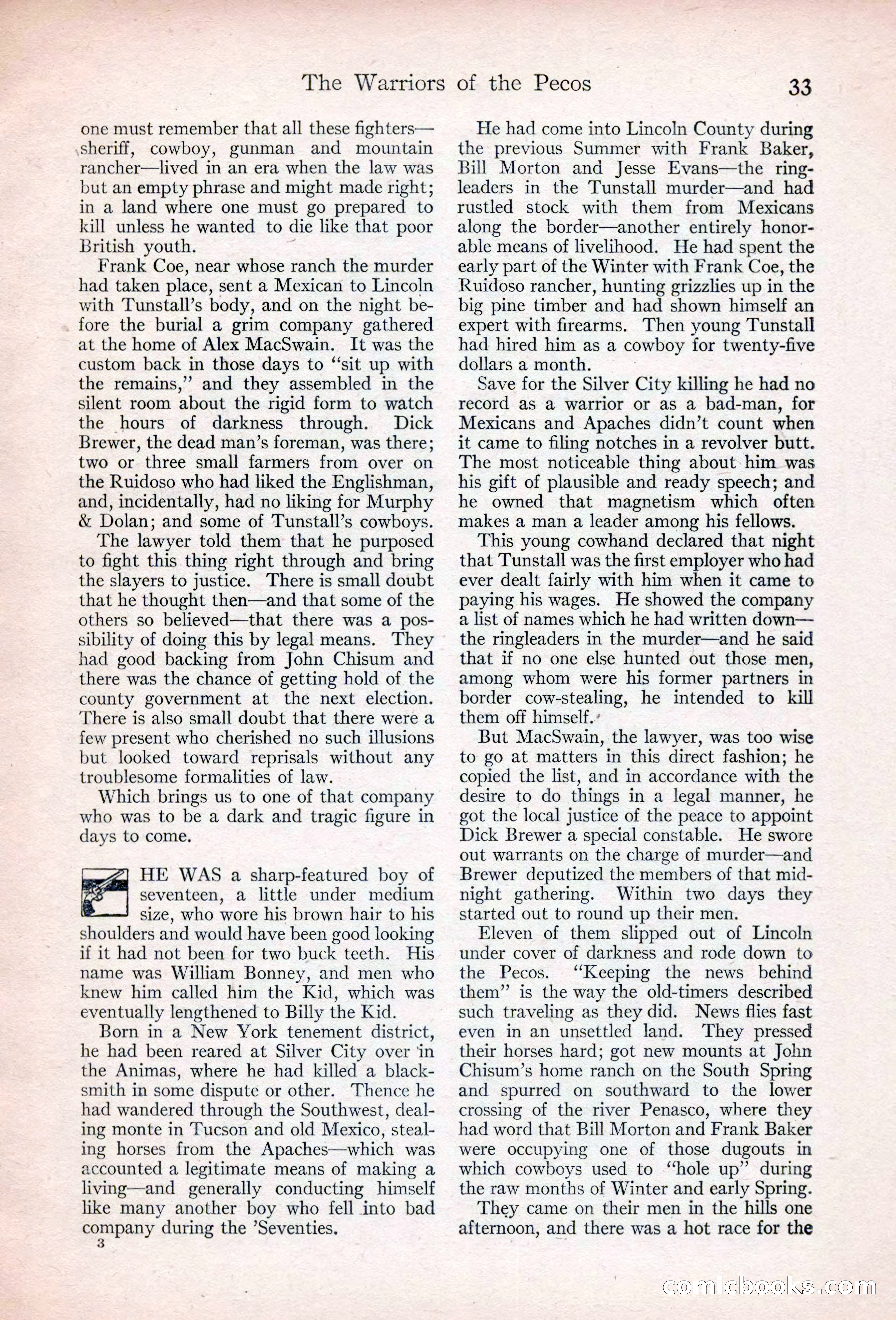
A restored page from Pulp Fiction, 1922. Page through the whole issue in the reader above.
📄 Transcribed text from this page (OCR, searchable)
Machine-transcribed from the original scan — historical spelling and the odd misread are preserved.
The Warriors one must remember that all these fighters— sheriff, cowboy, gunman and mountain rancher—lived in an era when the law was but an empty phrase and might made right; in a land where one must go prepared to kill unless he wanted to die like that poor British youth. Frank Coe, near whose ranch the murder had taken place, sent a Mexican to Lincoln with Tunstall’s body, and on the night be- fore the burial a grim company gathered at the home of Alex MacSwain. It was the custom back in those days to “‘sit up with the remains,’ and they assembled in the silent room about the rigid form to watch the hours of darkness through. Dick Brewer, the dead man’s foreman, was there; two or three small farmers from over on the Ruidoso who had liked the Englishman, and, incidentally, had no liking for Murphy & Dolan; and some of Tunstall’s cowboys. The lawyer told them that he purposed to fight this thing right through and bring the slayers to justice. There is small doubt that he thought then—and that some of the others so believed—that there was a pos- sibility of doing this by legal means. They had good backing from John Chisum and there was the chance of getting hold of the county government at the next election. There is also small doubt that there were a few present who cherished no such illusions but looked toward reprisals without any troublesome formalities of law. Which brings us to one of that company who was to be a dark and tragic figure in days to come. HE WAS a sharp-featured boy of seventeen, a little under medium size, who wore his brown hair to his houldes: and would have been good looking if it had not been for two buck teeth. His name was William Bonney, and men who knew him called him the Kid, which was eventually lengthened to Billy the Kid. Born in a New York tenement district, he had been reared at Silver City over ‘in the Animas, where he had killed a black- smith in some dispute or other. Thence he had wandered through the Southwest, deal- ing monte in Tucson and old Mexico, steal- ing horses from the Apaches—which was accounted a legitimate means of making a living—and generally conducting himself like many another boy who fell into bad company during the Seventies. of the Pecos 32 He had come into Lincoln County during the previous Summer with Frank Baker, Bill Morton and Jesse Evans—the ring- leaders in the Tunstall murder—and had rustled stock with them from Mexicans along the border—another entirely honor- able means of livelihood. He had spent the early part of the Winter with Frank Coe, the Ruidoso rancher, hunting grizzlies up in the big pine timber and had shown himself an expert with firearms. Then young Tunstall had hired him as a cowboy for twenty-five dollars a month. Save for the Silver City killing he had no record as a warrior or as a bad-man, for Mexicans and Apaches didn’t count when it came to filing notches in a revolver butt. The most noticeable thing about him was his gift of plausible and ready speech; and he owned that magnetism which often makes a man a leader among his fellows. This young cowhand declared that night that Tunstall was the first employer who had ever dealt fairly with him when it came to paying his wages. He showed the company a list of names which he had written down— the ringleaders in the murder—and he said that if no one else hunted out those men, among whom were his former partners in border cow-stealing, he intended to kill them off himself. But MacSwain, the lawyer, was too wise to go at matters in this direct fashion; he copied the list, and in accordance with the desire to do things in a legal manner, he got the local justice of the peace to appoint Dick Brewer a special constable. He swore out warrants on the charge of murder—and Brewer deputized the members of that mid- night gathering. Within two days they started out to round up their men. Eleven of them slipped out of Lincoln under cover of darkness and rode down to the Pecos. “Keeping the news behind them” is the way the old-timers described such traveling as they did. News flies fast even in an unsettled land. They pressed their horses hard; got new mounts at John Chisum’s home ranch on the South Spring and spurred on southward to the lower crossing of the river Penasco, where they had word that Bill Morton and Frank Baker were occupying one of those dugouts in which cowboys used to “hole up” during the raw months of Winter and early Spring. They came on their men in the hills one afternoon, and there was a hot race for the Go TOO ANUG SS (C@ im