
Pulp Fiction, 1922 · page 50 of 200
Adventure Magazine Cover — page 50: what you’re looking at
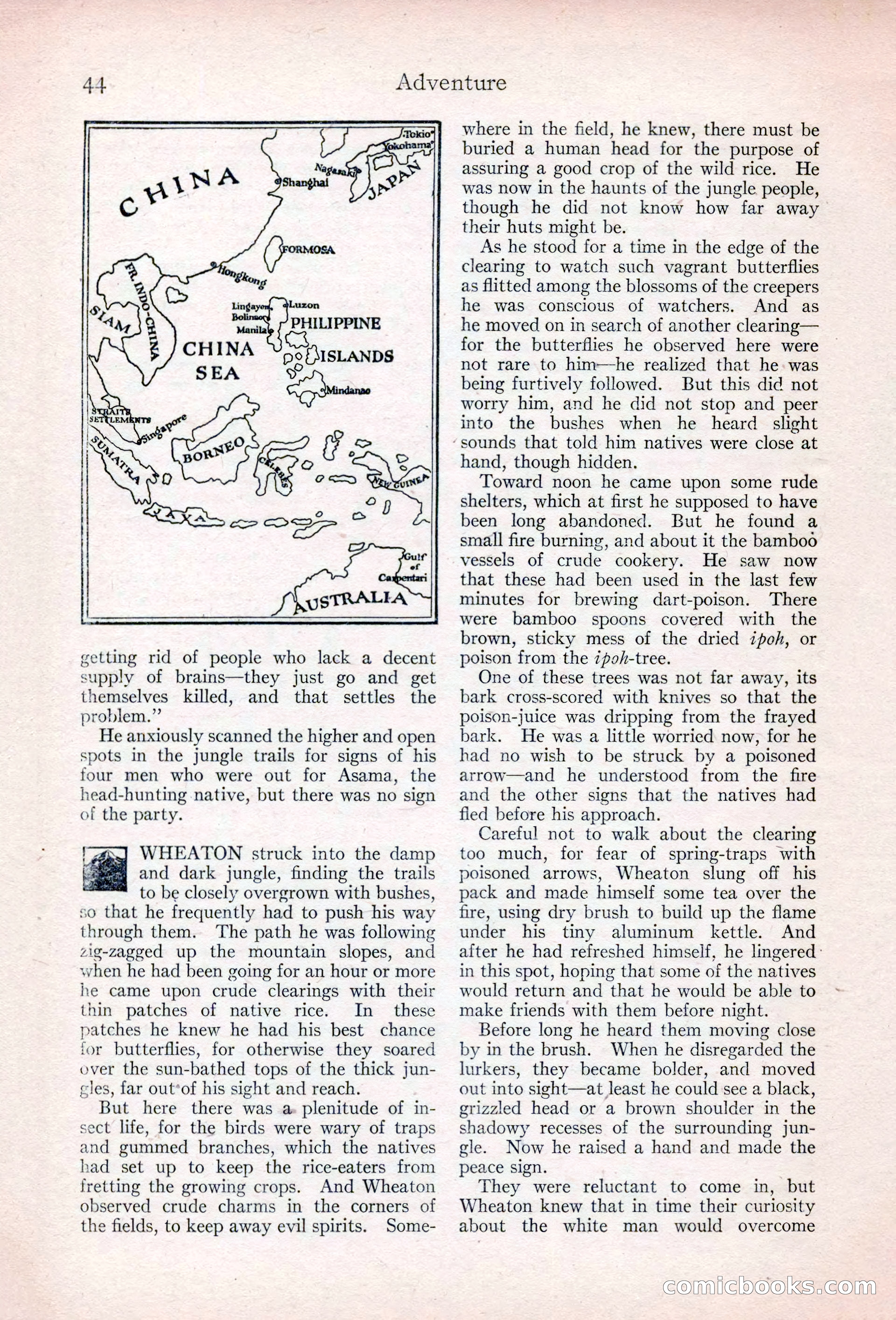
A restored page from Pulp Fiction, 1922. Page through the whole issue in the reader above.
📄 Transcribed text from this page (OCR, searchable)
Machine-transcribed from the original scan — historical spelling and the odd misread are preserved.
44 % a Ling Luzon <ES depiurme NA po {ISLANDS SEA nae getting rid of people who lack a decent supply of brains—they just go and get themselves killed, and that settles the problem.” He anxiously scanned the higher and open spots in the jungle trails for signs of his four men who were out for Asama, the head-hunting native, but there was no sign of the party. and dark jungle, finding the trails to be closely overgrown with bushes, so that he frequently had to push his way through them. The path he was following zig-zagged up the mountain slopes, and when he had been going for an hour or more he came upon crude clearings with their thin patches of native rice. In _ these patches he knew he had his best chance ior butterflies, for otherwise they soared over the sun-bathed tops of the thick jun- cles, far out*of his sight and reach. But here there was a plenitude of in- sect life, for the birds were wary of traps and gummed branches, which the natives had set up to keep the rice-eaters from fretting the growing crops. And Wheaton observed crude charms in the corners of the fields, to keep away evil spirits. Some- gS WHEATON struck into the damp Adventure where in the field, he knew, there must be buried a human head for the purpose of assuring a good crop of the wild rice. He was now in the haunts of the jungle people, though he did not know how far away their huts might be. As he stood for a time in the edge of the clearing to watch such vagrant butterflies as flitted among the blossoms of the creepers he was conscious of watchers. And as he moved on in search of another clearing— for the butterflies he observed here were not rare to him—he realized that he was being furtively followed. But this did not worry him, and he did not stop and peer into the bushes when he heard slight ‘sounds that told him natives were close at hand, though hidden. Toward noon he came upon some rude shelters, which at first he supposed to have been long abandoned. But he found a small fire burning, and about it the bamboo vessels of crude cookery. He saw now that these had been used in the last few minutes for brewing dart-poison. There were bamboo spoons covered with the brown, sticky mess of the dried ipoh, or poison from the zpoh-tree. One of these trees was not far away, its bark cross-scored with knives so that the poison-juice was dripping from the frayed bark. He was a little worried now, for he had no wish to be struck by a poisoned arrow—and he understood from the fire and the other signs that the natives had fled before his approach. Careful not to walk about the clearing too much, for fear of spring-traps with poisoned arrows, Wheaton slung off his pack and made himself some tea over the fire, using dry brush to build up the flame under his tiny aluminum kettle. And after he had refreshed himself, he lingered: in this spot, hoping that some of the natives would return and that he would be able to make friends with them before night. Before long he heard them moving close by in the brush. When he disregarded the lurkers, they became bolder, and moved out into sight—at least he could see a black, grizzled head or a brown shoulder in the shadowy recesses of the surrounding jun- gle. Now he raised a hand and made the peace sign. They were reluctant to come in, but Wheaton knew that in time their curiosity about the white man would overcome CORNICLOOOKS (C@