
Pulp Fiction, 1922 · page 58 of 200
Adventure Magazine Cover — page 58: what you’re looking at
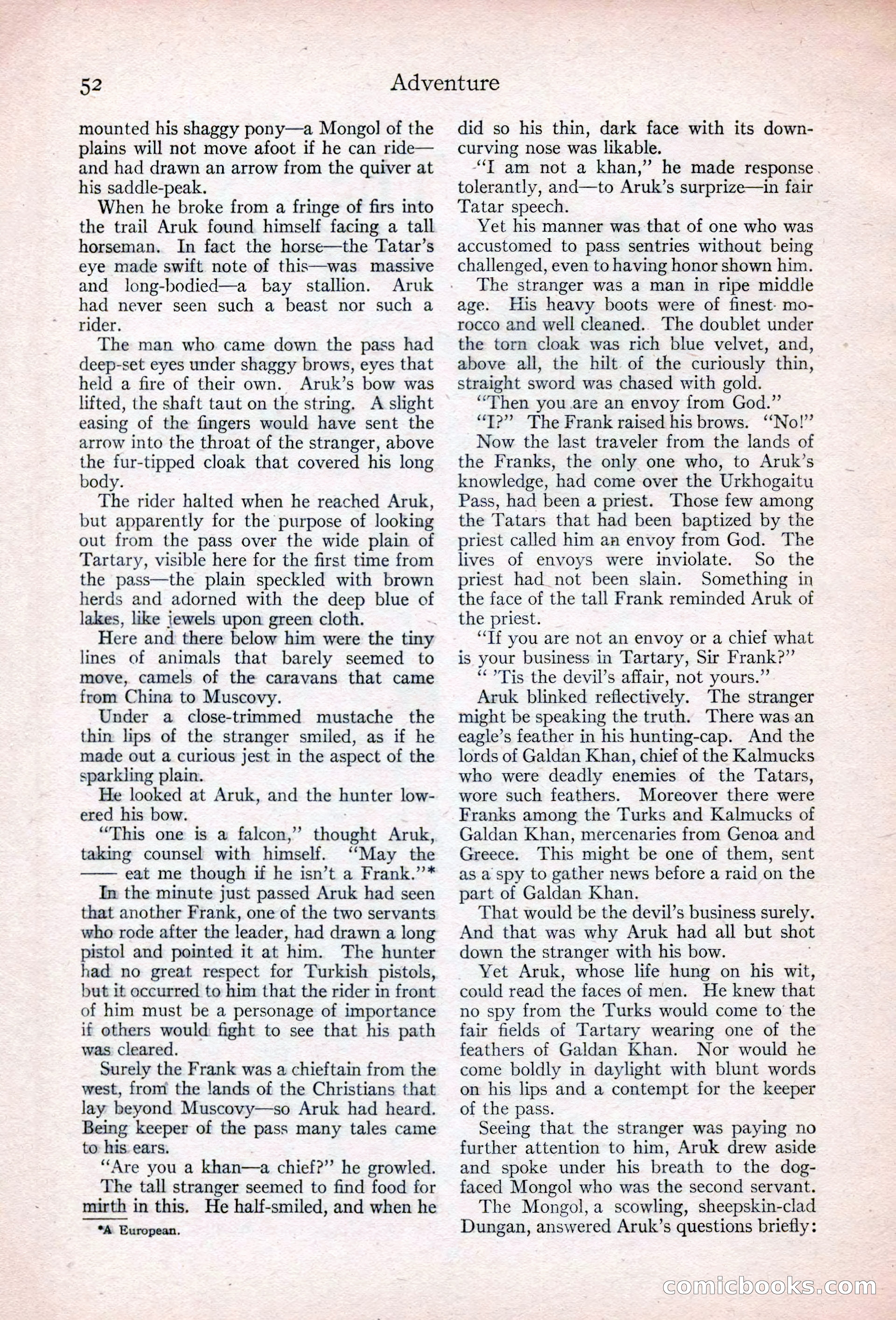
A restored page from Pulp Fiction, 1922. Page through the whole issue in the reader above.
📄 Transcribed text from this page (OCR, searchable)
Machine-transcribed from the original scan — historical spelling and the odd misread are preserved.
52 mounted his shaggy pony—a Mongol of the plains will not move afoot if he can ride— and had drawn an arrow from the quiver at his saddle-peak. When he broke from a fringe of firs into the trail Aruk found himself facing a tall horseman. In fact the horse—the Tatar’s eye made swift note of this—was massive and long-bodied—a bay stallion. Aruk had never seen such a beast nor such a rider. The man who came down the pass had deep-set eyes under shaggy brows, eyes that held a fire of their own. Aruk’s bow was lifted, the shaft taut on the string. A slight easing of the fingers would have sent the arrow into the throat of the stranger, above the fur-tipped cloak that covered his long body. The rider halted when he reached Aruk, but apparently for the purpose of looking out from the pass over the wide plain of Tartary, visible here for the first time from the pass—the plain speckled with brown herds and adorned with the deep blue of lakes, like jewels upon green cloth. Here and there below him were the tiny lines of animals that barely seemed to move, camels of the caravans that came from China to Muscovy. Under a close-trimmed mustache the thin lips of the stranger smiled, as if he made out a curious jest in the aspect of the sparkling plain. He looked at Aruk, and the hunter low- ered his bow. “This one is a falcon,” thought Aruk, taking counsel with himself. ‘‘May the eat me though if he isn’t a Frank.’’* In the minute just passed Aruk had seen that another Frank, one of the two servants who rode after the leader, had drawn a long pistol and pointed it at him. The hunter had no great respect for Turkish pistols, but it occurred to him that the rider in front of him must be a personage of importance if others would. fight to see that his path was cleared. Surely the Frank was a chieftain from the west, from the lands of the Christians that lay beyond Muscovy—so Aruk had heard. Being keeper of the pass many tales came to his. ears. “Are you a khan—a chief?” he growled. The tall stranger seemed to find food for mirth in this. He half-smiled, and when he *A European. Adventure did so his thin, dark face with its down- curving nose was likable. “T am not a khan,” tolerantly, and—to Aruk’s surprize—in fair Tatar speech. Yet his manner was that of one who was accustomed to pass sentries without being challenged, even to having honor shown him. The stranger was a man in ripe middle age. His heavy boots were of finest- mo- rocco and well cleaned.. The doublet under the torn cloak was rich blue velvet, and, above all, the hilt of the curiously thin, straight sword was chased with gold. ‘Then you are an envoy from God.” “T?” The Frank raised his brows. ‘‘No!” Now the last traveler from the lands of the Franks, the only one who, to Aruk’s knowledge, had come over the Urkhogaitu Pass, had been a priest. Those few among the Tatars that had been baptized by the priest called him an envoy from God. The lives of envoys were inviolate. So the priest had not been slain. Something in the face of the tall Frank reminded Aruk of the priest. “Tf you are not an envoy or a chief what is your business in Tartary, Sir Frank?”’ “°Tis the devil’s affair, not yours.” Aruk blinked reflectively. The stranger might be speaking the truth. There was an eagle’s feather in his hunting-cap. And the lords of Galdan Khan, chief of the Kalmucks who were deadly enemies of the Tatars, wore such feathers. Moreover there were Franks among the Turks and Kalmucks of Galdan Khan, mercenaries from Genoa and Greece. This might be one of them, sent as a spy to gather news before a raid on the part of Galdan Khan. That would be the devil’s business surely. And that was why Aruk had all but shot down the stranger with his bow. Yet Aruk, whose life hung on his wit, could read the faces of men. He knew that no spy from the Turks would come to the fair fields of Tartary wearing one of the feathers of Galdan Khan. Nor would he come boldly in daylight with blunt words on his lips and a contempt for the keeper of the pass. Seeing that the stranger was paying no further attention to him, Aruk drew aside and spoke under his breath to the dog- faced Mongol who was the second servant. The Mongol, a scowling, sheepskin-clad Dungan, answered Aruk’s questions briefly: CORMICLOO© S he made response. (C@