
Pulp Fiction, 1922 · page 74 of 200
Adventure Magazine Cover — page 74: what you’re looking at
A restored page from Pulp Fiction, 1922. Page through the whole issue in the reader above.
📄 Transcribed text from this page (OCR, searchable)
Machine-transcribed from the original scan — historical spelling and the odd misread are preserved.
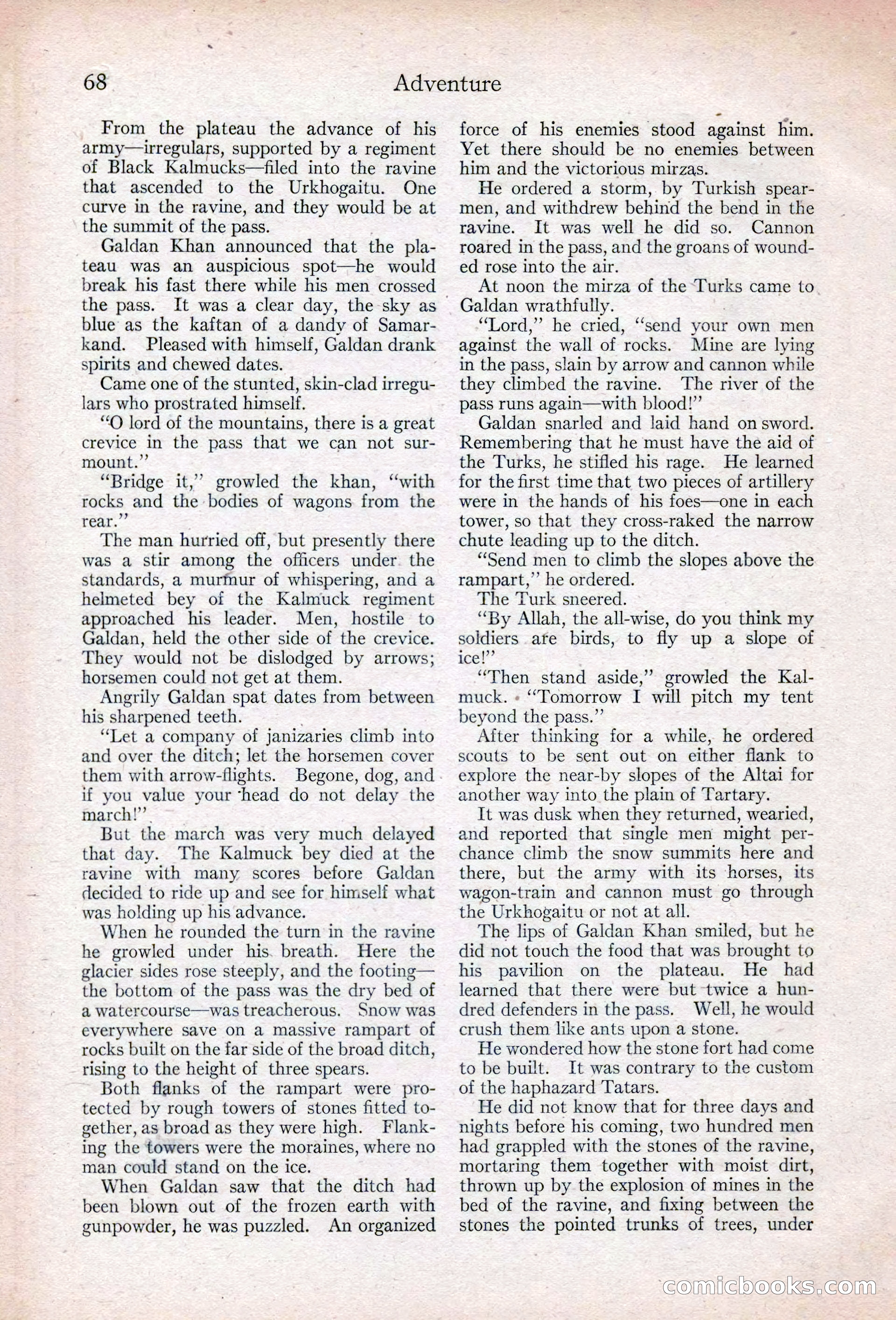
68 From the plateau the advance of his army—irregulars, supported by a regiment of Black Kalmucks—filed into the ravine that ascended to the Urkhogaitu. One curve in the ravine, and they would be at the summit of the pass. Galdan Khan announced that the pla- teau was an auspicious spot—he would break his fast there while his men crossed the pass. blue as the kaftan of a dandy of Samar- kand. Pleased with himself, Galdan drank spirits and chewed dates. Came one of the stunted, skin-clad irregu- lars who prostrated himself. “O lord of the mountains, there is a great crevice in the pass that we can not sur- mount.” “Bridge it,’ growled the khan, ‘“‘with rocks and the bodies of wagons from the rear.” The man hurried off, but presently there was a stir among the officers under. the standards, a murmur of whispering, and a helmeted bey of the Kalmuck regiment approached his leader. Men, hostile to Galdan, held the other side of the crevice. They would not be dislodged by arrows; horsemen could not get at them. Angrily Galdan spat dates from between his sharpened teeth. 3 “Let a company of janizaries climb into and over the ditch; let the horsemen cover them with arrow-flights. Begone, dog, and if you value your ‘head do not delay the march!”’. But the march was very much delayed that day. The Kalmuck bey died at the ravine with many scores before Galdan decided to ride up and see for himself what was holding up his advance. When he rounded the turn in the ravine he growled under his. breath. Here the glacier sides rose steeply, and the footing— the bottom of the pass was the dry bed of a watercourse—was treacherous. Snow was everywhere save on a massive rampart of rocks built on the far side of the broad ditch, rising to the height of three spears. Both flanks of the rampart were pro- tected by rough towers of stones fitted to- gether, as broad as they were high. Flank- ing the towers were the moraines, where no man could stand on the ice. When Galdan saw that the ditch had been blown out of the frozen earth with gunpowder, he was puzzled. An organized It was a clear day, the sky as — Adventure force of his enemies stood against him. Yet there should be no enemies between him and the victorious mirzas. He ordered a storm, by Turkish spear- men, and withdrew behind the bend in the ravine. It was well he did so. Cannon roared in the pass, and the groans of wound- ed rose into the air. At noon the mirza of the Turks came to Galdan wrathfully. “Lord,” he cried, ‘send your own men against the wall of rocks. Mine are lying in the pass, slain by arrow and cannon while they climbed the ravine. The river of the pass runs again—with blood!” Galdan snarled and laid hand on sword. Remembering that he must have the aid of the Turks, he stifled his rage. He learned for the first time that two pieces of artillery were in the hands of his foes—one in each tower, so that they cross-raked the narrow chute leading up to the ditch. “Send men to climb the slopes above the rampart,” he ordered. The Turk sneered. “By Allah, the all-wise, do you think my soldiers afe birds, to fly up a slope of ice!” “Then stand aside,” growled the Kal- muck. « “Tomorrow I will pitch my tent beyond the pass.” After thinking for a while, he ordered scouts to be sent out on either flank to explore the near-by slopes of the Altai for another way into the plain of Tartary. It was dusk when they returned, wearied, and reported that single men might per- chance climb the snow summits here and there, but the army with its horses, its wagon-train and cannon must go through the Urkhogaitu or not at all. The lips of Galdan Khan smiled, but he did not touch the food that was brought to his pavilion on the plateau. He had learned that there were but twice a hun- dred defenders in the pass. Well, he would crush them like ants upon a stone. He wondered how the stone fort had come to be built. It was contrary to the custom of the haphazard Tatars. He did not know that for three days and nights before his coming, two hundred men had grappled with the stones of the ravine, mortaring them together with moist dirt, thrown up by the explosion of mines in the bed of the ravine, and fixing between the stones the pointed trunks of trees, under ECORmmicloookxs (C@