
Pulp Fiction, 1922 · page 100 of 200
Adventure Magazine Cover — page 100: what you’re looking at
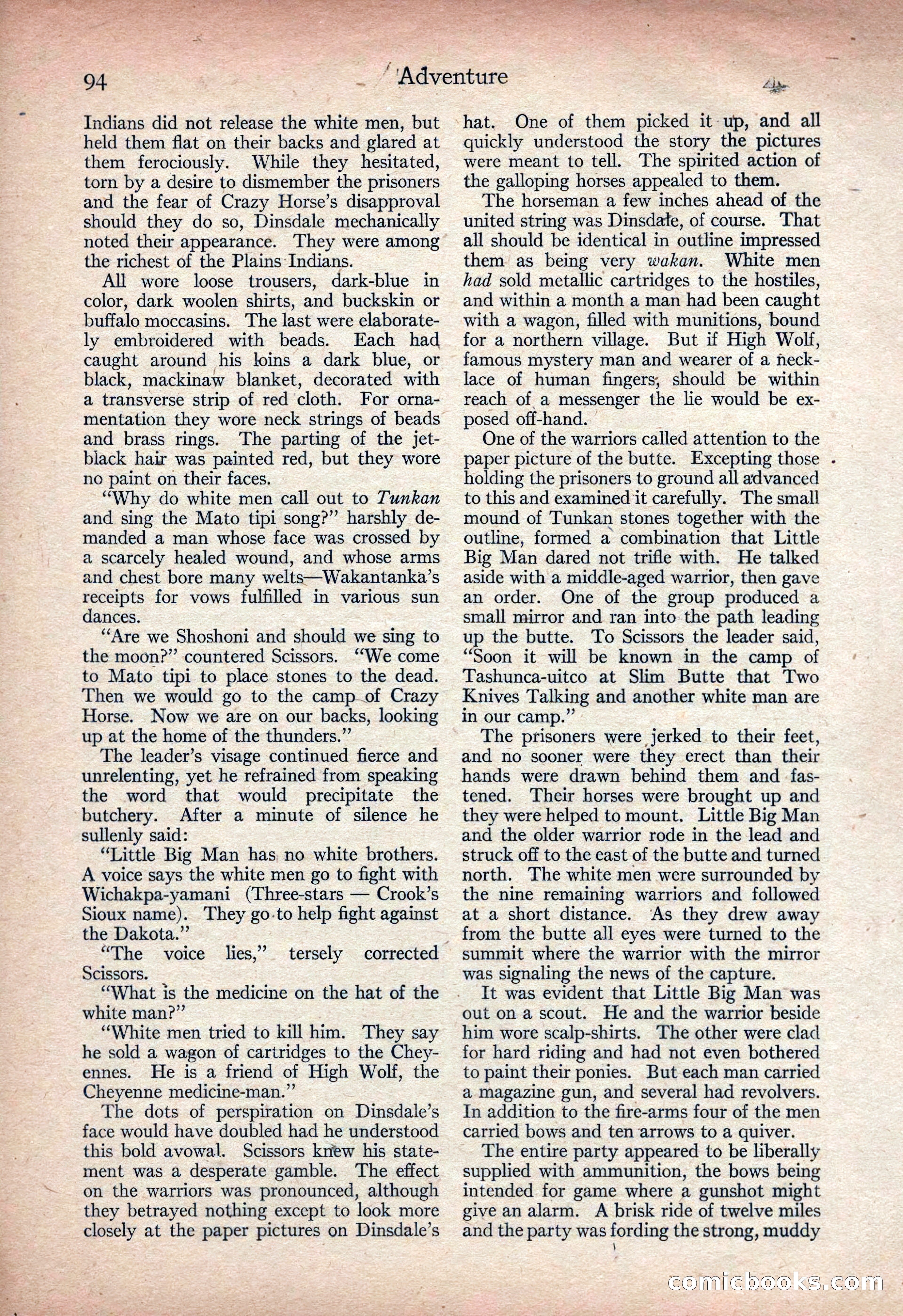
A restored page from Pulp Fiction, 1922. Page through the whole issue in the reader above.
📄 Transcribed text from this page (OCR, searchable)
Machine-transcribed from the original scan — historical spelling and the odd misread are preserved.
Wylie) 2 =~ tee ee ag et eee es ee ee eee ee i, en ee oe : . Ws Came I Gns 00g Ne + ag / ee 94 | _ ‘'‘Adventure Indians did not release the white men, but held them flat on their backs and glared at them ferociously. While they hesitated, torn by a desire to dismember the prisoners and the fear of Crazy Horse’s disapproval should they do so, Dinsdale mechanically noted their appearance. They were among the richest of the Plains Indians. All wore loose trousers, dark-blue in color, dark woolen shirts, and buckskin or buffalo moccasins. The last were elaborate- ly embroidered with beads. Each had caught around his loins a dark blue, or black, mackinaw blanket, decorated with a transverse strip of red cloth. For orna- mentation they wore neck strings of beads and brass rings. The parting of the jet- black hair was painted red, but they wore no paint on their faces. “Why do white men call out to Tunkan and sing the Mato tipi song?” harshly de- manded a man whose face was crossed by a scarcely healed wound, and whose arms and chest bore many welts—Wakantanka’s receipts for vows fulfilled in various sun dances. “Are we Shoshoni and should we sing to the moon?” countered Scissors. “We come to Mato tipi to place stones to the dead. Then we would go to the camp of Crazy Horse. Now we are on our backs, looking up at the home of the thunders.” The leader’s visage continued fierce and unrelenting, yet he refrained from speaking the word that would precipitate the butchery. After a minute of silence he sullenly said: “Little Big Man has no white brothers. A voice says the white men go to fight with Wichakpa-yamani (Three-stars — Crook’s Sioux name). They go-to help fight against the Dakota.” “The voice _ lies,”’ Scissors. ‘What is the medicine on the hat of the white man?” “White men tried to kill him. They say he sold a wagon of cartridges to the Chey- ennes. He is a friend of High Wolf, the Cheyenne medicine-man.”’ The dots of perspiration on Dinsdale’s face would have doubled had he understood this bold avowal. Scissors kriew his state- ment was a desperate gamble. The effect on the warriors was pronounced, although they betrayed nothing except to look more closely at the paper pictures on Dinsdale’s tersely corrected Pat a og te ea en te en, a 4 — z “Ae hat. One of them picked it up, and all quickly understood the story the pictures were meant to tell. The spirited action of the galloping horses appealed to them. The horseman a few inches ahead of the united string was Dinsdate, of course. That all should be identical in outline impressed them as being very wakan. White men had sold metallic cartridges to the hostiles, and within a month a man had been caught with a wagon, filled with munitions, bound for a northern village. But if High Wolf, famous mystery man and wearer of a neck- lace of human fingers, should be within reach of a messenger the lie would be ex- posed off-hand. One of the warriors called attention to the ae ee! ae ey: ae aa ve ee paper picture of the butte. Excepting those - holding the prisoners to ground all advanced to this and examined it carefully. The smal! mound of Tunkan stones together with the outline, formed a combination that Little Big Man dared not trifle with. He talked aside with a middle-aged warrior, then gave an order. One of the group produced a small mirror and ran into the path leading up the butte. To Scissors the leader said, “Soon it will be known in the camp of Tashunca-uitco at Slim Butte that Two Knives Talking and another white man are in our camp.” The prisoners were jerked to their feet, and no sooner were they erect than their hands were drawn behind them and fas- tened. Their horses were brought up and they were helped to mount. Little Big Man and the older warrior rode in the lead and struck off to the east of the butte and turned north. The white men were surrounded by the nine remaining warriors and followed at a short distance. ‘As they drew away from the butte all eyes were turned to the summit where the warrior with the mirror was signaling the news of the capture. It was evident that Little Big Man was out on a scout. He and the warrior beside him wore scalp-shirts. The other were clad for hard riding and had not even bothered to paint their ponies. But each man carried a magazine gun, and several had revolvers. In addition to the fire-arms four of the men carried bows and ten arrows to a quiver. The entire party appeared to be liberally supplied with ammunition, the bows being intended for game where a gunshot might give an alarm. A brisk ride of twelve miles and the party was fording the strong, muddy \ Gomichbooks