
Pulp Fiction, 1922 · page 197 of 200
Adventure Magazine Cover — page 197: what you’re looking at
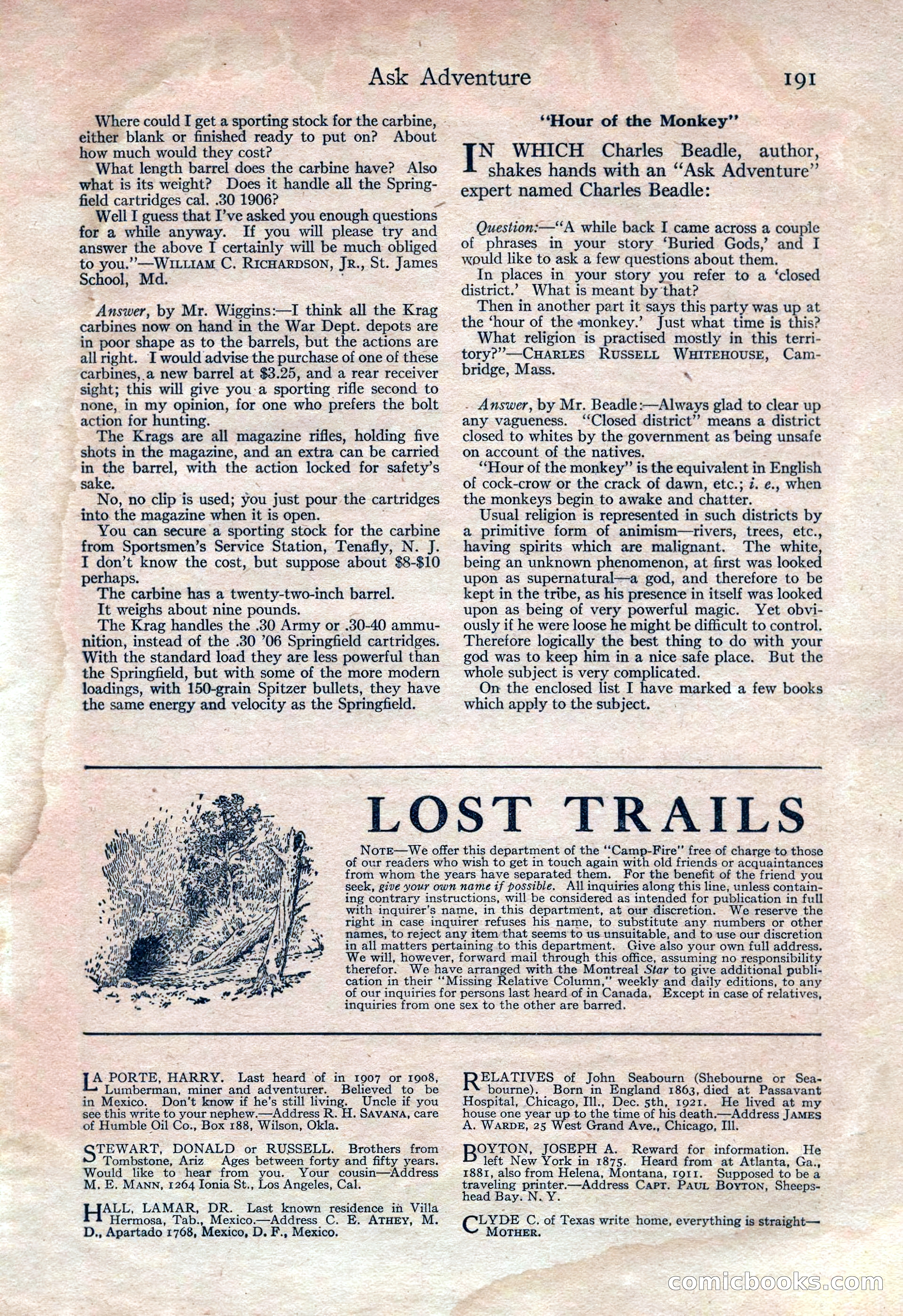
A restored page from Pulp Fiction, 1922. Page through the whole issue in the reader above.
📄 Transcribed text from this page (OCR, searchable)
Machine-transcribed from the original scan — historical spelling and the odd misread are preserved.
‘ Where could I get a sporting stock for the carbine, either blank or finished ready to put on? About how much would they cost? What length barrel does the carbine have? Also what is its weight? Does it handle all the Spring- field cartridges cal. .30 1906? = Well I guess that I’ve asked you enough questions for a while anyway. If you will please try and answer the above I certainly will be much obliged to you.” —WILi1Am C, RICHARDSON, JR., St. James School, Md. Answer, by Mr. Wiggins:—I think all the Krag carbines now on hand in the War Dept. depots are in poor shape as to the barrels, but the actions are all right. I would advise the purchase of one of these carbines, a new barrel at $3.25, and a rear receiver sight; this will give you.a sporting rifle second to none, in my opinion, for one who prefers the bolt action for hunting. The Krags are all magazine rifles, holding five shots in the magazine, and an extra can be carried — barrel, with the action locked for safety’s sake. No, no clip is used; you just pour the cartridges into the magazine when it is open. You can secure a sporting stock for the carbine from Sportsmen’s Service Station, Tenafly, N. J. I don’t know the cost, but suppose about $8-$10 perhaps. The carbine has a twenty-two-inch barrel. It weighs about nine pounds. The Krag handles the .30 Army or .30-40 ammu- nition, instead of the .30 ’06 Springfield cartridges. With the standard load they are less powerful than the Springfield, but with some of the more modern loadings, with 150-grain Spitzer bullets, they have the same energy and velocity as the Springfield. Ask Adventure IQ! ‘Hour of the Monkey’’ IX WHICH Charles Beadle, author, shakes hands with an “‘Ask Adventure” expert named Charles Beadle: Question:—‘A while back I came across a couple of phrases in your story ‘Buried Gods,’ and I would like to ask a few questions about them. In places in your story you refer to a ‘closed district.’ What is meant by that? Then in another part it says this party was up at the ‘hour of the monkey.’ Just what time is this? What religion is practised mostly in this terri- tory?’”—CHARLES RUSSELL WHITEHOUSE, Cam- bridge, Mass. . Answer, by Mr. Beadle:—Always glad to clear up any vagueness. ‘Closed district’? means a district closed to whites by the government as being unsafe on account of the natives. “Hour of the monkey”’ is the equivalent in English of cock-crow or the crack of dawn, etc.; z. e., when the monkeys begin to awake and chatter. Usual religion is represented in such districts by a primitive form of animism—trivers, trees, etc., having spirits which are malignant. The white, being an unknown phenomenon, at first was looked upon as supernatural—a god, and therefore to be kept in the tribe, as his presence in itself was looked upon as being of very powerful magic. Yet obvi- ously if he were loose he might be difficult to control. Therefore logically the best thing to do with your god was to keep him in a nice safe place. But the whole subject is very complicated. On the enclosed list I have marked a few books which apply to the subject. fs ' ‘ pry * nM "fe hes [) ¥ Led 4 LOST TRAILS NotE—We offer this department of the ‘‘Camp-Fire”’ free of charge to those of our readers who wish to get in touch again with old friends or acquaintances from whom the years have separated them. For the benefit of the friend you seek, give your own name if possible. All inquiries along this line, unless contain- ing contrary instructions, will be considered as intended for publication in full with inquirer’s name, in this departnient, at our discretion. We reserve the right in case inquirer refuses his name, to substitute any numbers or other names, to reject any item that seems to us unsuitable, and to use our discretion in all matters pertaining to this department. We will, however, forward mail through this office, assuming no responsibility therefor. We have arranged with the Montreal Star to give additional publi- cation in their ‘‘Missing Relative Column,” weekly and daily editions, to any of our inquiries for persons last heard of in Canada, Except in case of relatives, inquiries from one sex to the other are barred. Give also your own full address. [4 PORTE, HARRY. Last heard of in 1907 or 1908, Lumberman, miner and adventurer. Believed to be in Mexico. Don't know if he's still living. Uncle if you see this write to your nephew.—Address R. H. SAVANA, care of Humble Oil Co., Box 188, Wilson, Okla. TEWART, DONALD or RUSSELL. Brothers from Tombstone, Ariz Ages between forty and fifty years. Would like to hear from you. Your cousin—Address M. E, Mann, 1264 Ionia St., Los Angeles, Cal. ALL, LAMAR, DR. Last known residence in Villa Hermosa, Tab., Mexico.—Address C. E. ATHEy, M. D., Apartado 1768, Mexico, D. F., Mexico. ELATIVES of John Seabourn (Shebourne or Sea- bourne). Born _in England 1863, died at Passavant Hospital, Chicago, Ill., Dec. 5th, 1921. He lived at my house one year up to the time of his death.—Address JAMES A. WARDE, 25 West Grand Ave,, Chicago, III. BOYTON, JOSEPH A. Reward for information. He left New York in 1875. Heard from at Atlanta, Ga., 1881, also from Helena, Montana, ro1r. Supposed to be a traveling printer.—Address Carr. Pau, Boyton, Sheeps- head Bay. N.Y. CLYDE C. of Texas write home, everything is straight— MOTHER. MICLOOO© S C@