
Pulp Fiction, 1922 · page 69 of 200
Adventure Magazine Cover — page 69: what you’re looking at
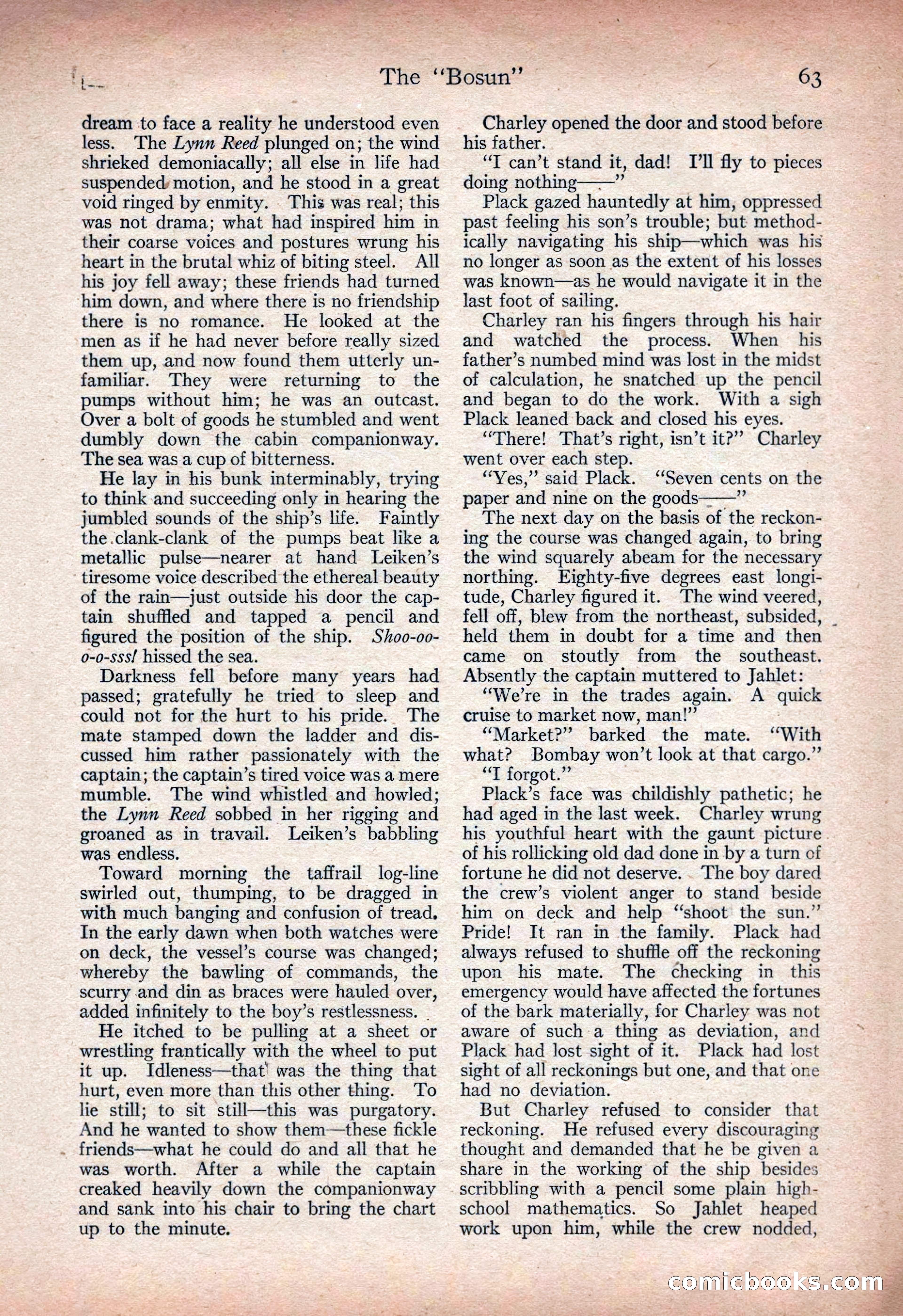
A restored page from Pulp Fiction, 1922. Page through the whole issue in the reader above.
📄 Transcribed text from this page (OCR, searchable)
Machine-transcribed from the original scan — historical spelling and the odd misread are preserved.
dream to face a reality he understood even less. The Lynn Reed plunged on; the wind shrieked demoniacally; all else in life had suspended motion, and he stood in a great void ringed by enmity. This was real; this was not drama; what had inspired him in their coarse voices and postures wrung his heart in the brutal whiz of biting steel. All his joy fell away; these friends had turned him down, and where there is no friendship there is no romance. He looked at the men as if he had never before really sized them up, and now found them utterly un- familiar. They were returning to the pumps without him; he was an outcast. Over a bolt of goods he stumbled and went dumbly down the cabin companionway. The sea was a cup of bitterness. He lay in his bunk interminably, trying to think and succeeding only in hearing the jumbled sounds of the ship’s life. Faintly the .clank-clank of the pumps beat like a metallic pulse—nearer at hand Leiken’s tiresome voice described the ethereal beauty of the rain—just outside his door the cap- tain shuffled and tapped a pencil and figured the position of the ship. Skoo-o0- o-o-sss! hissed the sea. Darkness fell before many years had passed; gratefully he tried to sleep and could not for the hurt to his pride. The mate stamped down the ladder and dis- cussed him rather passionately with the captain; the captain’s tired voice was a mere mumble. The wind whistled and howled; the Lynn Reed sobbed in her rigging and groaned as in travail. Leiken’s babbling was endless. Toward morning the tafirail log-line swirled out, thumping, to be dragged in with much banging and confusion of tread, In the early dawn when both watches were on deck, the vessel’s course was changed; whereby the bawling of commands, the scurry and din as braces were hauled over, added infinitely to the boy’s restlessness. . He itched to be pulling at a sheet or wrestling frantically with the wheel to put it up. Idleness—that' was the thing that hurt, even more than this other thing. To lie still; to sit still—this was purgatory. And he wanted to show them—these fickle . friends—what he could do and all that he was worth. After a while the captain creaked heavily down the companionway and sank into his chair to bring the chart up to the minute. The ‘‘Bosun”’ paper and nine on the goods— 63 Charley opened the door and stood before his father. “T can’t stand it, dad! doing nothing——” Plack gazed hauntedly at him, oppressed past feeling his son’s trouble; but method- ically navigating his ship—which was his no longer as soon as the extent of his losses was known—as he would navigate it in the last foot of sailing. Charley ran his fingers through his hair and watched the process. When his father’s numbed mind was lost in the midst of calculation, he snatched up the pencil and began to do the work. With a sigh Plack leaned back and closed his eyes. “There! That’s right, isn’t it?’ Charley went over each step. “Ves,” said Plack. I'll fly to pieces ‘Seven cents on the 3) The next day on the basis of the reckon- ing the course was changed again, to bring the wind squarely abeam for the necessary northing. Eighty-five degrees east longi- tude, Charley figured it. The wind veered, fell off, blew from the northeast, subsided, - held them in doubt for a time and then came on stoutly from the southeast. Absently the captain muttered to Jahlet: ‘“‘We’re in the trades again. A quick cruise to market now, man!” | “Market?” barked the mate. “With what? Bombay won’t look at that cargo.” “T forgot.” Plack’s face was childishly pathetic; he had aged in the last week. Charley wrung his youthful heart with the gaunt picture. of his rollicking old dad done in by a turn of fortune he did not deserve. . The boy dared the crew’s violent anger to stand beside him on deck and help “shoot the sun.’ Pride! It ran in the family. Plack had always refused to shuffle off the reckoning upon his mate. The checking in this emergency would have affected the fortunes of the bark materially, for Charley was not aware of such a thing as deviation, and Plack had lost sight of it. Plack had lost sight of all reckonings but one, and that one had no deviation. But Charley refused to consider that reckoning. He refused every discouraging thought and demanded that he be given a share in the working of the ship besides scribbling with a pencil some plain high- school mathematics. So Jahlet heaped work upon him, while the crew nodded, Gomichooks com