
Pulp Fiction, 1922 · page 74 of 200
Adventure Magazine Cover — page 74: what you’re looking at
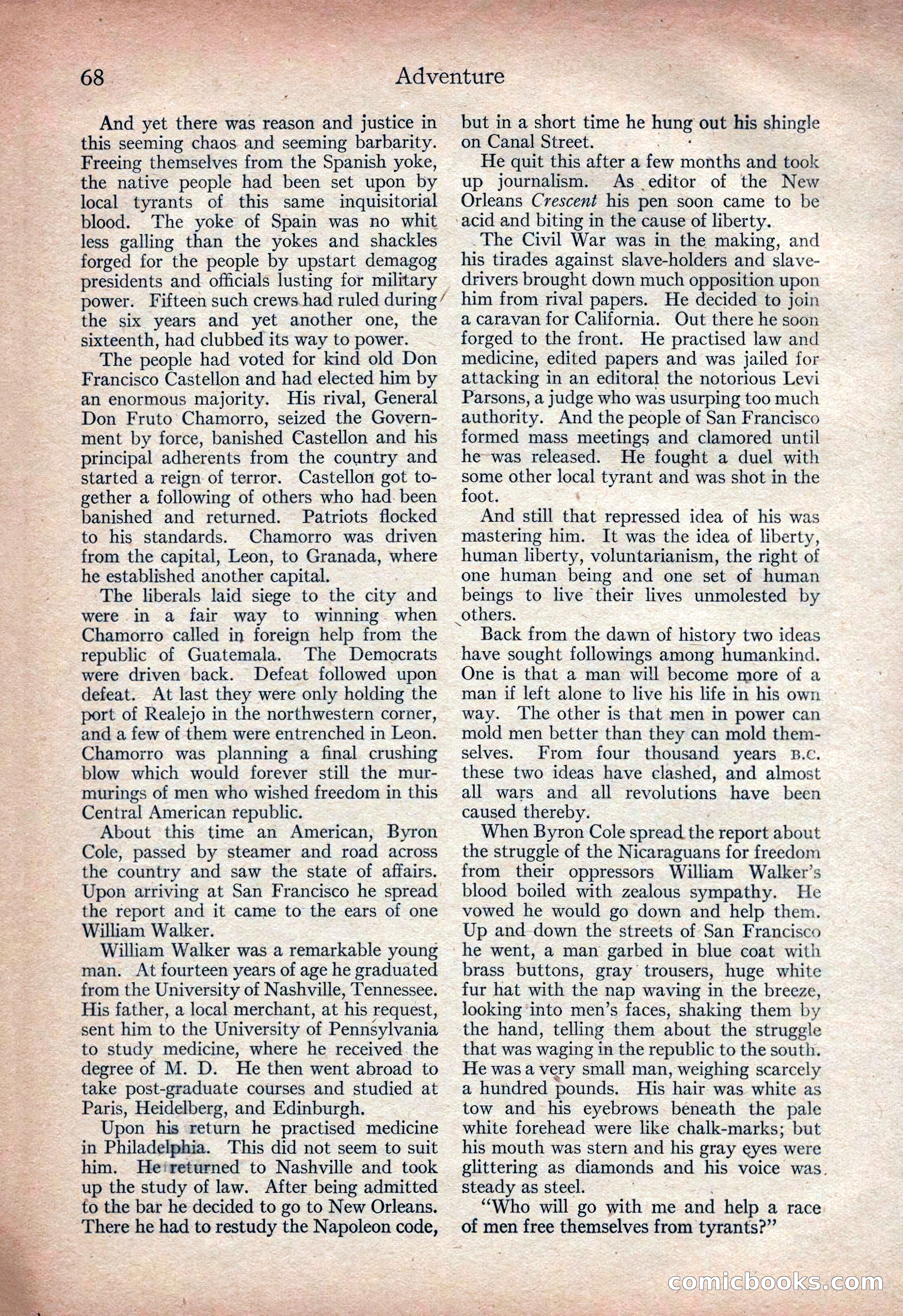
A restored page from Pulp Fiction, 1922. Page through the whole issue in the reader above.
📄 Transcribed text from this page (OCR, searchable)
Machine-transcribed from the original scan — historical spelling and the odd misread are preserved.
68. And yet there was reason and justice in this seeming chaos and seeming barbarity. Freeing themselves from the Spanish yoke, the native people had been set upon by local tyrants of this same inquisitorial blood. The yoke of Spain was no whit less galling than the yokes and shackles forged for the people by upstart demagog presidents and officials lusting for military power. Fifteen such crews had ruled during / the six years and yet another one, the sixteenth, had clubbed its way to power. The people had voted for kind old Don Francisco Castellon and had elected him by an enormous majority. His rival, General Don Fruto Chamorro, seized the Govern- ment by force, banished Castellon and his principal adherents from the country and started a reign of terror. Castellon got to- gether a following of others who had. been banished and returned. Patriots flocked to his standards. Chamorro was driven from the capital, Leon, to Granada, where he established another capital. The liberals laid siege to the city and were in a fair way to winning when Chamorro called in foreign help from the republic of Guatemala. The Democrats were driven back. Defeat followed upon defeat. At last they were only holding the port of Realejo in the northwestern corner, and a few of them were entrenched in Leon. Chamorro was planning a final crushing blow which would forever still the mur- murings of men who wished freedom in this Central American republic. About this time an American, Byron Cole, passed by steamer and road across the country and saw the state of affairs. Upon arriving at San Francisco he spread the report and it came to the ears of one William Walker. William Walker was a remarkable young man. At fourteen years of age he graduated from the University of Nashville, Tennessee. His father, a local merchant, at his request, sent him to the University of Pennsylvania to study medicine, where he received. the degree of M. D. He then went abroad to - take post-graduate courses and studied at Paris, Heidelberg, and Edinburgh. Upon his return he practised medicine in Philadelphia. This did not seem to suit him. Hefreturned to Nashville and took up the study of law. After being admitted to the bar he decided to go to New Orleans. There he had to restudy the Napoleon code, Adventure but in a short time he hung out his shingle on Canal Street. He quit this after a few months and took up journalism. As editor of the New Orleans Crescent his pen soon came to be ‘acid and biting in the cause of liberty. .The Civil War was in the making, and his tirades against slave-holders and slave- drivers brought down much opposition upon him from rival papers. He decided to join a caravan for California. Out there he soon forged to the front. He practised law and medicine, edited papers and was jailed for attacking in an editoral the notorious Levi Parsons, a judge who was usurping too much authority. And the people of San Francisco formed mass meetings and clamored until he was released. He fought a duel with some other local tyrant and was shot in the foot. And still that repressed idea of his was mastering him. It was the idea of liberty, human liberty, voluntarianism, the right of one human being and one set of human beings to live their lives unmolested by _others. Back from the dawn of history two ideas have sought followings among humankind. One is that a man will become more of a man if left alone to live his life in his own way. The other is that men in power can mold men better than they can mold them- selves. From four thousand years B.c. these two ideas have clashed, and almost all wars and all revolutions have been caused thereby. When Byron Cole spread the report about the struggle of the Nicaraguans for freedom from their oppressors William Walker’s blood boiled with zealous sympathy. He vowed he would go down and help them. Up and down the streets of San Francisco he went, a man garbed in blue coat with brass buttons, gray trousers, huge white fur hat with the nap waving in the breeze, looking into men’s faces, shaking them by the hand, telling them about the struggle that was waging in the republic to the south. He was a very small man, weighing scarcely a hundred pounds. His hair was white as ' tow and his eyebrows beneath the pale white forehead were like chalk-marks; but his mouth was stern and his gray eyes were glittering as diamonds and his voice was. steady as steel. “Who will go with me and help a race of men free ieericsbges from tyrants?” (E©) MMIGCLOOOL< (E@)