
Pulp Fiction, 1922 · page 80 of 200
Adventure Magazine Cover — page 80: what you’re looking at
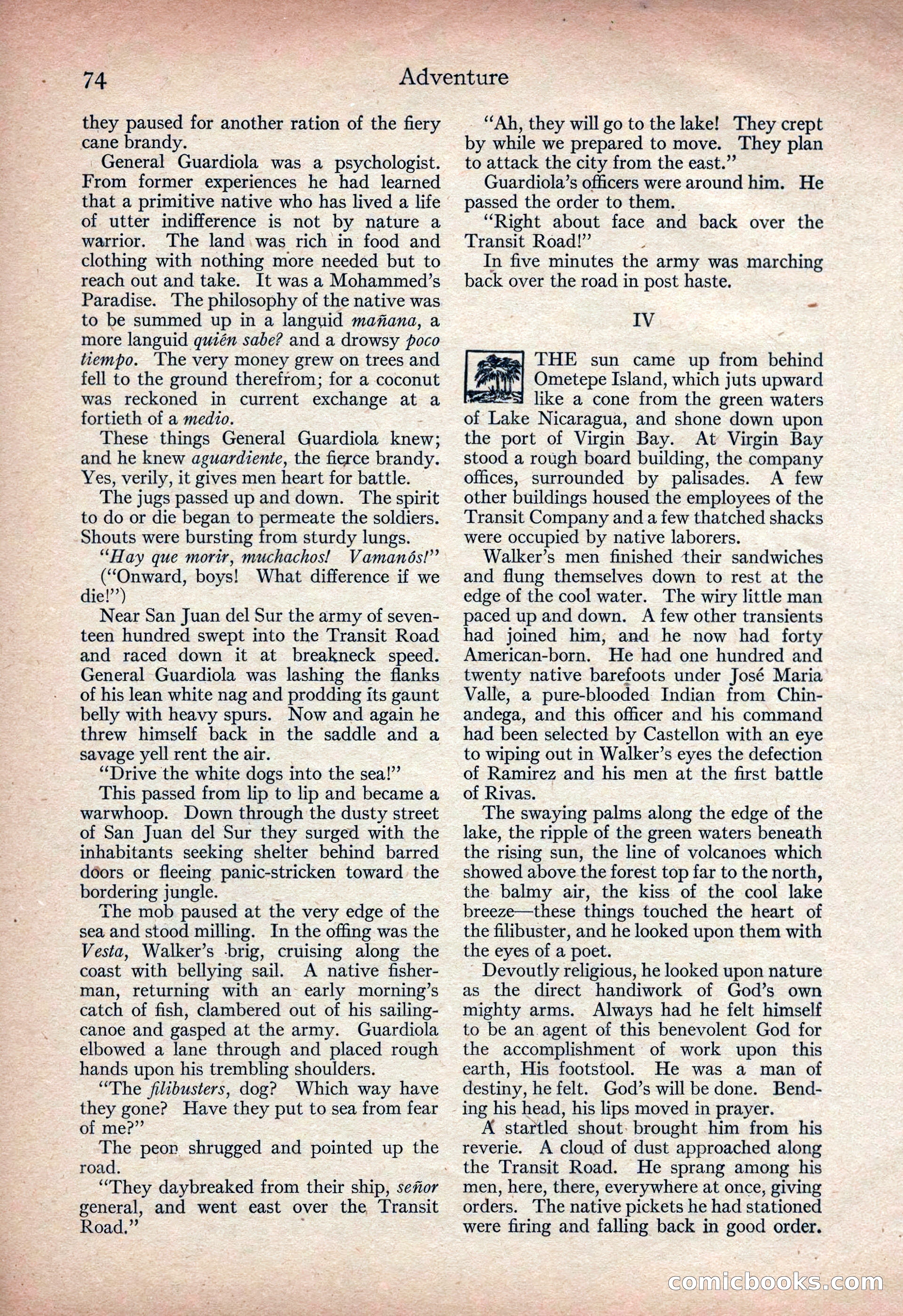
A restored page from Pulp Fiction, 1922. Page through the whole issue in the reader above.
📄 Transcribed text from this page (OCR, searchable)
Machine-transcribed from the original scan — historical spelling and the odd misread are preserved.
(reeds 74 they paused for another ration of the fiery cane brandy. © General Guardiola was a psychologist. F rom former experiences he had learned that a primitive native who has lived a life of utter indifference is not by nature a warrior. The land was rich in food and clothing with nothing more needed but to reach out and take. It was a Mohammed’s Paradise. The philosophy of the native was to be summed up in a languid manana, a more languid quzén sabe? and a drowsy poco tiempo. The very money grew on trees and fell to the ground therefrom; for a coconut was reckoned in current exchange at a fortieth of a medzo. These things General Guardiola knew: and he knew aguardiente, the fierce brandy. Yes, verily, it gives men heart for battle. The jugs passed up and down. The spirit to do or die began to permeate the soldiers. Shouts were bursting from sturdy lungs. “Hay que mori, muchachos! Vamanés!” pees boys! What difference if we die!” Near San Juan del Sur the army of seven- teen hundred swept into the Transit Road and raced down it at breakneck speed. General Guardiola was lashing the flanks of his lean white nag and prodding its gaunt belly with heavy spurs. Now and again he threw himself back in the saddle and a savage yell rent the air. “Drive the white dogs into the sea!”’ This passed from lip to lip and became a warwhoop. Down through the dusty street of San Juan del Sur they surged with the inhabitants seeking shelter behind barred doors or fleeing panic-stricken toward the bordering jungle. The mob paused at the very edge of the sea and stood milling. In the offing was the Vesta, Walker’s -brig, cruising along the coast with bellying sail. A native fisher- man, returning with an early morning’s catch of fish, clambered out of his sailing- _ canoe and gasped at the army. Guardiola elbowed a lane through and placed rough hands upon his trembling shoulders. “The filibusters, dog? Which way have they gone? Have they put to sea from fear of me?” The peor shrugged and pointed up the road. general, and went east over the Transit Road,” “They daybreaked from their ship, sefor Adventure _ “Ah, they will go to the lake! They crept by while we prepared to move. They plan to attack the city from the east.” Guardiola’s officers were around him. He passed the order to them. “Right about face and back over the Transit Road!” In five minutes the army was marching back over the road in post haste. - IV wa.) THE sun came up from behind é Aki Ometepe Island, which juts upward PES jike a cone from the green waters of, Lake Nicaragua, and shone down upon the port of Virgin Bay. At Virgin Bay stood a rough board building, the company offices, surrounded by palisades. A few other buildings housed the employees of the Transit Company and a few thatched shacks were occupied by native laborers. Walker’s men finished their sandwiches and flung themselves down to rest at the edge of the cool water. The wiry little man paced up and down. A few other transients had joined him, and he now had forty American-born. He had one hundred and twenty native barefoots under José Maria Valle, a pure-blooded Indian from Chin- andega, and this officer and his command had been selected by Castellon with an eye to wiping out in Walker’s eyes the defection of Ramirez and his men at the first battle of Rivas. The swaying palms along the edge of the lake, the ripple of the green waters beneath the rising sun, the line of volcanoes which showed above the forest top far to the north, the balmy air, the kiss of the cool lake breeze—these things touched the heart of the filibuster, and he looked upon them with the eyes of a poet. - Devoutly religious, he looked upon nature as the direct handiwork of God’s own mighty arms. Always had he felt himself to be an.agent of this benevolent God for the accomplishment of work upon. this earth, His footstool. He was a man of destiny, he felt. God’s will be done. Bend- ing his head, his lips moved in prayer. A startled shout: brought him from his reverie. A cloud of dust approached along the Transit Road. He sprang among his men, here, there, everywhere at once, giving orders. The native pickets he had stationed were firing and falling back in good order. Gomicbooks (EC) im