
Pulp Fiction, 1922 · page 83 of 200
Adventure Magazine Cover — page 83: what you’re looking at
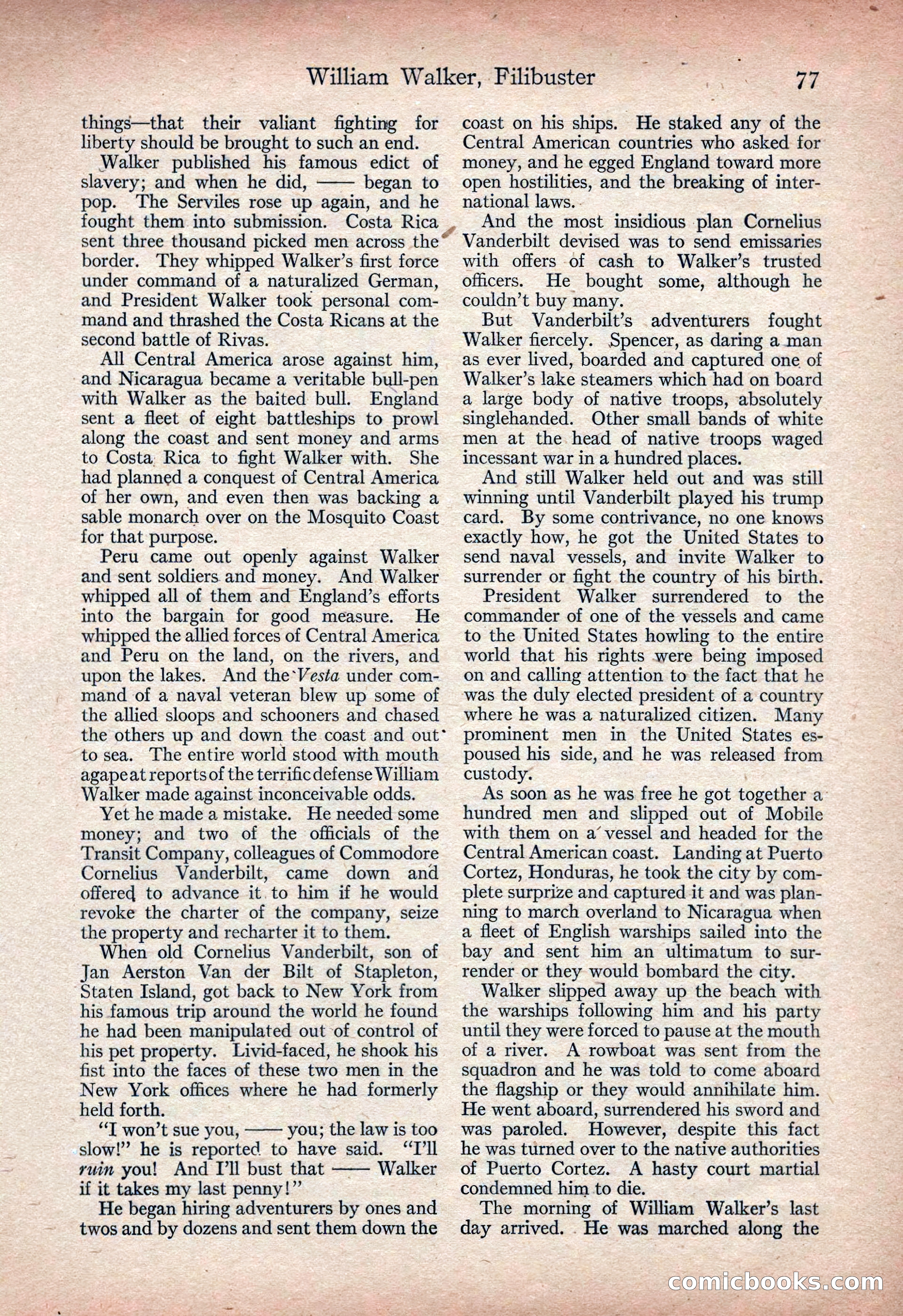
A restored page from Pulp Fiction, 1922. Page through the whole issue in the reader above.
📄 Transcribed text from this page (OCR, searchable)
Machine-transcribed from the original scan — historical spelling and the odd misread are preserved.
we ae oe as i a ty 2 ae oes ee .. Se ose yee vo oe Ft ¥ ? —_ 4S * be lt . 4 2 =S 7 a p a oe <" #2 . Jp. ws ee William Walker, Filibuster things—that their valiant fighting for liberty should be brought to such an end. Walker published his famous edict of slavery; and when he did, —— began to pop. The Serviles rose up again, and he fought them into submission. Costa Rica. sent three thousand picked men across the border. They whipped Walker’s first force under command of a naturalized German, and President Walker took personal com- mand and thrashed the Costa Ricans at the second battle of Rivas. All Central America arose against him, and Nicaragua became a veritable bull-pen with Walker as the baited bull. England sent a fleet of eight battleships to prowl along the coast and sent money and arms to Costa, Rica to fight Walker with. She had planned a conquest of Central America of her own, and even then was backing a sable monarch over on the Mosquito Coast for that purpose. ? Peru came out openly against Walker and sent soldiers and money. And Walker whipped all of them and England’s efforts into the bargain for good measure. He whipped the allied forces of Central America and Peru on the land, on the rivers, and upon the lakes. And the*Vesta under com- mand of a naval veteran blew up some of the allied sloops and schooners and chased the others up and down the coast and out” to sea. The entire world stood with mouth agapeat reports of the terrificdefense William Walker made against inconceivable odds. Yet he made a mistake. He needed some money; and two of the officials of the Transit Company, colleagues of Commodore Cornelius Vanderbilt, came down and offered to advance it.to him if he would revoke the charter of the company, seize the property and recharter it to them. When old Cornelius Vanderbilt, son of Jan Aerston Van der Bilt of Stapleton, Staten Island, got back to New York from his famous trip around the world he found he had been manipulated out of control of his pet property. Livid-faced, he shook his fist into the faces of these two men in the New York offices where he had formerly held forth. “T won’t sue you, —— you; the law is too slow!” he is reported to have said. “T’ll ryuin you! And [’ll bust that —— Walker if it takes my last penny!”’ He began hiring adventurers by ones and twos and by dozens and sent them down the # ae ae - — -— 2 ee Sa — ia J +. eS Pets —e fe I eg ee gl oe eS ee ese se SO ee aes SS he ge Rane ie CiaX, > Spar % ; SS ee ek eS > ae we ~ Se ee pe as tae 77 coast on his ships. He staked any of the Central American countries who asked for money, and he egged England toward more open hostilities, and the breaking of inter- national laws... And the most insidious plan Cornelius Vanderbilt devised was to send emissaries with offers of cash to Walker’s trusted officers. He bought some, although he couldn’t buy many. But Vanderbilt’s adventurers fought Walker fiercely. Spencer, as daring a man as ever lived, boarded and captured one of Walker’s lake steamers which had on board a large body of native troops, absolutely singlehanded. Other small bands of white men at the head of native troops waged incessant war in a hundred places. And still Walker held out and was still winning until Vanderbilt played his trump card. By some contrivance, no one knows exactly how, he got the United States to send naval vessels, and invite Walker to surrender or fight the country of his birth. President Walker surrendered to the commander of one of the vessels and came to the United States howling to the entire world that his rights were being imposed on and calling attention to the fact that he was the duly elected president of a country where he was a naturalized citizen. Many prominent men in the United States es- poused his side, and he was released from custody. As soon as he was free he got together a hundred men and slipped out of Mobile with them on a’ vessel and headed for the Central American coast. Landing at Puerto Cortez, Honduras, he took the city by com- plete surprize and captured it and was plan- ning to march overland to N icaragua when a fleet of English warships sailed into the bay and sent him an ultimatum to sur- render or they would bombard the city. Walker slipped away up the beach with the warships following him and his party until they were forced to pause at the mouth of a river. A rowboat was sent from the squadron and he was told to come aboard the flagship or they would annihilate him. He went aboard, surrendered his sword and was paroled. However, despite this fact he was turned over to the native authorities of Puerto Cortez. A hasty court martial condemned him to die. The morning of William Walker’s last day arrived. .He was marched along the (E) mic IOOKS Eom ae > ° ey Se ili - ‘ inate 29 os