
Pulp Fiction, 1921 · page 13 of 194
Adventure Magazine Cover — page 13: what you’re looking at
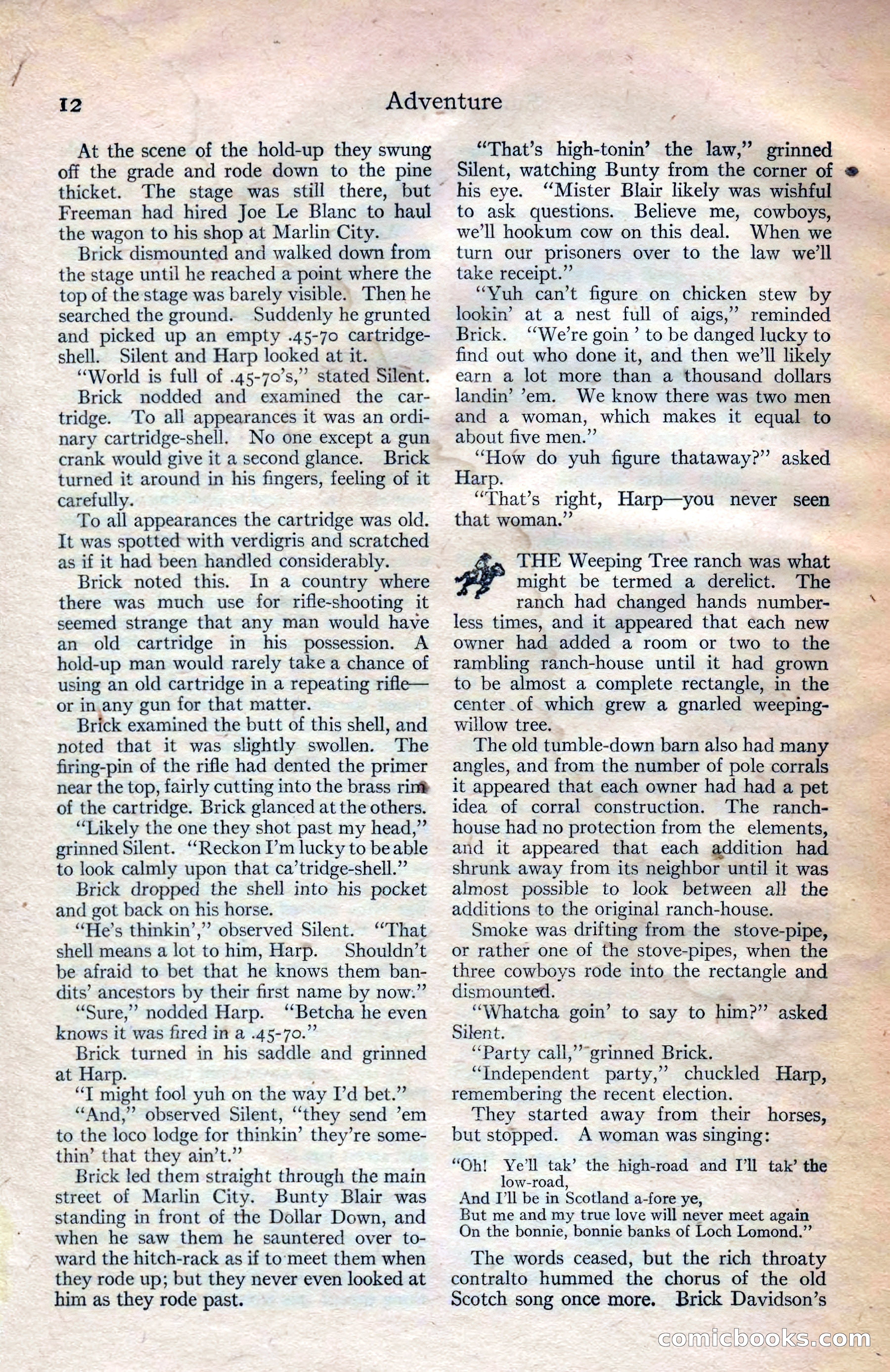
A restored page from Pulp Fiction, 1921. Page through the whole issue in the reader above.
📄 Transcribed text from this page (OCR, searchable)
Machine-transcribed from the original scan — historical spelling and the odd misread are preserved.
12 Adventure At the scene of the hold-up they swung off the grade and rode down to the pine thicket. Freeman had hired Joe Le Blanc to haul the wagon to his shop at Marlin City. Brick dismounted and walked down from the stage until he reached a point where the top of the stage was barely visible. Then he searched the ground. Suddenly he grunted and picked up an empty .45-70 cartridge- shell. Silent and Harp looked at it. “World is full of .45-70’s,” stated Silent. Brick nodded and examined the car- tridge. To all appearances it was an ordi- nary cartridge-shell. No one except a gun crank would give it a second glance. Brick turned it around in his fingers, feeling of it carefully. To all appearances the cartridge was old. It was spotted with verdigris and scratched as if it had been handled considerably. Brick noted this. In a country where there was much use for rifle-shooting it seemed strange that any man would have an old cartridge in his possession. A hold-up man would rarely take a chance of using an old cartridge in a repeating rifle— or in.any gun for that matter. Brick examined the butt of this shell, and noted that it was slightly swollen. The firing-pin of the rifle had dented the primer near the top, fairly cutting into the brass rin of the cartridge. Brick glanced at the others. “Likely the one they shot past my head,” grinned Silent. “‘Reckon I’m lucky to beable to look calmly upon that ca’tridge-shell.” Brick dropped the shell into his pocket and got back on his horse. “He’s thinkin’,” observed Silent. “That shell means a lot to him, Harp. Shouldn’t be afraid to bet that he knows them ban- dits’ ancestors by their first name by now.” “Sure,” nodded Harp. ‘Betcha he even knows it was fired in a .45-70.”’ Brick turned in his saddle and grinned at Harp. “T might fool yuh on the way Id bet.” “And,” observed Silent, “they send ’em to the loco lodge for thinkin’ they’re some- thin’ that they ain’t.” Brick led them straight through the main street of Marlin City. Bunty Blair was standing in front of the Dollar Down, and when he saw them he sauntered over to- ward the hitch-rack as if to meet them when they rode up; but they never even looked at hima as they rode past. The stage was still there, but © “That’s high-tonin’ the law,” grinned Silent, watching Bunty from the corner of @ “Mister Blair likely was wishful to ask questions. Believe me, cowboys, we'll hookum cow on this deal. When we turn our prisoners over to the law we'll take receipt.” “Vuh can’t figure on chicken stew by lookin’ at a nest full of aigs,’ reminded Brick. ‘We’re goin’ to be danged lucky to find out who done it, and then we'll likely earn a lot more than a thousand dollars landin’ ’°em. We know there was two men and a woman, which makes it equal to about five men.”’ “How do yuh figure thataway?” asked Harp. “That’s right, that woman.” his eye. Harp—you never seen THE Weeping Tree ranch was what might be termed a derelict. The ranch had changed hands number- less times, and it appeared that each new owner had added a room or two to the rambling ranch-house until it had grown to be almost a complete rectangle, in the center of which grew a gnarled weeping- willow tree. The old tumble-down barn also had many angles, and from the number of pole corrals it appeared that each owner had had a pet idea of corral construction. The ranch- house had no protection from the elements, and it appeared that each addition had shrunk away from its neighbor until it was almost possible to look between all the additions to the original ranch-house. Smoke was drifting from the stove-pipe, or rather one of the stove-pipes, when the three cowboys rode into the rectangle and dismounted. “Whatcha goin’ to say to him?” asked Silent. “Party call,’ grinned Brick. “Independent party,” chuckled Harp, remembering the recent election. 2 am They started away from their horses, — but stopped. A woman was singing: “Oh! Ye'll tak’ the high-road and I'll tak’ the low-road, And I'll be j in Scotland a-fore ye, But me and my true love will never meet again On the bonnie, bonnie banks of Loch Lomond.” The words ceased, but the rich throaty contralto hummed the chorus of the old Scotch song once more. Brick Davidson’s Gomichbooks: co