
Pulp Fiction, 1921 · page 182 of 194
Adventure Magazine Cover — page 182: what you’re looking at
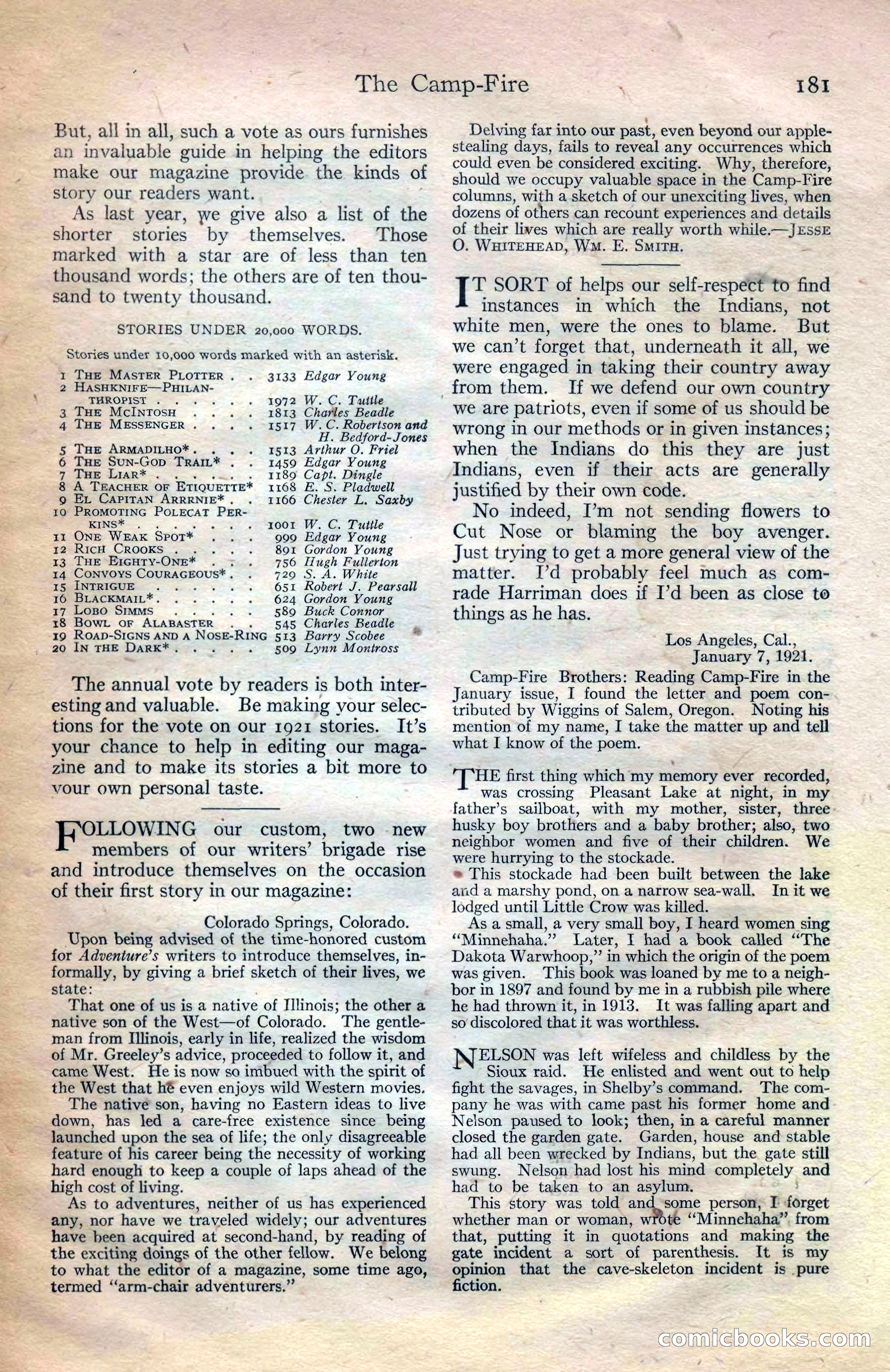
A restored page from Pulp Fiction, 1921. Page through the whole issue in the reader above.
📄 Transcribed text from this page (OCR, searchable)
Machine-transcribed from the original scan — historical spelling and the odd misread are preserved.
The Camp-Fire But, all in all, such a vote as ours furnishes an invaluable guide in helping the editors make our magazine provide the kinds of story our readers want. | As last year, we give also a list of the shorter stories by themselves. Those marked with a star are of less than ten thousand words; the others are of ten thou- sand to twenty thousand. STORIES UNDER 20,000 WORDS. Stories under 16,000 words marked with an asterisk. THe MASTER PLOTTER , HASHKNIFE—PHILAN- THROPIST . ‘ 3133 Edgar Young 1972 W. C. Tuttle oH 3 THe McINTosH 1813 Charles Beadle 4 THE MESSENGER . 1517 W.C. Robertson and H. Bedford-Jones 5 THEr ARMADILHO*. . , 1513 Arthur O. Friel 6 Tre Sun-Gop TRAIL* , 1459 Edgar Young 7 Tee Zaar* -.. ~ ene + 11890 Capt. Dingle 8 A TEACHER OF ETIQUETTE* 1168 E. S. Pladwell 9 Ex CaAPiItaN ARRRNIE* . 1166 Chester L. Saxby 10 PROMOTING POLECAT PER- ee ow oe Se eS et OOE . & Tune tx ONE WEAK Spot* .... 999 Edgar Young 12 RicH Crooks . .. . . 891 Gordon Young 13 THe ErcHTy-ONe* . 7; . 756 Hugh Fullerton 14 Convoys CouraGgEous*. . 720 S. A. White 1S INTRIGUE .... . . £651 Robert J. Pearsall 16 BLACKMAIL*. . . . . . 624 Gordon Young 17 Loso Smms... .. . »« 589 Buck Connor 18 BowL or ALABASTER .. 545 Charles Beadle 19 Roap-SIGNs AND A NosE-RING 513 Barry Scobee 20 IN THE DarK*. . . . . 509 Lynn Montross re a The annual vote by readers is both inter- esting and valuable. Be making vour selec- tions for the vote on our 1921 stories. It’s your chance to help in editing our maga- zine and to make its stories a bit more to vour own personal taste. LLOWING our custom, two new members of our writers’ brigade rise and introduce themselves on the occasion of their first story in our magazine: Colorado Springs, Colorado. Upon being advised of the time-honored custom for Adventure’s writers to introduce themselves, in- formally, by giving a brief sketch of their lives, we state: That one of us is a native of Illinois; the other a native son of the West—of Colorado. The gentle- man from Illinois, early in life, realized the wisdom of Mr. Greeley’s advice, proceeded to follow it, and came West. He is now so imbued with the spirit of the West that hé even enjoys wild Western movies. The native son, having no Eastern ideas to live down, has led a care-free existence since being Jaunched upon the sea of life; the only disagreeable feature of his career being the necessity of working hard enough to keep a couple of laps ahead of the high cost of living. As to adventures, neither of us has experienced any, nor have we traveled widely; our adventures have been acquired at second-hand, by reading of the exciting doings of the other fellow. We belong to what the editor of a magazine, some time ago, termed “arm-chair adventurers.” 181 Delving far into our past, even beyond our apple- stealing days, fails to reveal any occurrences which could even be considered exciting. Why, therefore, should we occupy valuable space in the Camp-Fire columns, with a sketch of our unexciting lives, when dozens of others can recount experiences and details of their lives which are really worth while.—JEssE O. WHITEHEAD, Wo. E. Smita. ; | SORT of helps our self-respect to find instances in which the Indians, not white men, were the ones to blame. But we can’t forget that, underneath it all, we were engaged in taking their country away from them. If we defend our own country we are patriots, even if some of us should be wrong in our methods or in given instances; when the Indians do this they are just Indians, even if their acts are generally justified by their own code. No indeed, I’m not sending flowers to Cut Nose or blaming the boy avenger. Just trying to get a more general view of the matter. I’d probably feel much as com- rade Harriman does if I’d been as close to things as he has. Los Angeles, Cal., January 7, 1921. Camp-Fire Brothers: Reading Camp-Fire in the January issue, I found the letter and poem con- tributed by Wiggins of Salem, Oregon. Noting his mention of my name, I take the matter up and tell what I know of the poem. HE first thing which my memory ever recorded, was crossing Pleasant Lake at night, in my father’s sailboat, with my mother, sister, three- husky boy brothers and a baby brother; also, two neighbor women and five of their children. We were hurrying to the stockade. » This stockade had been built between the lake and a marshy pond, on a narrow sea-wall, In it we lodged until Little Crow was killed. As a small, a very small boy, I heard women sing “Minnehaha.” Later, I had a book called “The Dakota Warwhoop,” in which the origin of the poem was given. This book was loaned by me to a neigh- bor in 1897 and found by me in a rubbish pile where he had thrown it, in 1913. It was falling apart and so discolored that it was worthless. NELSON was left wifeless and childless by the Sioux raid. He enlisted and went out to help fight the savages, in Shelby’s command. The com- pany he was with came past his former home and Nelson paused to look; then, in a careful manner closed the garden gate. Garden, house and stable had all been wrecked by Indians, but the gate still swung. Nelson had lost his mind completely and had to be taken to an asylum. This story was told ies CE person, I forget whether man or woman, wrote “Minnehaha”, from that, putting it in quotations and making the gate incident a sort of parenthesis. It is my opinion that the cave-skeleton incident is pure fiction. COPE OOKSECO