
Pulp Fiction, 1921 · page 191 of 194
Adventure Magazine Cover — page 191: what you’re looking at
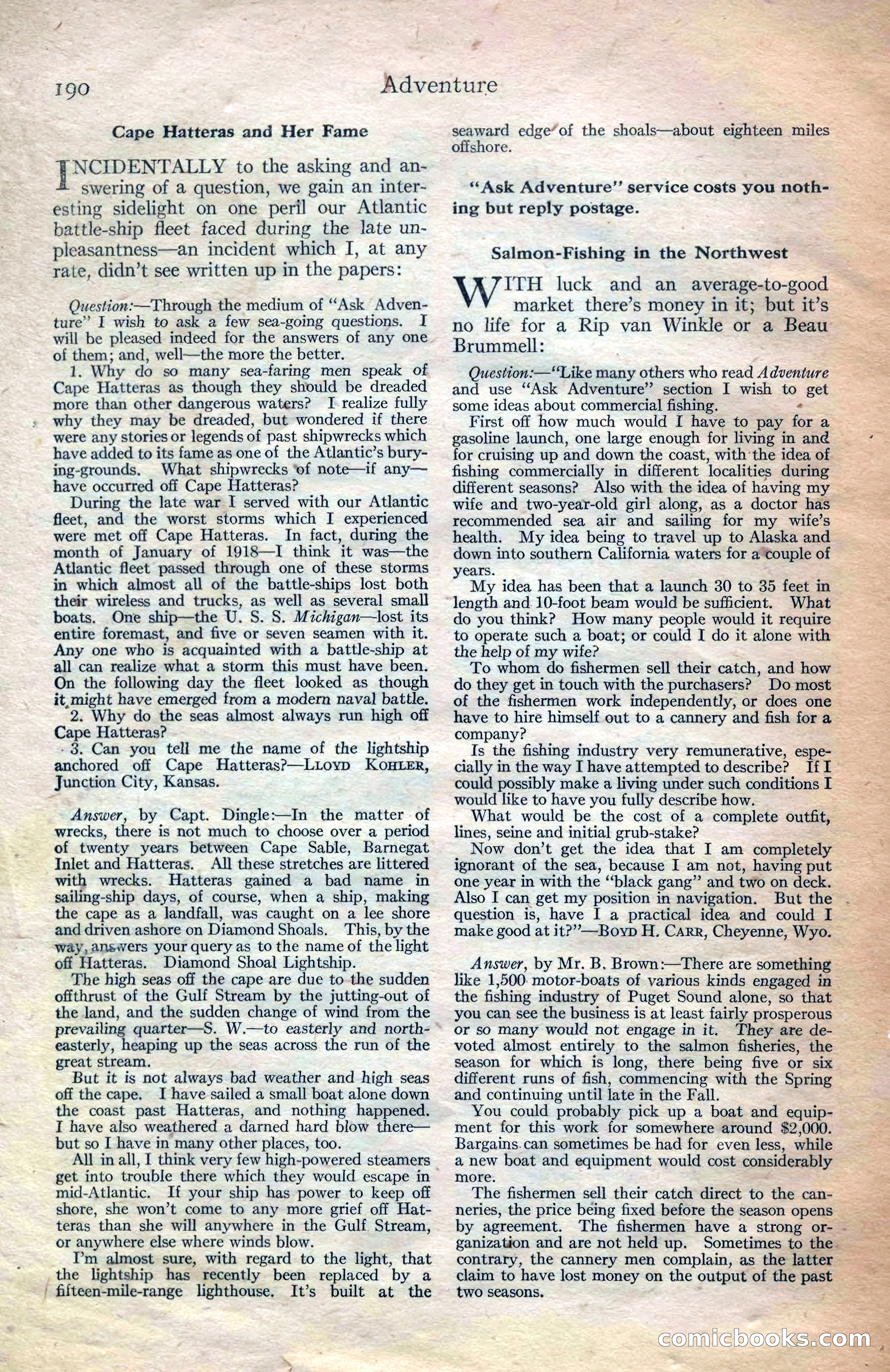
A restored page from Pulp Fiction, 1921. Page through the whole issue in the reader above.
📄 Transcribed text from this page (OCR, searchable)
Machine-transcribed from the original scan — historical spelling and the odd misread are preserved.
190 Cape Hatteras and Her Fame pee TALL to the asking and an- swering of a question, we gain an inter- esting sidelight on one peril our Atlantic battle-ship fleet faced during the late un- pleasantness—an incident which I, at any rate, didn’t see written up in the papers: Question:—Through the medium of “Ask Adven- ture’ I wish to ask a few sea-going questions. I will be pleased indeed for the answers of any one of them; and, well—the more the better. 1. Why do so many sea-faring men speak of Cape Hatteras as though they should be dreaded more than other dangerous waters? TI realize fully why they may be dreaded, but wondered if there were any stories or legends of past shipwrecks which have added to its fame as one of the Atlantic’s bury- ing-grounds. What shipwrecks ‘of note—if any— have occurred off Cape Hatteras? During the late war I served with our Atlantic fleet, and the worst storms which I experienced were met off Cape Hatteras. In fact, during the month of January of 1918—I think it was—the Atlantic fleet passed through one of these storms in which almost all of the battle-ships lost both their wireless and trucks, as well as several small boats, One ship—the U. S. S. Michigan—lost its entire foremast, and five or seven seamen with it. Any one who is acquainted with a battle-ship at all can realize what a storm this must have been. On the following day the fleet looked as though it,might have emerged from a modern naval battle. 2. Why do the seas almost always run high off Cape Hatteras? - 8. Can you tell me the name of the lightship anchored off Cape Hatteras?p—Lioyp KOHLER, Junction City, Kansas. Answer, by Capt. Dingle—In the matter of wrecks, there is not much to choose over a period of twenty years between Cape Sable, Barnegat Inlet and Hatteras. All these stretches are littered with wrecks. Hatteras gained a bad name in sailing-ship days, of course, when a ship, making the cape as a landfall, was caught on a lee shore and driven ashore on Diamond Shoals. This, by the way, answers your query as to the name of the light off Hatteras. Diamond Shoal Lightship. The high seas off the cape are due to the sudden offthrust of the Gulf Stream by the jutting-out of the land, and the sudden change of wind from the prevailing quarter—S. W.—to easterly and north- easterly, heaping up the seas across the run of the great stream. But it is not always bad weather and high seas off the cape. I have sailed a small boat alone down the coast past Hatteras, and nothing happened. I have also weathered a darned hard blow there— but so I have in many other places, too. All in all, I think very few high-powered steamers get into trouble there which they would escape in mid-Atlantic. If your ship has power to keep off shore, she won’t come to any more grief off Hat- teras than she will anywhere in the Gulf Stream, or anywhere else where winds blow. I’m almost sure, with regard to the light, that the lightship has recently been replaced by a | fifteen-mile-range lighthouse. It’s built at the Adventure seaward edge’of the shoals—about eighteen miles offshore. *‘Ask Adventure’”’ service costs you noth- ing but reply postage. Salmon-Fishing in the Northwest \ K YITH luck and an average-to-good market there’s money in it; but it’s no life for a Rip van Winkle or a Beau Brummell: Question: —“Like many others who read Adventure and use ‘Ask Adventure” section I wish to get some ideas about commercial fishing. ‘ First off how much would [ have to pay for a gasoline launch, one large enough for living in and for cruising up and down the coast, with the idea of fishing commercially in different localities during different seasons? Also with the idea of having my wife and two-year-old girl along, as a doctor has recommended sea air and sailing for my wife’s health. My idea being to travel up to Alaska and down into southern California waters for a Couple of years. My idea has been that a launch 30 to 35 feet in length and. 10-foot beam would be sufficient. What do you think? How many people would it require to operate such a boat; or could [ do it alone with the help of my wife? To whom do fishermen sell their catch, and how do they get in touch with the purchasers? Do most of the fishermen work independently, or does one have to hire himself out to a cannery and fish for a company? Is the fishing industry very remunerative, espe- cially in the way I have attempted to describe? IfiI could possibly make a living under such conditions I would like to have you fully describe how. What would be the cost of a complete outfit, lines, seine and initial grub-stake? Now don’t get the idea that I am completely ignorant of the sea, because I am not, having put one year in with the “black gang” and two on deck. Also I can get my position in navigation. But the - question is, have I a practical idea and could I make good at it?’”—Boyp H. Carr, Cheyenne, Wyo. Answer, by Mr. B, Brown:—There are something like 1,500: motor-boats of various kinds engaged in~ the fishing industry of Puget Sound alone, so that you can see the business is at least fairly prosperous or so many would not engage in it. They are de- voted almost entirely to the salmon fisheries, the season for which is long, there being five or six different runs of fish, commencing with the Spring and continuing until late in the Fall. You could probably pick up a boat and equip- ment for this work for somewhere around $2,000. Bargains.can sometimes be had for even less, while a new boat and equipment would cost considerably more. The fishermen sell their catch direct to the can- neries, the price being fixed before the season opens by agreement. ganization and are not held up. Sometimes to the contrary, the cannery men complain, as the latter — claim to have lost money on the output of the past two seasons. Eomichoo The fishermen have a strong or-- SaAlS@) Arti hrn 4 ~ _ 4 < 7 ~_— _