
Pulp Fiction, 1921 · page 51 of 194
Adventure Magazine Cover — page 51: what you’re looking at
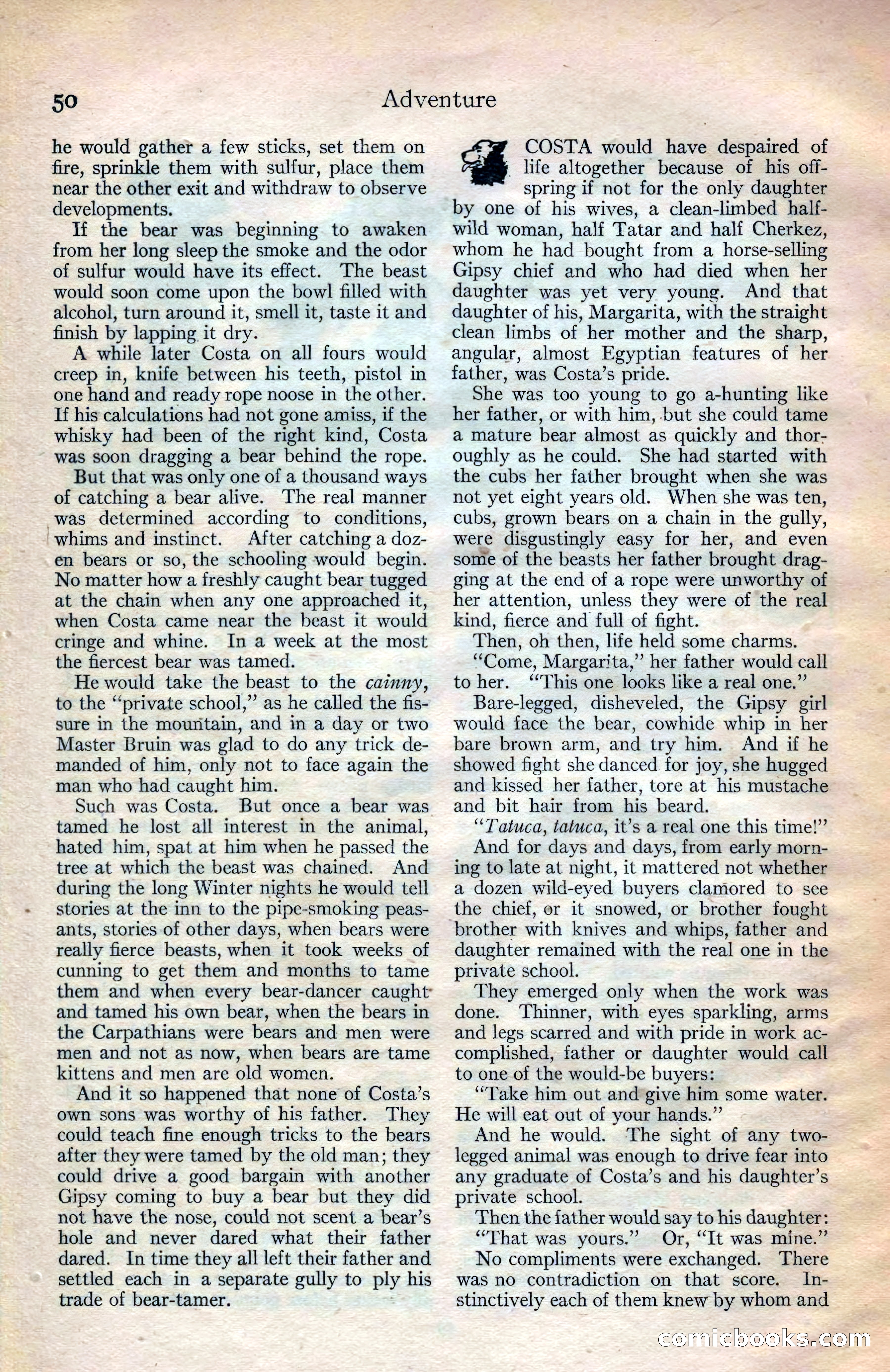
A restored page from Pulp Fiction, 1921. Page through the whole issue in the reader above.
📄 Transcribed text from this page (OCR, searchable)
Machine-transcribed from the original scan — historical spelling and the odd misread are preserved.
50 he would gather a few sticks, set them on fire, sprinkle them with sulfur, place them near the other exit and withdraw to observe developments. If the bear was beginning to awaken from her long sleep the smoke and the odor of sulfur would have its effect. The beast would soon come upon the bowl filled with alcohol, turn around it, smell it, taste it and finish by lapping it dry. A while later Costa on all fours would creep in, knife between his teeth, pistol in one hand and ready rope noose in the other. If his calculations had not gone amiss, if the whisky had been of the right kind, Costa was soon dragging a bear behind the rope. But that was only one of a thousand ways of catching a bear alive. The real manner was determined according to conditions, whims and instinct. After catching a doz- en bears or so, the schooling would begin. No matter how a freshly caught bear tugged at the chain when any one approached it, when Costa came near the beast it would cringe and whine. In a week at the most the fiercest bear was tamed. He would take the beast to the cainny, to the “private school,” as he called the fis- sure in the mountain, and in a day or two Master Bruin was glad to do any trick de- manded of him, only not to face again the man who had caught him. Such was Costa. But once a bear was tamed he lost all interest in the animal, hated him, spat at him when he passed the tree at which the beast was chained. And during the long Winter nights he would tell stories at the inn to the pipe-smoking peas- ants, stories of other days, when bears were really fierce beasts, when it took weeks of cunning to get them and months to tame them and when every bear-dancer caught and tamed his own bear, when the bears in the Carpathians were bears and men were men and not as now, when bears are tame kittens and men are old women. And it so happened that none of Costa’s own sons was worthy of his father. They could teach fine enough tricks to the bears after they were tamed by the old man; they could drive a good bargain with another Gipsy coming to buy a bear but they did not have the nose, could not scent a bear’s hole and never dared what their father dared. In time they all left their father and settled each in a separate gully to ply his trade of bear-tamer. Adventure COSTA would have despaired of oF | life altogether because of his off- spring if not for the only daughter by one of his wives, a clean-limbed half- wild woman, half Tatar and half Cherkez, whom he had bought from a horse-selling Gipsy chief and who had died when her daughter was yet very young. And that daughter of his, Margarita, with the straight clean limbs of her mother and the sharp, angular, almost Egyptian features of her father, was Costa’s pride. She was too young to go a-hunting like her father, or with him, but she could tame a mature bear almost as quickly and thor- oughly as he could. She had started with the cubs her father brought when she was not yet eight years old. When she was ten, cubs, grown bears on a chain in the gully, were disgustingly easy for her, and even some of the beasts her father brought drag- ging at the end of a rope were unworthy of her attention, unless they were of the real kind, fierce and full of fight. Then, oh then, life held some charms. “Come, Margarita,” her father would call to her. ‘This one looks like a real one.” Bare-legged, disheveled, the Gipsy girl would face the bear, cowhide whip in her bare brown arm, and try him. And if he showed fight she danced for joy, she hugged and kissed her father, tore at his mustache and bit hair from his beard. “‘Tatuca, tatuca, it’s a real one this time!’’ And for days and days, from early morn- ing to late at night, it mattered not whether a dozen wild-eyed buyers clamored to see the chief, or it snowed, or brother fought brother with knives and whips, father and daughter remained with the real one in the private school. They emerged only when the work was done. Thinner, with eyes sparkling, arms and legs scarred and with pride in work ac- complished, father or daughter would call to one of the would-be buyers: “Take him out and give him some water. He will eat out of your hands.” And he would. ‘The sight of any two- legged animal was enough to drive fear into any graduate of Costa’s and his daughter’s private school. Then the father would say to his daughter: “That was yours.” Or, “It was mine.” No compliments were exchanged. There was no contradiction on that score. In- stinctively each of them knew by whom and GOmMmIiGDooks.co