
Pulp Fiction, 1921 · page 66 of 194
Adventure Magazine Cover — page 66: what you’re looking at
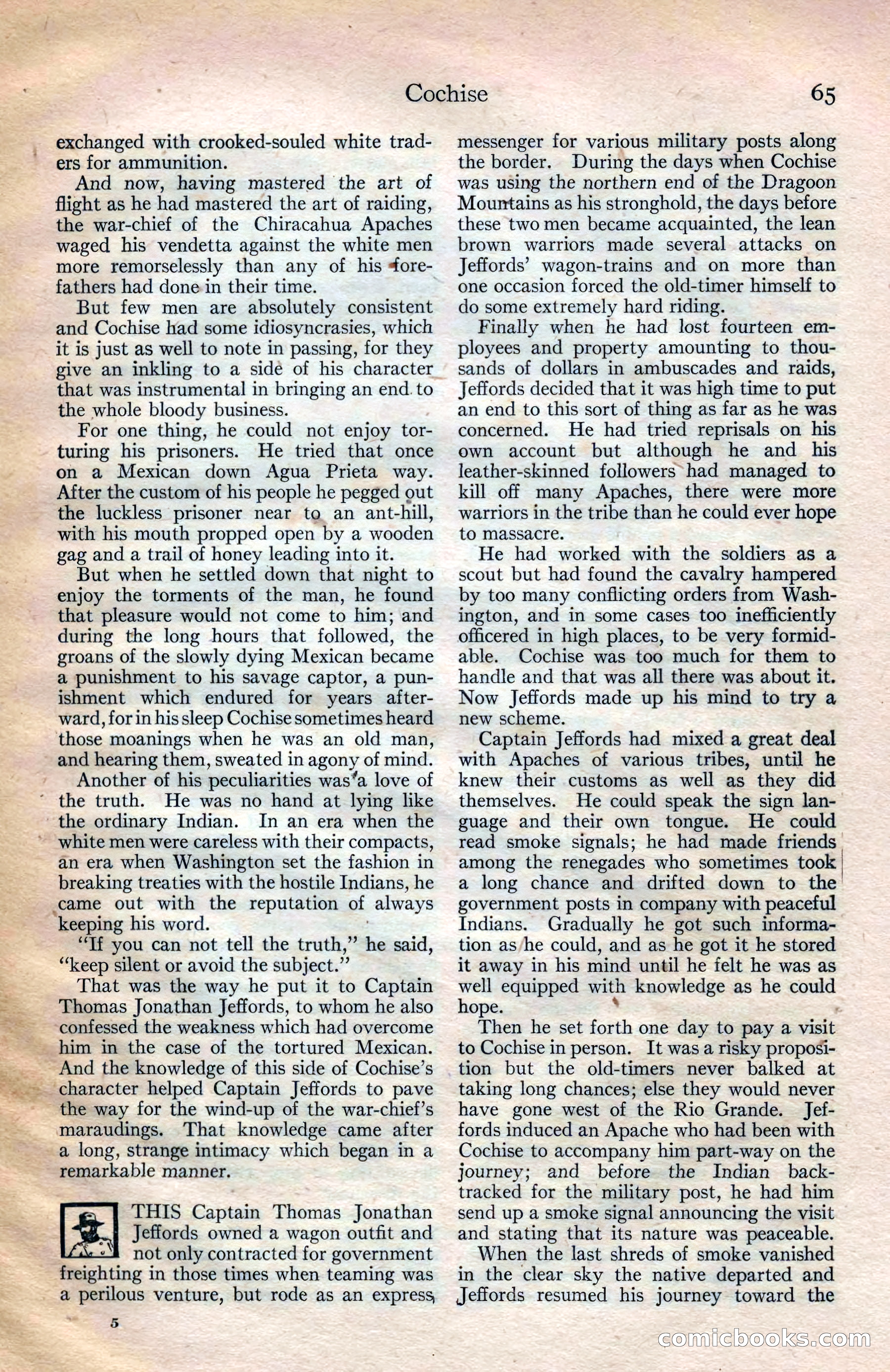
A restored page from Pulp Fiction, 1921. Page through the whole issue in the reader above.
📄 Transcribed text from this page (OCR, searchable)
Machine-transcribed from the original scan — historical spelling and the odd misread are preserved.
Cochise exchanged with crooked-souled white trad- ers for ammunition. And now, having mastered the art of flight as he had mastered the art of raiding, the war-chief of the Chiracahua Apaches waged his vendetta against the white men more remorselessly than any of his -fore- fathers had done in their time. But few men are absolutely consistent and Cochise had some idiosyncrasies, which it is just as well to note in passing, for they give an inkling to a side of his character that was instrumental in bringing an end. to the whole bloody business. For one thing, he could not enjoy tor- turing his prisoners. He tried that once on a Mexican down Agua Prieta way. After the custom of his people he pegged out the luckless prisoner near to an ant-hill, with his mouth propped open by a wooden gag and a trail of honey leading into it. But when he settled down that night to enjoy the torments of the man, he found that pleasure would not come to him; and during the long hours that followed, the groans of the slowly dying Mexican became a punishment to his savage captor, a pun- ishment which endured for years after- ward, for in his sleep Cochise sometimes heard those moanings when he was an old man, and hearing them, sweated in agony of mind. Another of his peculiarities was‘a love of * the truth. He was no hand at lying like the ordinary Indian. ~ white men were careless with their compacts, In an era when the an era when Washington set the fashion in breaking treaties with the hostile Indians, he came out with the reputation of always ‘keeping his word. “Tf you can not tell the truth,” = said, “keep silent or avoid the subject.” That was the way he put it to Captain Thomas Jonathan Jeffords, to whom he also ‘confessed the weakness which had overcome _ him in the case of the tortured Mexican. _ And the knowledge of this side of Cochise’s character helped Captain Jeffords to pave - the way for the wind-up of the war-chief’s maraudings. That knowledge came after a long, strange intimacy which began in a THIS Captain Thomas Jonathan remarkable manner. =) ej) Jeffords owned a wagon outfit and AX. -I not only contracted for government freighting in those times when teaming was a perilous venture, but rode as an express, 5 65 messenger for various military posts along the border. During the days when Cochise was using the northern end of the Dragoon Mountains as his stronghold, the days before these two men became acquainted, the lean brown warriors made several attacks on Jeffords’ wagon-trains and on more than one occasion forced the old-timer himself to do some extremely hard riding. Finally when he had lost fourteen em- ployees and property amounting to thou- sands of dollars in ambuscades and raids, Jeffords decided that it was high time to put an end to this sort of thing as far as he was concerned. He had tried reprisals on his own account but although he and his leather-skinned followers had managed to kill off many Apaches, there were more warriors in the tribe than he could ever hope to massacre. He had worked with the soldiers as a scout but had found the cavalry hampered by too many conflicting orders from Wash- ington, and in some cases too inefficiently officered in high places, to be very formid- able. Cochise was too much for them to handle and that was all there was about it. Now Jeffords made up his mind to try a new scheme. Captain Jeffords had mixed a great deal with Apaches of various tribes, until he knew their customs as well as they did themselves. He could speak the sign lan- guage and their own tongue. He could read smoke signals; he had made friends among the renegades who sometimes took a long chance and drifted down to the government posts in company with peaceful Indians. Gradually he got such informa- tion as/he could, and as he got it he stored it away in his mind until he felt he was as well equipped with knowledge as he could hope. to Cochise in person. It was a risky proposi- tion but the old-timers never balked at taking long chances; else they would never have gone west of the Rio Grande. Jef- fords induced an Apache who had been with Cochise to accompany him part-way on the journey; and before the Indian back- tracked for the military post, he had him send up a smoke signal announcing the visit and stating that its nature was peaceable. When the last shreds of smoke vanished in the clear sky the native departed and Jeffords resumed his journey toward the EOMIGdoOO <Si Then he set an one day to pay a visit (S@)