
Pulp Fiction, 1921 · page 7 of 194
Adventure Magazine Cover — page 7: what you’re looking at
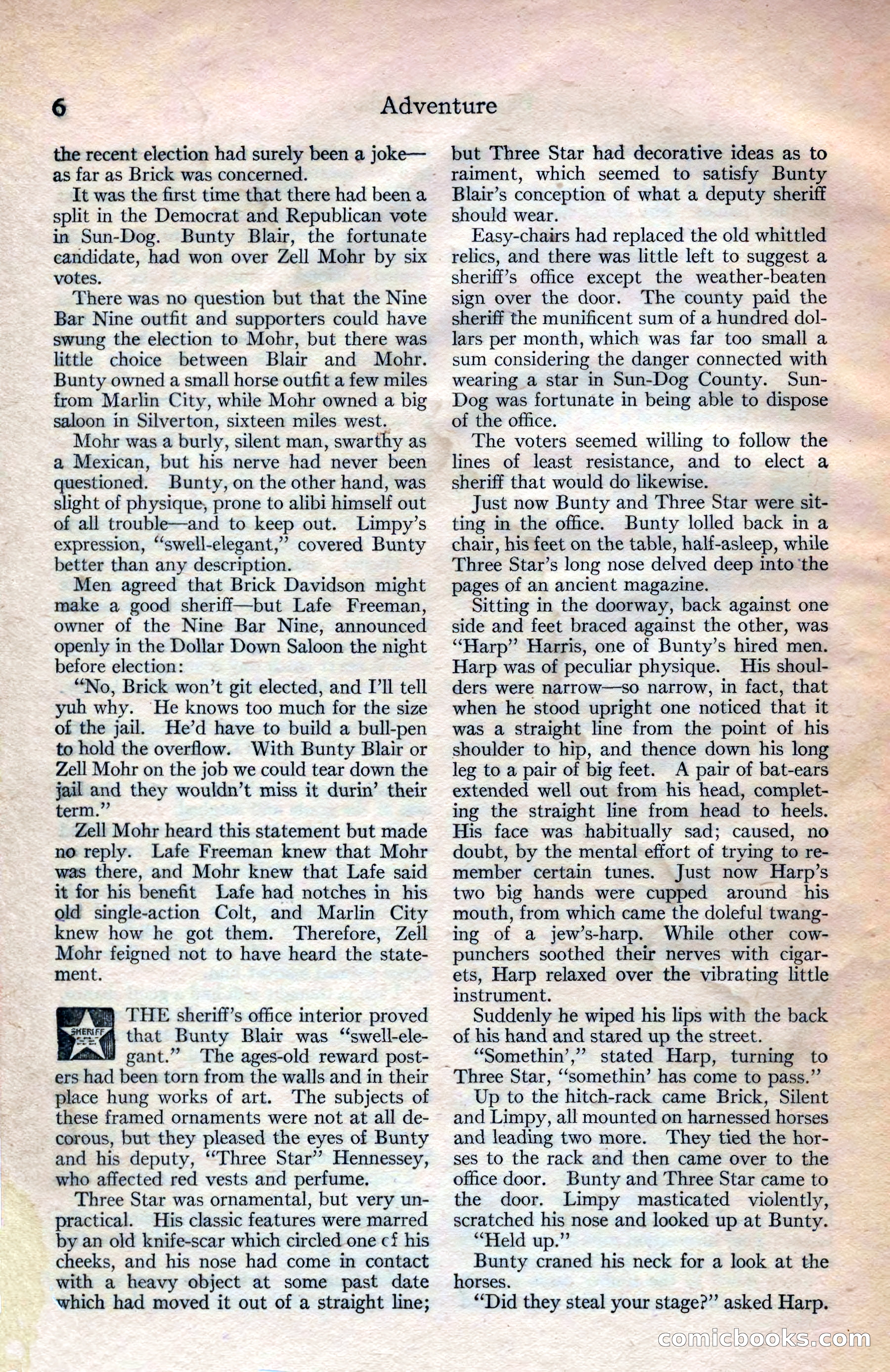
A restored page from Pulp Fiction, 1921. Page through the whole issue in the reader above.
📄 Transcribed text from this page (OCR, searchable)
Machine-transcribed from the original scan — historical spelling and the odd misread are preserved.
6 Adventure the recent election had surely been a joke— as far as Brick was concerned. It was the first time that there had been a split in the Democrat and Republican vote in Sun-Dog. Bunty Blair, the fortunate candidate, had won over Zell Mohr by six votes. There was no question but that the Nine Bar Nine outfit and supporters could have swung the election to Mohr, but there was little choice between Blair and Mohr. Bunty owned a small horse outfit a few miles from Marlin City, while Mohr owned a big saloon in Silverton, sixteen miles west. Mohr was a burly, silent man, swarthy as a Mexican, but his nerve had never been questioned. Bunty, on the other hand, was slight of physique, prone to alibi himself out of all trouble—and to keep out. Limpy’s expression, “‘swell-elegant,” covered Bunty better than any description. Men agreed that Brick Davidson might make a good sheriff—but Lafe Freeman, owner of the Nine Bar Nine, announced openly in the Dollar Down Saloon the night before election: “No, Brick won’t git elected, and I’ll tell yuh why. He knows too much for the size of the jail. He’d have to build a bull-pen to hold the overflow. With Bunty Blair or Zell Mohr on the job we could tear down the jail and they wouldn’t miss it durin’ their term.” Zell Mohr heard this statement but made no reply. Lafe Freeman knew that Mohr was there, and Mohr knew that Lafe said it for his benefit Lafe had notches in his old single-action Colt, and Marlin City knew how he got them. Therefore, Zell Mohr feigned not to have heard the state- ment. mm) THE sheriff’s office interior proved that Bunty Blair was “‘swell-ele- mW gant.” The ages-old reward post- ers had been torn from the walls and in their place hung works of art. The subjects of these framed ornaments were not at all de- corous, but they pleased the eyes of Bunty and his deputy, “Three Star’ Hennessey, who affected red vests and perfume. Three Star was ornamental, but very un- practical. His classic features were marred by an old knife-scar which circled one ci his cheeks, and his nose had come in contact with a heavy object at some past date which had moved it out of a straight line; but Three Star had decorative ideas as to - raiment, which seemed to satisfy Bunty Blair’s conception of what a deputy sheriff should wear. Easy-chairs had replaced the old whittled relics, and there was little left to suggest a sheriff’s office except the weather-beaten sign over the door. The county paid the sheriff the munificent sum of a hundred dol- lars per month, which was far too small a sum considering the danger connected with wearing a star in Sun-Dog County. Sun- Dog was fortunate in being able to dispose of the office. The voters seemed willing to follow the lines of least resistance, and to elect a sheriff that would do likewise. Just now Bunty and Three Star were sit- ting in the office. Bunty lolled back in a chair, his feet on the table, half-asleep, while Three Star’s long nose delved deep into ‘the pages of an ancient magazine. Sitting in the doorway, back against one side and feet braced against the other, was “Harp” Harris, one of Bunty’s hired men. Harp was of peculiar physique. His shoul- ders were narrow—so narrow, in fact, that when he stood upright one noticed that it was a straight line from the point of his shoulder to hip, and thence down his long leg to a pair of big feet. A pair of bat-ears extended well out from his head, complet- ing the straight line from head to heels. His face was habitually sad; caused, no doubt, by the mental effort of trying to re- member certain tunes. Just now Harp’s two big hands were cupped around his mouth, from which came the doleful twang- ing of a jew’s-harp. While other cow- punchers soothed their nerves with cigar- ets, Harp relaxed over the vibrating little instrument. Suddenly he wiped his lips with the back of his hand and stared up the street. “Somethin’,” stated Harp, turning to Three Star, ‘somethin’ has come to pass.” Up to the hitch-rack came Brick, Silent and Limpy, all mounted on harnessed horses and leading two more. They tied the hor- ses to the rack and then came over to the office door. Bunty and Three Star came to the door. Limpy masticated violently, scratched his nose and looked up at Bunty. “Held up.” Bunty craned his neck for a look at the horses. “Did they steal your stage?” asked Harp. GOMichbooksaco