
Pulp Fiction, 1921 · page 73 of 194
Adventure Magazine Cover — page 73: what you’re looking at
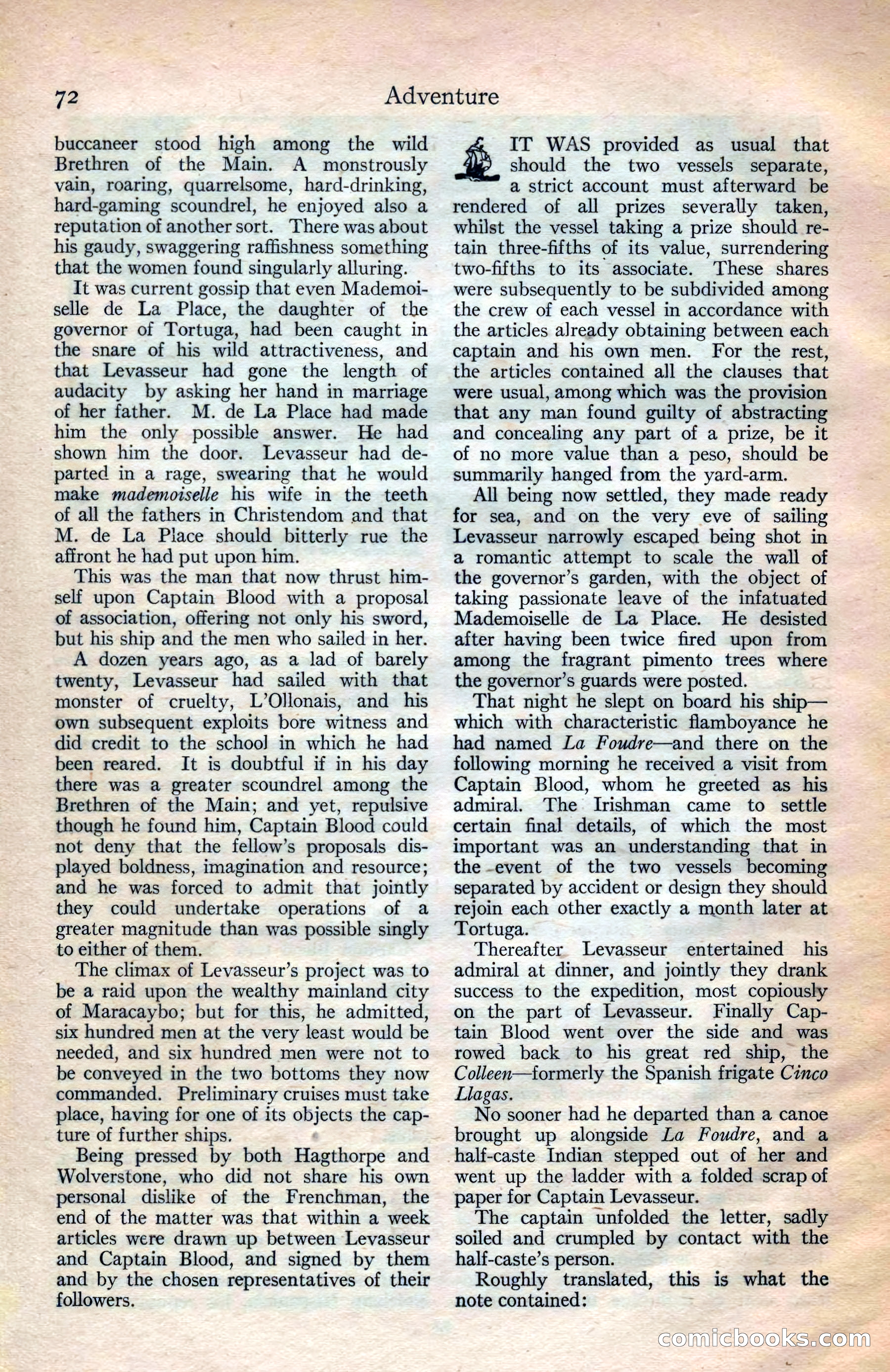
A restored page from Pulp Fiction, 1921. Page through the whole issue in the reader above.
📄 Transcribed text from this page (OCR, searchable)
Machine-transcribed from the original scan — historical spelling and the odd misread are preserved.
72 Adventure buccaneer stood high among the wild Brethren of the Main. A monstrously vain, roaring, quarrelsome, hard-drinking, hard-gaming scoundrel, he enjoyed also a reputation of another sort. There was about his gaudy, swaggering raffishness something that the women found singularly alluring. It was current gossip that even Mademoi- selle de La Place, the daughter of the governor of Tortuga, had been caught in the snare of his wild attractiveness, and that Levasseur had gone the length of audacity by asking her hand in marriage of her father. M. de La Place had made him the only possible answer. He had shown him the door. Levasseur had de- parted in a rage, swearing that he would make mademoiselle his wife in the teeth of all the fathers in Christendom and that M. de La Place should bitterly rue the affront he had put upon him. This was the man that now thrust him- self upon Captain Blood with a proposal of association, offering not only his sword, but his ship and the men who sailed in her. A dozen years ago, as a lad of barely twenty, Levasseur had sailed with that monster of cruelty, L’Ollonais, and his own subsequent exploits bore witness and did credit to the schoo] in which he had been reared. It is doubtful if in his day there was a greater scoundrel among the Brethren of the Main; and yet, repulsive though he found him, Captain Blood could not deny that the fellow’s proposals dis- played boldness, imagination and resource; and he was forced to admit that jointly they could undertake operations of a greater magnitude than was possible singly to either of them. The climax of Levasseur’s project was to be a raid upon the wealthy mainland city of Maracaybo; but for this, he admitted, six hundred men at the very least would be needed, and six hundred men were not to be conveyed in the two bottoms they now commanded. Preliminary cruises must take place, having for one of its objects the cap- ture of further ships. Being pressed by both Hagthorpe and Wolverstone, who did not share his own personal dislike of the Frenchman, the end of the matter was that within a week articles were drawn up between Levasseur and Captain Blood, and signed by them and by the chosen representatives of their followers. should the two vessels separate, a strict account must afterward be rendered of all prizes severally taken, whilst the vessel taking a prize should re- tain three-fifths of its value, surrendering two-fifths to its associate. These shares were subsequently to be subdivided among the crew of each vessel in accordance with the articles already obtaining between each captain and his own men. For the rest, the articles contained all the clauses that were usual, among which was the provision that any man found guilty of abstracting and concealing any part of a prize, be it of no more value than a peso, should be summarily hanged from the yard-arm. All being now settled, they made ready for sea, and on the very eve of sailing Levasseur narrowly escaped being shot in a romantic attempt to scale the wall of the governor’s garden, with the object of taking passionate leave of the infatuated Mademoiselle de La Place. He desisted after having been twice fired upon from among the fragrant pimento trees where the governor’s guards were posted. That night he slept on board his ship— which with characteristic flamboyance he had named La Foudre—and there on the following morning he received a visit from Captain Blood, whom he greeted as his admiral. The Irishman came to settle certain final details, of which the most important was an understanding that in the -event of the two vessels becoming separated by accident or design they should rejoin each other exactly a month later at Tortuga. Thereafter. Levasseur entertained his admiral at dinner, and jointly they drank success to the expedition, most copiously on the part of Levasseur. Finally Cap- tain Blood went over the side and was rowed back to his great red ship, the Colleen—formerly the Spanish frigate Cinco Llagas. No sooner had he departed than a canoe brought up alongside La Foudre, and a half-caste Indian stepped out of her and went up the ladder with a folded scrap of paper for Captain Levasseur. The captain unfolded the letter, sadly soiled and crumpled by contact with the half-caste’s person. Roughly translated, this is what the note contained: i IT WAS provided as usual that Eomicbooks.co ee