
Pulp Fiction, 1921 · page 75 of 194
Adventure Magazine Cover — page 75: what you’re looking at
A restored page from Pulp Fiction, 1921. Page through the whole issue in the reader above.
📄 Transcribed text from this page (OCR, searchable)
Machine-transcribed from the original scan — historical spelling and the odd misread are preserved.
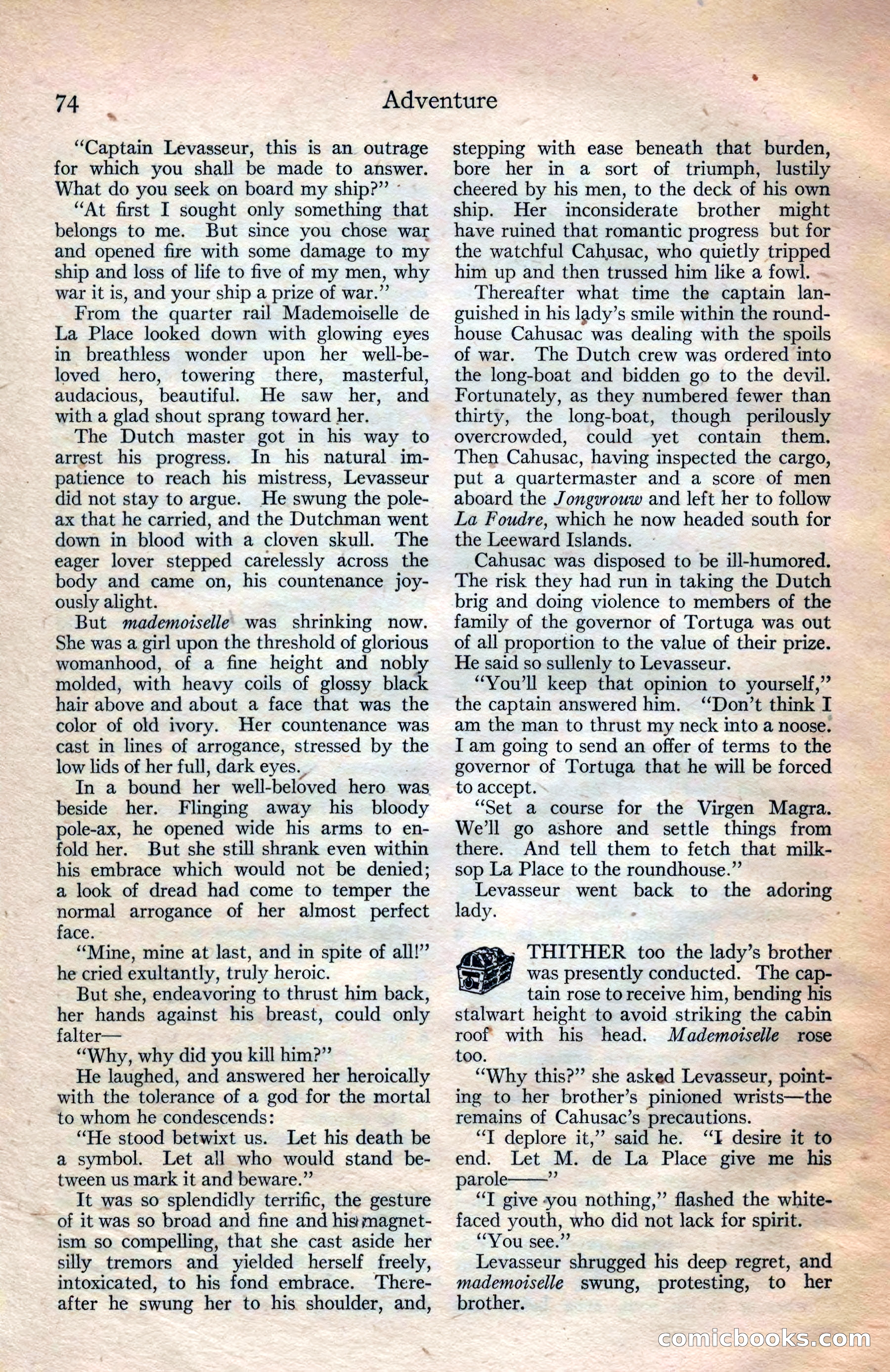
74 - Adventure * “Captain Levasseur, this is an outrage for which you shall be made to answer. What do you seek on board my ship?” ° “At first I sought only something that belongs to me. But since you chose war and opened fire with some damage to my ship and loss of life to five of my men, why war it is, and your ship a prize of war.” From the quarter rail Mademoiselle de La Place looked down with glowing eyes in breathless wonder upon her well-be- loved hero, towering there, masterful, audacious, beautiful. He saw her, and with a glad shout sprang toward her. The Dutch master got in his way to arrest his progress. In his natural im- patience to reach his mistress, Levasseur did not stay to argue. He swung the pole- ax that he carried, and the Dutchman went down in blood with a cloven skull. The eager lover stepped carelessly across the body and came on, his countenance joy- ously alight. But mademoiselle' was shrinking now. She was a girl upon the threshold of glorious womanhood, of a fine height and nobly molded, with heavy coils of glossy black hair above and about a face that was the color of old ivory. Her countenance was cast in lines of arrogance, stressed oF: the low lids of her full, dark eyes. In a bound her well-beloved hero was beside her. Flinging away his bloody pole-ax, he opened wide his arms to en- fold her. But she still shrank even within his embrace which would not be denied; a look of dread had come to temper the normal arrogance of her almost perfect face. “Mine, mine at last, and in spite of all!” he cried exultantly, truly heroic. But she, endeavoring to thrust him back, her hands against his breast, could only falter— “Why, why did you kill him?” He laughed, and answered her heroically with the tolerance of a god for the mortal to whom he condescends: “He stood betwixt us. Let his death be a symbol. Let all who would stand be- tween us mark it and beware.” It was so splendidly terrific, the gesture of it was so broad and fine and hisimagnet- ism so compelling, that she cast aside her silly tremors and yielded herself freely, intoxicated, to his fond embrace. There- after he swung her to his shoulder, and, stepping with ease beneath that burden, bore her in a sort of triumph, lustily cheered by his men, to the deck of his own ship. Her inconsiderate brother might have ruined that romantic progress but for the watchful Cahusac, who quietly tripped him up and then trussed him like a fowl. Thereafter what time the captain lan- guished in his lady’s smile within the round- house Cahusac was dealing with the spoils of war. The Dutch crew was ordered into the long-boat and bidden go to the devil. Fortunately, as they numbered fewer than thirty, the long-boat, though perilously overcrowded, could yet contain them. Then Cahusac, having inspected the cargo, put a quartermaster and a score of men aboard the Jongvrouw and left her to follow La Foudre, which he now headed south for the Leeward Islands. Cahusac was disposed to be ill-humored. The risk they had run in taking the Dutch brig and doing violence to members of the family of the governor of Tortuga was out of all proportion to the value of their prize. He said so sullenly to Levasseur. “You'll keep that opinion to yourself,” the captain answered him. ‘Don’t think I am the man to thrust my neck into a noose. I am going to send an offer of terms to the governor of Tortuga that he will be forced to accept. “Set a course for the Virgen Magra. We'll go ashore and settle things from there. And tell them to fetch that milk- sop La Place to the roundhouse.”’ Levasseur went back to the adoring lady. , THITHER too the lady’s brother. was presently conducted. The cap- tain rose to receive him, bending his stalwart height to avoid striking the cabin roof with his head. Mademoiselle rose too. “Why this?” she asked Levasseur, point- ing to her brother’s pinioned wrists—the remains of Cahusac’s precautions. “T deplore it,” said he. ‘TI desire it to end. Let M. de La Place give me his parole zs “T give you nothing,”’ flashed the white- faced youth, who did not lack for spirit. “You see.” Levasseur shrugged his deep regret, and mademoiselle swung, protesting, to her brother. (CCOPMIE OOlKSarere)