
Pulp Fiction, 1921 · page 88 of 194
Adventure Magazine Cover — page 88: what you’re looking at
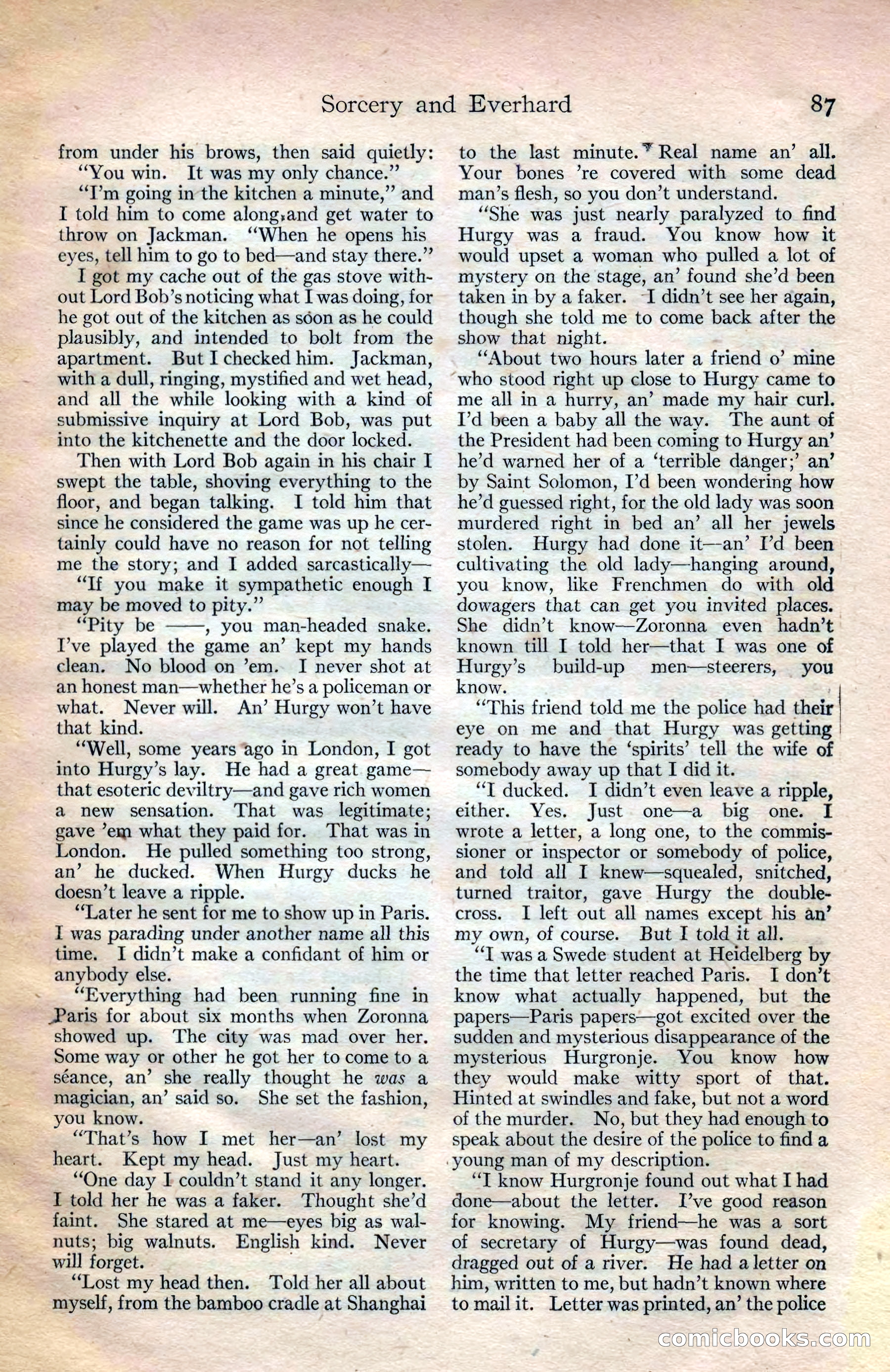
A restored page from Pulp Fiction, 1921. Page through the whole issue in the reader above.
📄 Transcribed text from this page (OCR, searchable)
Machine-transcribed from the original scan — historical spelling and the odd misread are preserved.
. Sorcery and Everhard from under his brows, then said quietly: “You win. It was my only chance.” “T’m going inthe kitchen a minute,” and I told him to come along;and get water to throw on Jackman. ‘‘When he opens his eyes, tell him to go to bed—and stay there.” I got my cache out of the gas stove with- out Lord Bob’s noticing what I was doing, for he got out of the kitchen as séon as he could plausibly, and intended to bolt from the apartment. But I checked him. Jackman, with a dull, ringing, mystified and wet head, and all the while looking with a kind of submissive inquiry at Lord Bob, was put into the kitchenette and the door locked. Then with Lord Bob again in his chair I swept the table, shoving everything to the floor, and began talking. I told him that since he considered the game was up he cer- tainly could have no reason for not telling me the story; and I added sarcastically— “If you make it sympathetic enough I may be moved to pity.” “Pity be ——, you man-headed snake. I’ve played the game an’ kept my hands clean. No blood on ’em. I never shot at an honest man—whether he’s a policeman or what. Never will. An’ Hurgy won’t have that kind. “Well, some years ‘ago in London, I got into Hurgy’s lay. He had a great game— that esoteric deviltry—and gave rich women a new sensation. That was _ legitimate; gave ’em what they paid for. That was in London. He pulled something too strong, an’ he ducked. When Hurgy ducks he doesn’t leave a ripple. “Later he sent for me to show up in Paris. I was parading under another name all this time. I didn’t make a confidant of him or anybody else. “Everything had been running fine in Paris for about six months when Zoronna showed up. The city was mad over her. Some way or other he got her to come to a séance, an’ she really thought he was a magician, an’ said so. She set the fashion, you know. “That’s how I met her—an’ lost my heart. Kept my head. Just my heart. “One day I couldn’t stand it any longer. I told her he was a faker. Thought she’d faint. She stared at me—eyes big as wal- nuts; big walnuts. English kind. Never will forget. “Lost my head then. Told her all about myself, from the bamboo cradle at Shanghai 87 to the last minute.* Real name an’ all. Your bones ’re covered with some dead man’s flesh, so you don’t understand. “She was just nearly paralyzed to find Hurgy was a fraud. You know how it would upset a woman who pulled a lot of mystery on the stage, an’ found she’d been taken in by a faker. -I didn’t see her again, though she told me to come back after the show that night. ‘‘About two hours later a friend o’ mine ‘who stood right up close to Hurgy came to me all in a hurry, an’ made my hair curl. I’d been a baby all the way. The aunt of the President had been coming to Hurgy an’ he’d warned her of a ‘terrible danger;’ an’ by Saint Solomon, I’d been wondering how he’d guessed right, for the old lady was soon murdered right in bed an’ all her jewels stolen. Hurgy had done it—an’ I’d been cultivating the old lady—hanging around, you know, like Frenchmen do with old dowagers that can get you invited places. She didn’t know—Zoronna even hadn’t known till I told her—that I was one of Hurgy’s build-up men—steerers, you know. “This friend told me the police had their eye on me and that Hurgy was getting ready to have the ‘spirits’ tell the wife of somebody away up that I did it. “T ducked. I didn’t even leave a ripple, either. Yes. Just one—a big one. I wrote a letter, a long one, to the commis- sioner or inspector or somebody of police, and told all I knew—squealed, snitched, turned traitor, gave Hurgy the double- cross. I left out all names except his an’ my own, of course. But I told it all. “T was a Swede student at Heidelberg by the time that letter reached Paris. I don’t know what actually happened, but the papers—Paris papers—got excited over the sudden and mysterious disappearance of the mysterious Hurgronje. You know how they would make witty sport of that. Hinted at swindles and fake, but not a word of the murder. No, but they had enough to speak about the desire of the police to find a young man of my description. “I know Hurgronje found out what I had done—about the letter. I’ve good reason for knowing. My friend—he was a sort of secretary of Hurgy—was found dead, dragged out of a river. He had a letter on him, written to me, but hadn’t known where to mailit. Letter was printed, an’ the police COpnicloookSs (S@)