
Pulp Fiction, 1922 · page 106 of 196
Adventure, February 20, 1922 — page 106: what you’re looking at
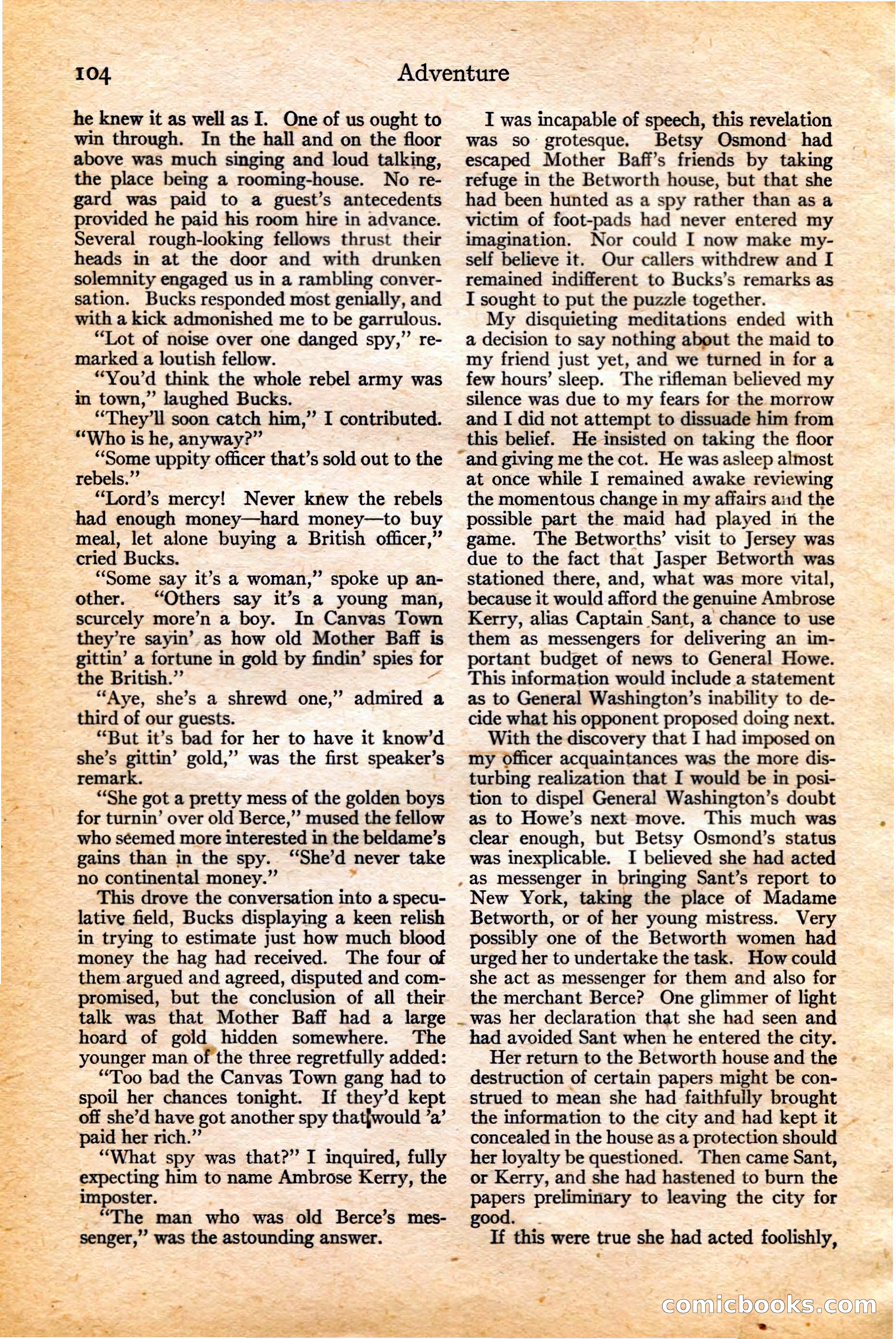
A restored page from Pulp Fiction, 1922. Page through the whole issue in the reader above.
📄 Transcribed text from this page (OCR, searchable)
Machine-transcribed from the original scan — historical spelling and the odd misread are preserved.
104 he knew it as well as I. One of us ought to win through. In the hall and on the floor above was much singing and loud talking, the place being a rooming-house. No re- gard was paid to a guest’s antecedents _ provided he paid his room hire in advance. Several rough-looking fellows thrust their heads in at the door and with drunken solemnity engaged us in a rambling conver- sation. Bucks responded most genially, and with a kick admonished me to be garrulous. “Lot of noise over one danged spy,” re- marked a loutish fellow. “You’d think the whole rebel army was _ in town,” laughed Bucks. “They'll soon catch him,” I contributed. “Who is he, anyway?” “Some uppity officer that’s sold out to the rebels. “Lord’s mercy! Never knew the rebels | had enough money—hard money—to buy meal, let alone buying a British officer,” cried Bucks. “Some say it’s a woman,” spoke up an- other. “Others say it’s a young man, scurcely more’n a boy. In Canvas Town they’re sayin’. as how old Mother Baff is gittin’ a fortune in gold by findin’ spies for the British.” “Aye, she’s a shrewd one,” admired a _ third of our guests. “But it’s bad for her to have it know’d she’s gittin’ gold,” was the first speaker’s remark. “She got a pretty mess of the golden boys for turnin’ over old Berce,” mused the fellow who séemed more interested in the beldame’s gains than in the Spy: “She’d never take no continental money.” This drove the conversation into a specu- lative field, Bucks displaying a keen relish in trying to estimate just how much blood money the hag had received. The four of them argued and agreed, disputed and com- promised, but the conclusion of all their talk was that Mother Baff had a large hoard of gold hidden somewhere. The younger man of the three regretfully added: “Too bad the Canvas Town gang had to spoil her chances tonight. If they’d kept off she’d have got another spy that{would ’a’ paid her rich.”’ “What spy was that?” I inquired, fully expecting him to name Ambrose Kerry, the imposter. “The man who was old Berce’s mes- senger,”’ was the astounding answer. Adventure I was incapable of speech, this revelation was so grotesque. Betsy Osmond had escaped Mother Baff’s friends by taking refuge in the Betworth house, but that she had been hunted as a spy rather than as a victim of foot-pads had never entered my imagination. Nor could I now make my- self believe it. Our callers withdrew and I remained indifferent to Bucks’s remarks as I sought to put the puzzle together. My disquieting meditations ended with ~ a decision to say nothing about the maid to my friend just yet, and we turned in for a few hours’ sleep. The rifleman believed my silence was due to my fears for the morrow and I did not attempt to dissuade him from this belief. He insisted on taking the floor “and giving me the cot. He was asleep almost at once while I remained awake reviewing the momentous change in my affairs and the possible part the maid had played in the game. The Betworths’ visit to Jersey was due to the fact that Jasper Betworth was stationed there, and, what was more vital, because it would afford the genuine Ambrose Kerry, alias Captain Sant, a chance to use them as messengers for delivering an im- portant budget of news to General Howe. This information would include a statement as to General Washington’s inability to de- cide what his opponent proposed doing next. With the discovery that I had imposed on turbing realization that I would be in posi- tion to dispel General Washington’s doubt as to Howe’s next move. This much was clear enough, but Betsy Osmond’s status was inexplicable. I believed she had acted , aS messenger in bringing Sant’s report to New York, taking the place of Madame Betworth, or of her young mistress. Very possibly one of the Betworth women had urged her to undertake the task. How could she act as messenger for them and also for the merchant Berce? One glimmer of light _was her declaration that she had seen and had avoided Sant when he entered the city. Her return to the Betworth house and the - destruction of certain papers might be con- strued to mean she had faithfully brought the information to the city and had kept it | concealed in the house as a protection should her loyalty be questioned. Then came Sant, or Kerry, and she had hastened to burn the papers preliminary to leaving the city for ood good. . If this were true she had acted foolishly, () : Eomicbooks (CO) 4 ec. se — a ~~" ae oe : . = ae —