
Pulp Fiction, 1922 · page 123 of 196
Adventure, February 20, 1922 — page 123: what you’re looking at
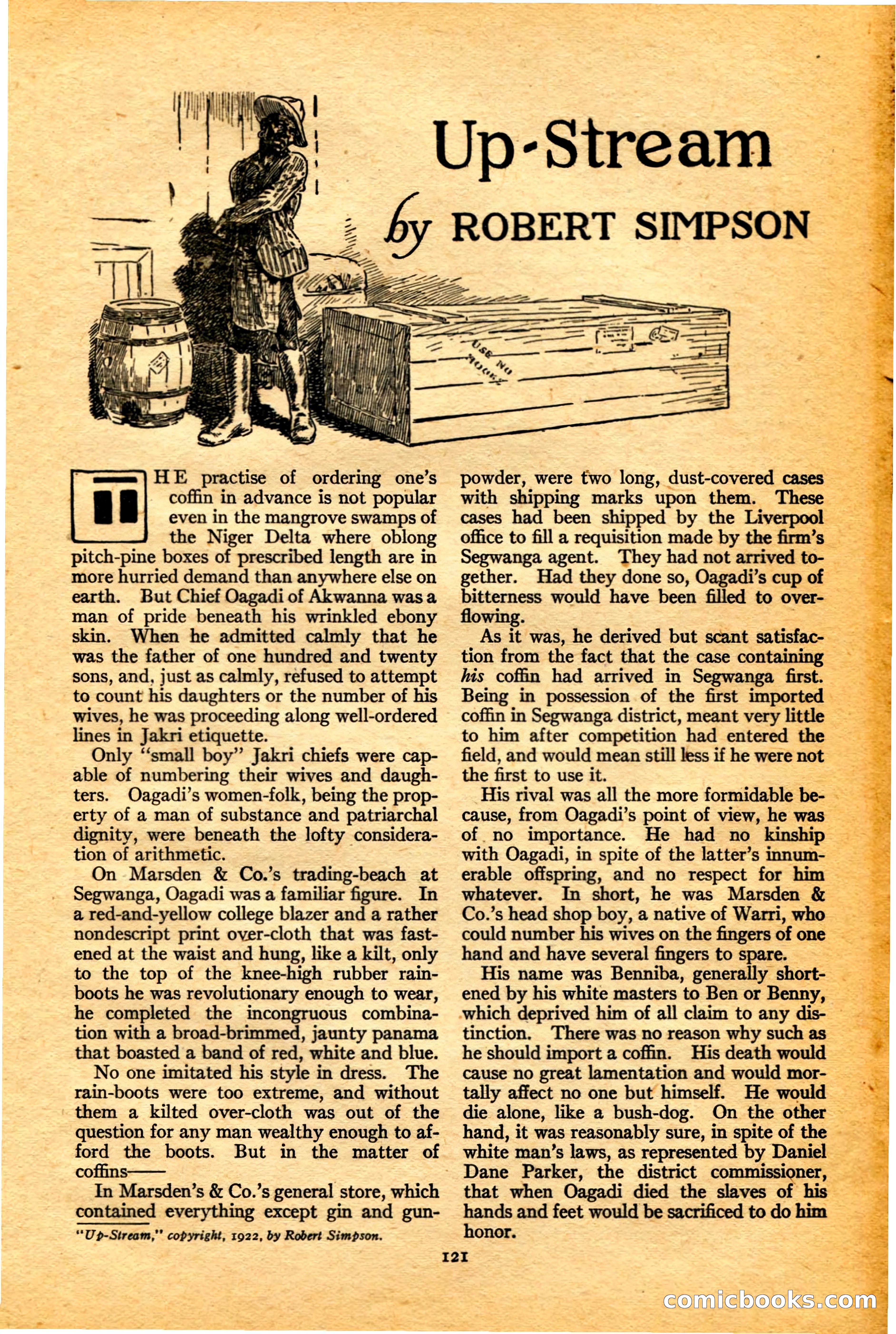
A restored page from Pulp Fiction, 1922. Page through the whole issue in the reader above.
📄 Transcribed text from this page (OCR, searchable)
Machine-transcribed from the original scan — historical spelling and the odd misread are preserved.
HE practise of ordering one’s coffin in advance is not popular even in the mangrove swamps of the Niger Delta where oblong pitch-pine boxes of prescribed length are in more hurried demand than anywhere else on earth. But Chief Oagadi of Akwanna wasa man of pride beneath his wrinkled ebony skin. When he admitted calmly that he was the father of one hundred and twenty sons, and, just as calmly, refused to attempt to count his daughters or the number of his wives, he was proceeding along well-ordered lines in Jakri etiquette. Only “small boy” Jakri chiefs were cap- able of numbering their wives and daugh- ters. Oagadi’s women-folk, being the prop- erty of a man of substance and patriarchal dignity, were beneath the lofty considera- tion of arithmetic. On Marsden & Co.’s trading-beach at Segwanga, Oagadi was a familiar figure. In a red-and-yellow college blazer and a rather nondescript print over-cloth that was fast- ened at the waist and hung, like a kilt, only to the top of the knee-high rubber rain- boots he was revolutionary enough to wear, he completed the incongruous combina- tion with a broad-brimmed, jaunty panama that boasted a band of red, white and blue. No one imitated his style in dress. The rain-boots were too extreme, and without them a kilted over-cloth was out of the question for any man wealthy enough to af- ford the boots. But in the matter of coffins—— j _ Up-Stream = by ROBERT SIMPSON | powder, were two long, dust-covered cases _ = with shipping marks upon them. These cases had been shipped by the pie os office to fill a requisition made by the firm’s Segwanga agent. They had not arrived to- gether. Had they done so, Oagadi’s cup of bitterness would have been filled to over- 3 flowing. As it was, he derived but scant satisfac-— tion from the fact that the case containing — his coffin had arrived in Segwanga first. Being in possession of the first imported coffin in Segwanga district, meant very little _ = to him after competition had entered the _ field, and would mean still less if he were not the first to use it. His rival was all the more formidable be- | cause, from Oagadi’s point of view, he was He had no kinship = of no importance. with Oagadi, in spite of the latter’s innum- erable offspring, and no respect for him — whatever. In short, he was Marsden & Co.’s head shop boy, a native of Warri, who could number his wives on the fingers of one = hand and have several fingers to spare. His name was Benniba, generally short- = ened by his white masters to Ben or Benny, which deprived him of all claim to any dis- — tinction. There was no reason why such as he should import a coffin. His death would A . cause no great lamentation and would mor- _ . tally affect no one but himself. He would die alone, like a bush-dog. On the other hand, it was reasonably sure, in spite of the | white man’s laws, as represented by Daniel — _ Dane Parker, the district commissioner, — In Marsden’s & Co.’s general store, which that when died the slaves of his contained everything except gin and gun- hands and feet would be sacrificed to do him ~ “Up-Stream,"" copyright, 1922, by Robert Simpson. honor. I2I - —comicbooks-com