
Pulp Fiction, 1922 · page 127 of 196
Adventure, February 20, 1922 — page 127: what you’re looking at
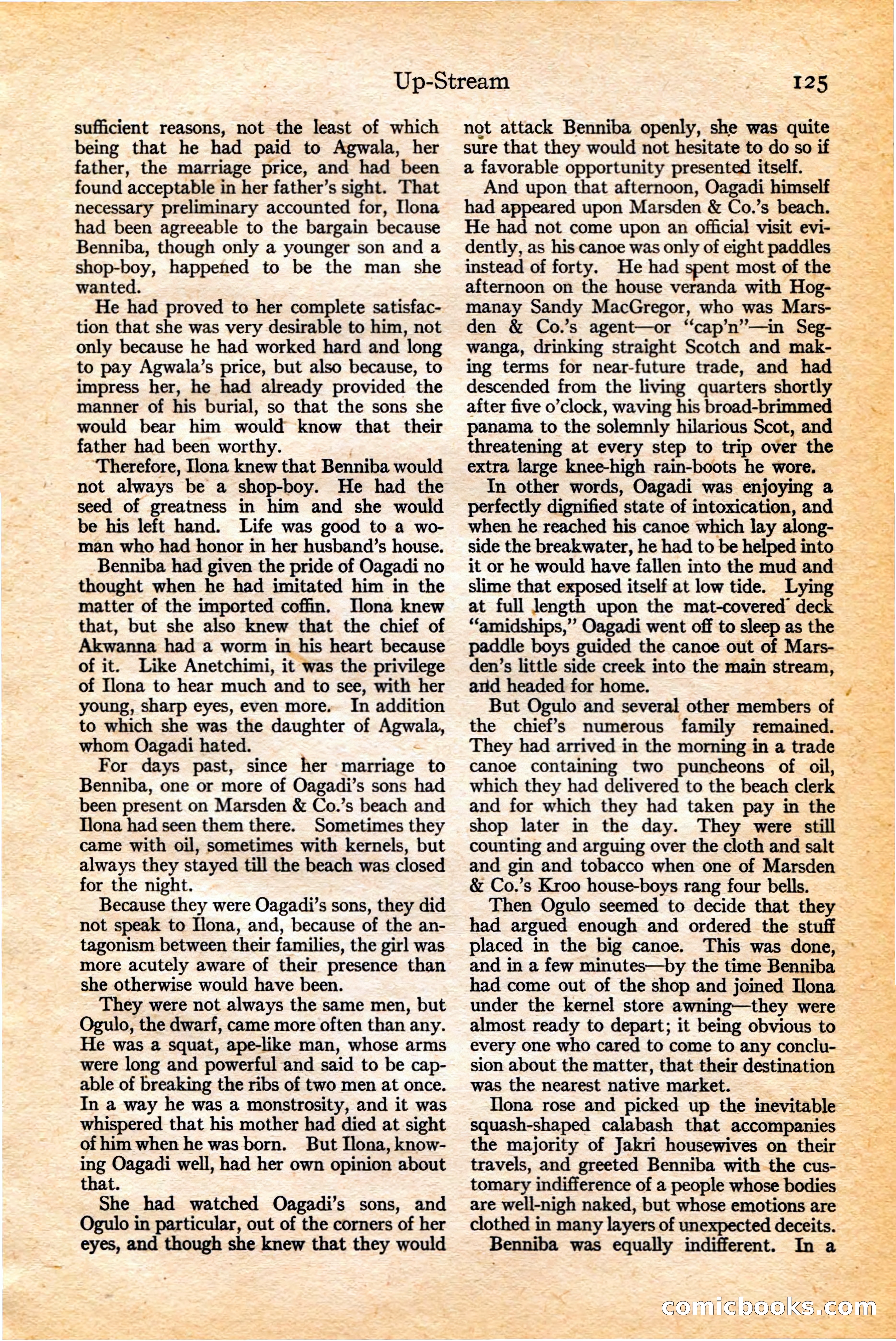
A restored page from Pulp Fiction, 1922. Page through the whole issue in the reader above.
📄 Transcribed text from this page (OCR, searchable)
Machine-transcribed from the original scan — historical spelling and the odd misread are preserved.
Up-Stream sufficient reasons, not the least of which being that he had paid to Agwala, her father, the marriage price, and had been found acceptable in her father’s sight. That necessary preliminary accounted for, Ilona had been agreeable to the bargain because Benniba, though only a younger son and a shop-boy, happened to be the man she wanted. He had proved to her complete satisfac- tion that she was very desirable to him, not only because he had worked hard and long to pay Agwala’s price, but also because, to impress her, he had already provided the manner of his burial, so that the sons she would bear him would know that their father had been worthy. ‘Therefore, Ilona knew that Benniba would not always be a shop-boy. He had the seed of greatness in him and she would be his left hand. Life was good to a wo- man who had honor in her husband’s house. -Benniba had given the pride of Oagadi no thought when he had imitated him in the matter of the imported coffin. Ilona knew that, but she also knew that the chief of Akwanna had a worm in his heart because of it. Like Anetchimi, it was the privilege of Ilona to hear much ‘and to see, with her young, sharp eyes, even more. In addition to which she was the daughter of Sewall, whom Oagadi hated. For days past, since her marriage to Benniba, one or more of Oagadi’s sons had been present on Marsden & Co.’s beach and Ilona had seen them there. Sometimes they came with oil, sometimes with kernels, but always they stayed till the beach was closed for the night. Because they were Oagadi’s sons, they did not speak to Ilona, and, because of the an- tagonism between their families, the girl was more acutely aware of their presence than she otherwise would have been. They were not always the same men, but Ogulo, the dwarf, came more often than any. He was a squat, ape-like man, whose arms were long and powerful and said to be cap- able of breaking the ribs of two men at once. In a way he was a monstrosity, and it was whispered that his mother had died at sight of him when he was born. But Ilona, know- ing Oagadi well, had her own opinion about that. She had watched Oagadi’s sons, and Ogulo in particular, out of the corners of her eyes, and though she knew that they would 125 not attack Benniba openly, she was quite sure that they would not hesitate to do so if — “3 a favorable opportunity presented itself. And upon that afternoon, Oagadi himself | had appeared upon Marsden & Co.’s beach. He had not come upon an official visit evi- dently, as his canoe was only of eight paddles instead of forty. He had spent most of the afternoon on the house veranda with Hog- manay Sandy MacGregor, who was Mars- den & Co.’s agent—or “cap’n’’—in Seg- wanga, drinking straight Scotch and mak- ing terms for near-future trade, and had descended from the living quarters shortly after five o’clock, waving his broad-brimmed panama to the solemnly hilarious Scot, and threatening at every step to trip over the extra large knee-high rain-boots he wore. In other words, Oagadi was enjoying a perfectly dignified state of intoxication, an when he reached his canoe which lay along- side the breakwater, he had to be helped into it or he would have fallen into the mud and slime that exposed itself at low tide. Lying at full length upon the mat-covered deck “‘amidships,”’ Oagadi went off to sleep as the paddle boys guided the canoe out of Mars- den’s little side creek into the main stream, arid headed for home. But Ogulo and several other members of the chief’s numerous family remained. They had arrived in the morning in a trade canoe containing two puncheons of oil, which they had delivered to the beach clerk and for which they had taken pay in the shop later in the day. They were still counting and arguing over the cloth and salt and gin and tobacco when one of Marsden & Co.’s Kroo house-boys rang four bells. Then Ogulo seemed to decide that they had argued enough and ordered the stuff placed in the big canoe. This was done, ° and in a few minutes—by the time Benniba had come out of the shop and joined Ilona under the kernel store awning—they were almost ready to depart; it being obvious to every one who cared to come to any conclu- sion about the matter, that their destination was the nearest native market. Tlona rose and picked up the inevitable” squash-shaped calabash that accompanies the majority of Jakri housewives on their travels, and greeted Benniba with the cus- — tomary indifference of a people whose bodies are well-nigh naked, but whose emotions are clothed in many layers of unexpected deceits. Benniba was equally indifferent. In a S Gomichboo ©) (E()