
Pulp Fiction, 1922 · page 144 of 196
Adventure, February 20, 1922 — page 144: what you’re looking at
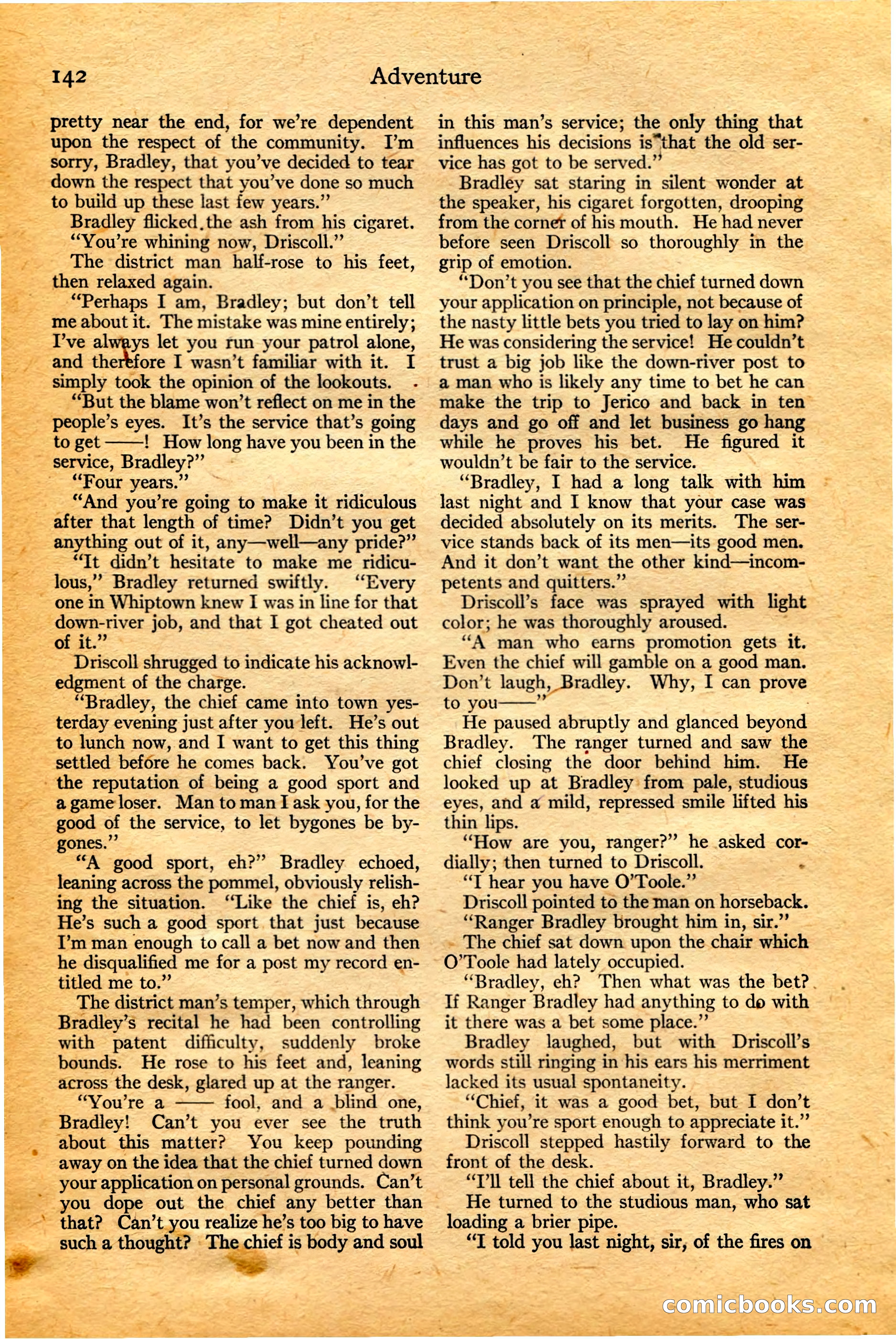
A restored page from Pulp Fiction, 1922. Page through the whole issue in the reader above.
📄 Transcribed text from this page (OCR, searchable)
Machine-transcribed from the original scan — historical spelling and the odd misread are preserved.
_. pretty near the end, for we’re dependent upon the respect of ‘the community. I’m a sorry, Bradley, that you ve decided to tear down the respect that you’ve done so much to build up these last few years.”’ Bradley flicked,the ash from his cigaret. =2 aan ‘“ oa ou’re whining now, Driscoll.” _. The district man half-rose to his feet, ___ then relaxed again. : “Perhaps I am, Bradley; but don’t tell __ meabout it. The mistake was mine entirely; _‘LPve theNto let you run your patrol alone, = _ and thertfore I wasn’t familiar with it. I simply took the opinion of the lookouts. “But the blame won’t reflect on me in the ce people’s eyes. It’s the service that’s going = “to get ——! How long have you been in the service, Bradley?” "Four years.’ - Loa “And you’re going to make it ridiculous after that length of time? Didn’t you get Eg: anything out of it, any—well—any pride?” p< “It didn’t hesitate to make me ridicu- lous,” Bradley returned swiftly. “Every one in Whiptown knew I was in line for that ' down-river job, and that I got cheated out a ae aie ____ Driscoll shrugged to indicate his acknowl- ___ edgment of the charge. “Bradley, the chief came into town yes- 8 _ terday evening just after you left. He’s out to lunch now, and I want to get this thing settled before he comes back. You’ve got _ + the reputation of being a good sport and - agameloser. Man to man J ask you, for the good of the service, to let bygones be by- _—-«gones.”’ Eas “A good sport, eh?” Bradley echoed, ____ leaning across the pommel, obviously relish- ee _ ‘ing the situation. “Like the chief is, eh? _. _He’s such a good sport that just because ia I’m man enough to call a bet now and then ae ‘ / he disqualified me for a post my record en- titled me to.” os _ The district man’s temper, which through __Bradley’s recital he had been controlling with Stent difficulty, suddenly broke bounds. He rose to his feet and, leaning _._ across the desk, glared up at the ranger. c=. **Vou’re -a fool, and a blind one, ee Bradley! Can’t you ever see the truth about this matter? You keep pounding away on the idea that the chief turned down ____ your application on personal grounds. Can’t 3 ~ you dope out the chief any better than — that? Can’ tye ou Tealize he’s too big to have Adventure in this man’s service; the only thing that influences his decisions is"that the old ser- vice has got to be served.’ Bradley sat staring in silent wonder at the speaker, his cigaret forgotten, drooping from the corner of his mouth. He had never before seen Driscoll so thoroughly in the grip of emotion. “Don’t you see that the chief turned down your application on principle, not because of the nasty little bets you tried to lay on him? He was considering the service! He couldn’t trust a big job like the down-river post to a man who is likely any time to bet he can make the trip to Jerico and back in ten’ days and go off and let business go hang while he proves his bet. He aeores it wouldn’t be fair to the service. “Bradley, I had a long talk with him last night and I know that your case was decided absolutely on its merits. The ser- vice stands back of its men—its good men. And it don’t want the other kind—incom- petents and quitters.” Driscoll’s face was sprayed with light color; he was thoroughly aroused. “A man who earns promotion gets it. Even the chief will gamble on a good man. Don’t laugh h, Bradley. Why, I can prove to you——’ He paused abruptly and glanced Ss Bradley. The ranger turned and saw the chief closing the door behind him. He looked up at Bradley from pale, studious eyes, and a mild, repressed smile lifted his thin lips. “How are you, ranger?” he asked cor- dially; then turned to Driscoll. ° “T hear you have O’Toole.” Driscoll pointed to the man on horseback. “Ranger Bradley brought him in, sir.”’ - The chief sat down upon the chair which O’Toole had lately occupied. “Bradley, eh? Then what was the bet?. If Ranger Bradley had anything to do with it there was a bet some place.” Bradley laughed, but with Driscoll’s words still ringing in his ears his merriment lacked its usual spontaneity. “Chief, it was a good bet, but I don’t think you’re sport enough to appreciate it.” Driscoll stepped hastily forward to the front of the desk. “T’ll tell the chief about it, Bradley.” He turned to the studious man, who sat loading a brier pipe. “T told you last night, sir, of the fires on — -_——- <S) com ~~ , > ee - a : = ~ 3 ~~ - . > 4 _ gS eae ee ee “ ee b ——7s 3 — ~ = _t a