
Pulp Fiction, 1922 · page 152 of 196
Adventure, February 20, 1922 — page 152: what you’re looking at
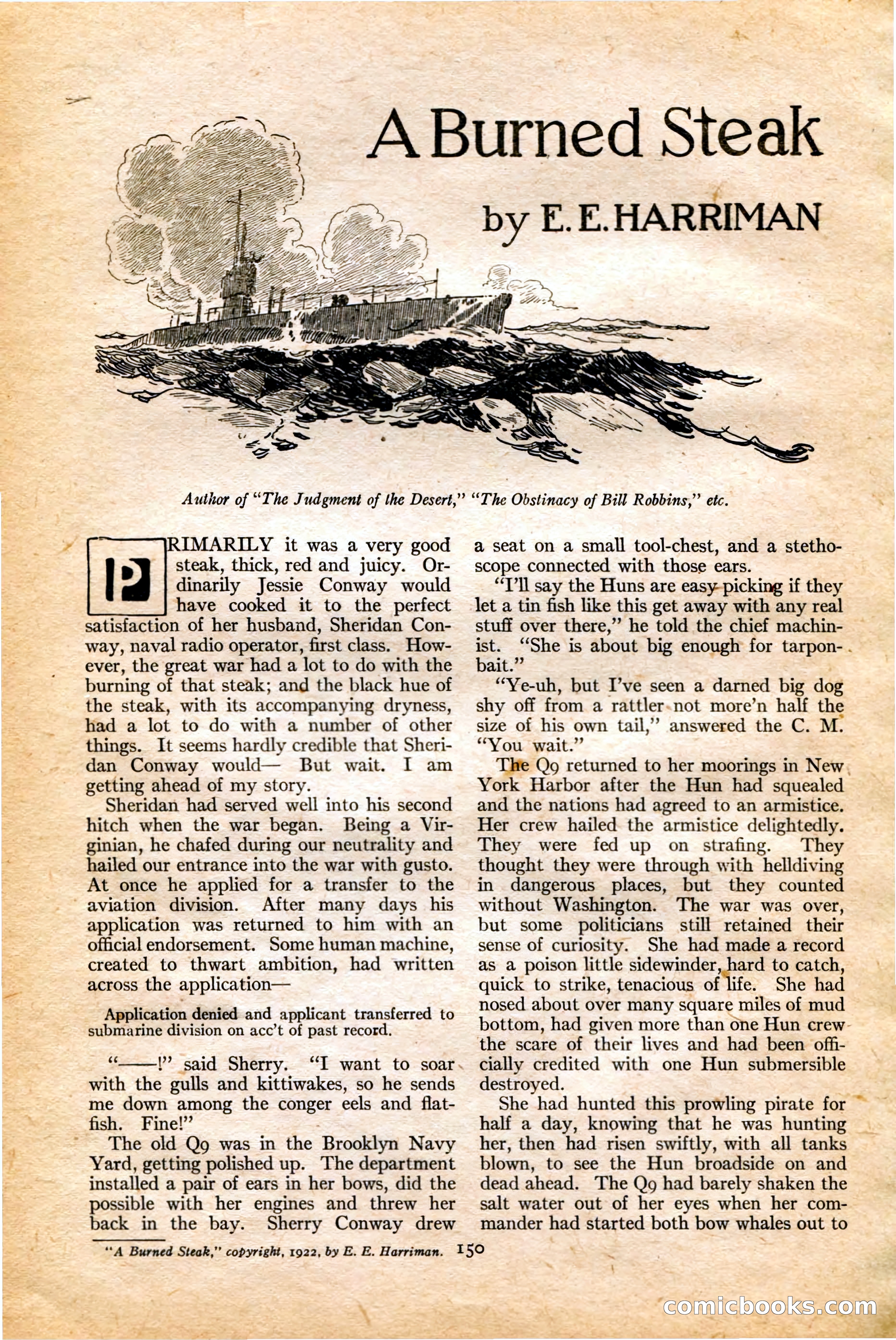
A restored page from Pulp Fiction, 1922. Page through the whole issue in the reader above.
📄 Transcribed text from this page (OCR, searchable)
Machine-transcribed from the original scan — historical spelling and the odd misread are preserved.
@@2s, ABurned Steak LA y E.E.HARRIMAN Author of “The Judgment of the Desert,” “The Obstinacy of Bill Robbins,” etc. IMARILY it was a very good steak, thick, red and juicy. Or- dinarily Jessie Conway would have cooked it to the perfect satisfaction of her husband, Sheridan Con- way, naval radio operator, first class. How- ever, the great war had a lot to do with the burning of that steak; and the black hue of the steak, with its accompanying dryness, had a lot to do with a number of other things. It seems hardly credible that Sheri- dan Conway would— But wait. I am getting ahead of my story. Sheridan had served well into his second hitch when the war began. Being a Vir- ginian, he chafed during our neutrality and hailed our entrance into the war with gusto. At once he applied for a transfer to the ' aviation division. After many days his application was returned to him with an official endorsement. Some human machine, created to thwart ambition, had written across the application— Application denied and applicant transferred to submarine division on acc’t of past record. ‘“‘_? said Sherry. with the gulls and kittiwakes, so he sends me down among the conger eels and flat- fish. Fine!” ~ The old Qo was in the Brooklyn Navy Yard, getting polished up. The department installed a pair of ears in her bows, did the possible with her engines and threw her back in the bay. Sherry Conway drew “A Burned Steak,” copyright, 1922, by E. E. Harriman. 150 “T want to soar. a seat on a small tool-chest, and a stetho- scope connected with those ears. “T’ll say the Huns are easy picking if they let a tin fish like this get away with any real stuff over there,” he told the chief machin- ist. bait.” ““Ye-uh, but I’ve seen a darned big dog shy off from a rattler-not more’n half the size of his own tail,’ answered the C. M. “You wait.” The Qo returned to her moorings in New. York Harbor after the Hun had squealed and the nations had agreed to an armistice. Her crew hailed the armistice delightedly. They were fed up on strafing. They thought they were through with helldiving in dangerous places, but they counted without Washington. The war was over, but some politicians still retained their sense of curiosity. She had made a record as a poison little sidewinder, hard to catch, quick to strike, tenacious of life. She had nosed about over many square miles of mud bottom, had given more than one Hun crew- the scare of their lives and had been off- cially credited with one Hun submersible destroyed. She had hunted this prowling pirate for half a day, knowing that he was hunting her, then had risen swiftly, with all tanks blown, to see the Hun broadside on and dead ahead. The Qo had barely shaken the salt water out of her eyes when her com- mander had started both bow whales out to ™ \ ‘CONMIC IOOL< “She is about big enough for tarpon- . 7",