
Pulp Fiction, 1922 · page 163 of 196
Adventure, February 20, 1922 — page 163: what you’re looking at
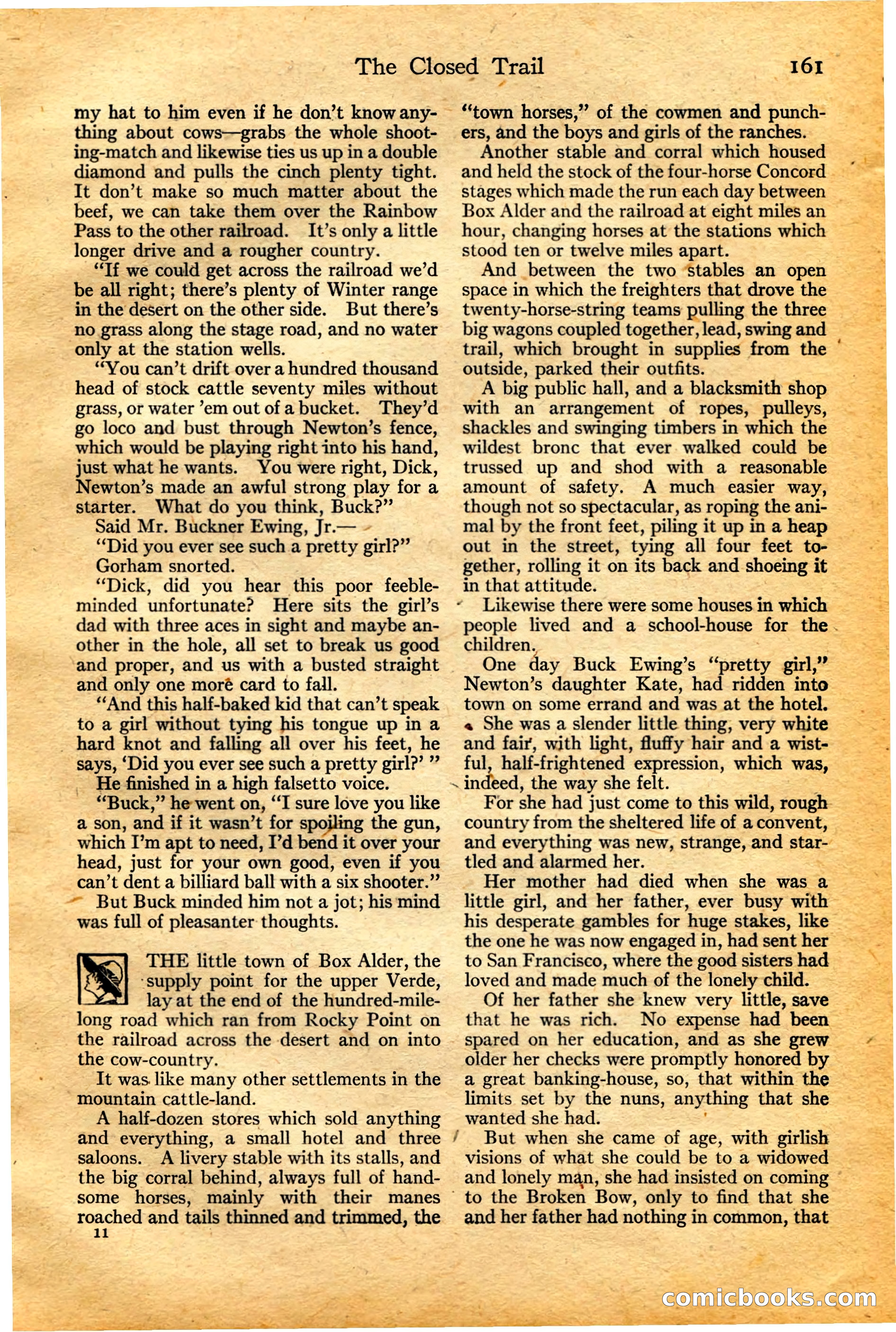
A restored page from Pulp Fiction, 1922. Page through the whole issue in the reader above.
📄 Transcribed text from this page (OCR, searchable)
Machine-transcribed from the original scan — historical spelling and the odd misread are preserved.
The Closed Trail my hat to him even if he don’t know any- thing about cows—grabs the whole shoot- ing-match and likewise ties us up in a double diamond and pulls the cinch plenty tight. It don’t make so much matter about the beef, we can take them over the Rainbow Pass to the other railroad. It’s only a little longer drive and a rougher country. “If we could get across the railroad we’d be all right; there’s plenty of Winter range in the desert on the other side. But there’s no grass along the stage road, and no water only at the station wells. “You can’t drift over a hundred thousand head of stock cattle seventy miles without grass, or water ’em out of a bucket. They’d go loco and bust through Newton’s fence, which would be playing right into his hand, just what he wants. You were right, Dick, Newton’s made an awful strong play for a starter. What do you think, Buck?” Said Mr. Buckner Ewing, Jr. —-s “Did you ever see such a pretty girl?” Gorham snorted. “Dick, did you hear this poor feeble- minded unfortunate? Here sits the girl’s dad with three aces in sight and maybe an- other in the hole, all set to break us good and proper, and us with a busted straight and only one moré card to fall. *fAnd this half-baked kid that can’t speak to a girl without tying his tongue up in a _ hard knot and falling all over his feet, he says, ‘Did you ever see such a pretty girl?’ ” He finished in a high falsetto voice. “Buck,” he went on, “I sure love you like a son, and if it wasn’t for spoiling the gun, which I’m apt to need, I’d bend it over your head, just for your own good, even if you can’t dent a billiard ball with a six shooter.” ~ But Buck minded him not a jot; his mind was full of pleasanter thoughts. 3 THE little town of Box Alder, the 9 ‘supply point for the upper Verde, iat jay at the end of the hundred-mile- long road which ran from Rocky Point on the railroad across the desert and on into the cow-country. It was like many other settlements in the - mountain cattle-land. A half-dozen stores which sold anything and everything, a small hotel and three saloons. A livery stable with its stalls, and the big corral behind, always full of hand- some horses, mainly with their manes roached and tails thinned and trimmed, the 1 161 - “town horses,” of the cowmen and punch- ers, and the boys and girls of the ranches. Another stable and corral which housed and held the stock of the four-horse Concord _ stages which made the run each day between Box Alder and the railroad at eight miles an hour, changing horses at the stations which __ stood ten or twelve miles apart. And between the two Stables an open space in which the freighters that drove the twenty-horse-string teams pulling the three big wagons coupled together, lead, swing and trail, which brought in supplies from the ° outside, parked their outfits. A big public hall, and a blacksmith shop with an arrangement of ropes, pulleys, shackles and swinging timbers in which the wildest bronc that ever walked could be trussed up and shod with a reasonable amount of safety. A much easier way, though not so spectacular, as roping the ani- mal by the front feet, piling it up in a heap out in the street, tying all four feet to- gether, rolling it on its back and shoeing it in that attitude. Likewise there were some houses in which people lived and a school-house for the children. One day Buck Ewing’s ‘coretty girl,” Newton’s daughter Kate, had ridden into town on some errand and was at the hotel. a She was a slender little thing, very white and fair, with light, fluffy hair and a wist- ful half-frightened expression, which was, indeed, the way she felt. For she had just come to this wild, rough — country from the sheltered life of a convent, and everything was new, strange, and star tled and alarmed her. Her mother had died when she was a little girl, and her father, ever busy with his desperate gambles for huge stakes, like — the one he was now engaged in, had sent her to San Francisco, where the good sisters ee loved and made much of the lonely child. Of her father she knew very little, save. that he was rich. No expense had been spared on her education, and as she grew older her checks were promptly honored by a great banking-house, so, that within the © limits set by the nuns, anything that she wanted she had. But when she came of age, with girlish visions of what she could be to a widowed and lonely man, she had insisted on coming © ~ to the Broken Bow, only to find that she and her father had nothing in common, that = ~~ 4 ye =. R} i, "a 7 3 ‘ee > ) ; é ; TAB IR ei é -' : phd 2 ray evs a" Wat sete OTe ae ae a) ¥i\y } th mae . Day Wy eee i "Ar iA : “ - zi! y mf a\e : Line FORA es v1 sy ' e's if x “ 1 ee’ ~ N + Ue 6, Sod, ‘A eg ~ to . “ly y irl! F ; fy" ye A ae Pe yn 4 \ ys ty