
Pulp Fiction, 1922 · page 178 of 196
Adventure, February 20, 1922 — page 178: what you’re looking at
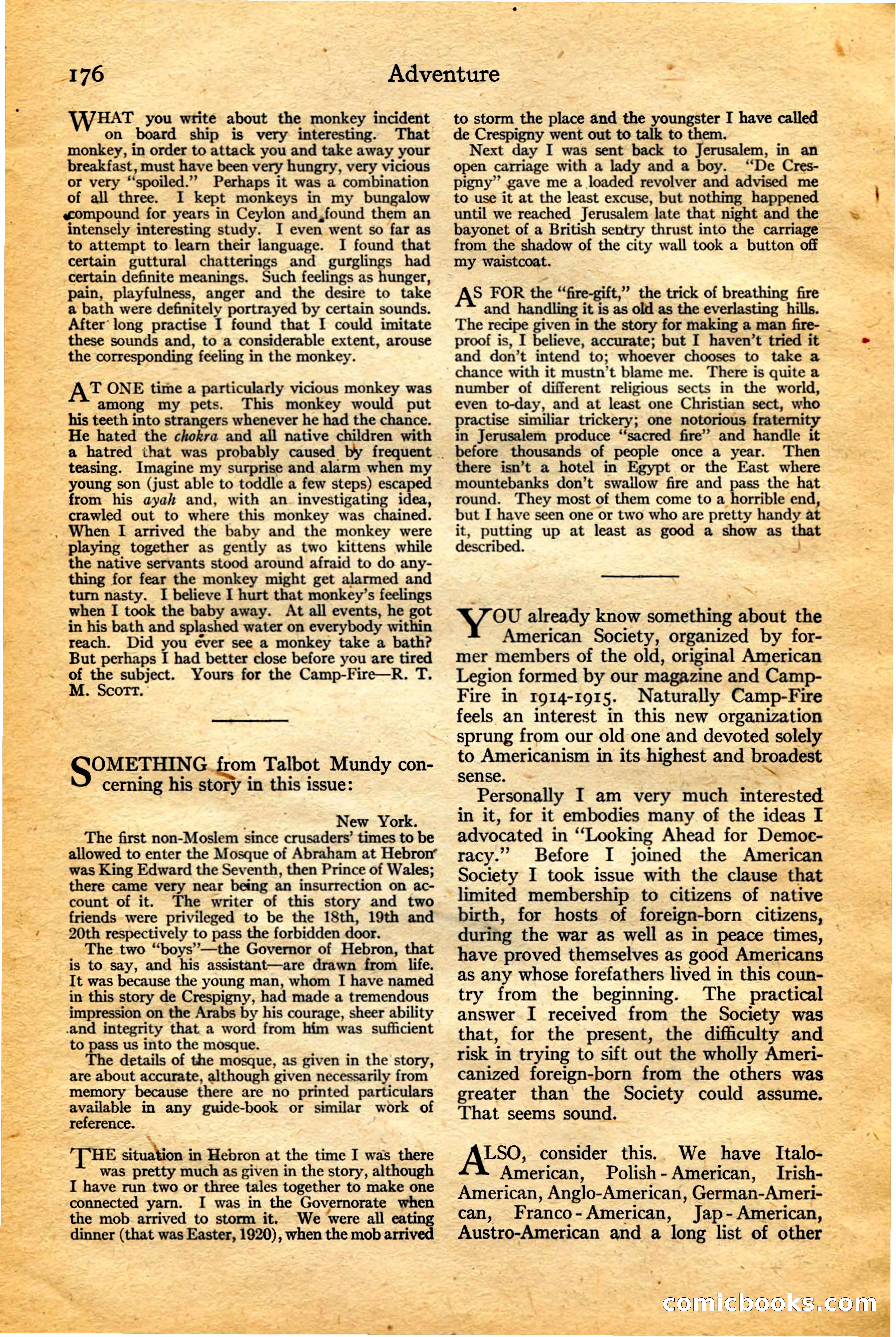
A restored page from Pulp Fiction, 1922. Page through the whole issue in the reader above.
📄 Transcribed text from this page (OCR, searchable)
Machine-transcribed from the original scan — historical spelling and the odd misread are preserved.
az eS he -,* ’ 7. 7 176 WHAT you write about the monkey incident on board ship is very interesting. That monkey, in order to attack you and take away your breakfast, must have been very hungry, very vicious or very “spoiled. ” Perhaps it was a combination of all three. I kept monkeys in my bungalow «compound for years in Ceylon and,found them an intensely interesting study. I even went so far as to attempt to learn their language. I found that certain guttural chatterings and gurglings had certain definite meanings. Such feelings as hunger, , Playfulnmess, anger and the desire to take a bath were definitely portrayed by certain sounds. After long practise I found that I could imitate these sounds and, to a considerable extent, arouse the corresponding feeling in the monkey. T ONE time a particularly vicious monkey was among my pets. This monkey would put his teeth into strangers whenever he had the chance. ’ He hated the chokra and all native children with a hatred that was probably caused by frequent . teasing. Imagine my surprise and alarm when my young son (just able to toddle a few steps) escaped from his aya and, with an. investigating idea, crawled out to where this monkey was chained . When I arrived the baby and the monkey were playing together as gently as two kittens while the native servants stood around afraid to do any- thing for fear the monkey might get alarmed and turn nasty. I believe I hurt that monkey’s feelings when I took the baby away. At all events, he got in his bath and splashed water on everybody within reach. Did you éver see a monkey take a bath? But perhaps I had better close before you are tired of the subject. Yours for the Camp-Fire—R. T. M. Scort. earem Talbot Mundy con- cerning his story in this issue: New York. The first non-Moslem since crusaders’ times to be allowed to enter the Mosque of Abraham at Hebron‘ was King Edward the Seventh, then Prince of Wales; _ there came very near being an insurrection on ac- count of it. The writer of this story and two friends were privileged to be the 18th, 19th and 20th respectively to pass the forbidden door. The two “boys’—the Governor of Hebron, that is to say, and his assistant—are drawn from life. _ It was because the young man, whom I have named in this story de Crespigny, had made a tremendous impression on the Arabs by his courage, sheer ability and integrity that a word from him was sufficient to oa us into the mosque. e details of the mosque, as given in the story, are about accurate, although given necessarily from memory because there are no printed particulars available in any guide-book or similar work of _Teference. "THE situation in Hebron at the time I was there was pretty much as given in the story, although I have run two or three tales together to make one connected yarn. I was in the Governorate when the mob arrived to storm it. We were all eating dinner (that was Easter, 1920), when the mob arrived Adventure r to storm the place and the youngster I have called de Crespigny went out to talk to them. Next day I was sent back to Jerusalem, in an open carriage with a lady and a boy. “De Cres- pigny” gave me a loaded revolver and advised me to use it at the least excuse, but nothing happened until we reached Jerusalem late that night and the bayonet of a British sentry thrust into the carriage from the shadow of the city wall took a button off my waistcoat. As FOR the “fire-gift,” the trick of breathing fire and handling it is as old as the everlasting hills. The recipe given in the story for making a man fire- proof is, I believe, accurate; but I haven’t tried it and don’t intend to; whoever chooses to take a chance with it mustn’t blame me. There is quite a number of different religious sects in the world, even to-day, and at least one Christian sect, who practise similiar trickery; one notorious fraternity in Jerusalem produce “sacred fire’? and handle it before thousands of people once a year. Then there isn’t a hotel in Egypt or the East where mountebanks don’t swailow fire and pass the hat round. They most of them come to a horrible end, but I have seen one or two who are pretty handy at it, putting up at least as good a described. ~ you already know something about the American Society, organized by for- mer members of the old, original American Legion formed by our magazine and Camp- Fire in rg14-1915. Naturally Camp-Fire feels an interest in this new organization sprung from our old one and devoted solely to Americanism in its highest and broadest sense. ae: Personally I am very much interested in it, for it embodies many of the ideas I advocated in “Looking Ahead for Demoe- racy.” Before I joined the American Society I took issue with the clause that limited membership to citizens of native birth, for hosts of foreign-born citizens, — during the war as well as in peace times, have proved themselves as good Americans as any whose forefathers lived in this coun- try from the beginning. ‘The practical answer I received from the Society was that, for the present, the difficulty and risk in trying to sift out the wholly Ameri- canized foreign-born from the others was greater than the Society could assume. That seems sound. ALSO, consider this. We have Italo- ‘American, Polish - American, Irish- American Anglo- American, German-Ameri- can, Franco - American, Jap-American, Austro-American and a ‘long list of other eomiic @ show as that — . % iboo