
Pulp Fiction, 1922 · page 31 of 196
Adventure, February 20, 1922 — page 31: what you’re looking at
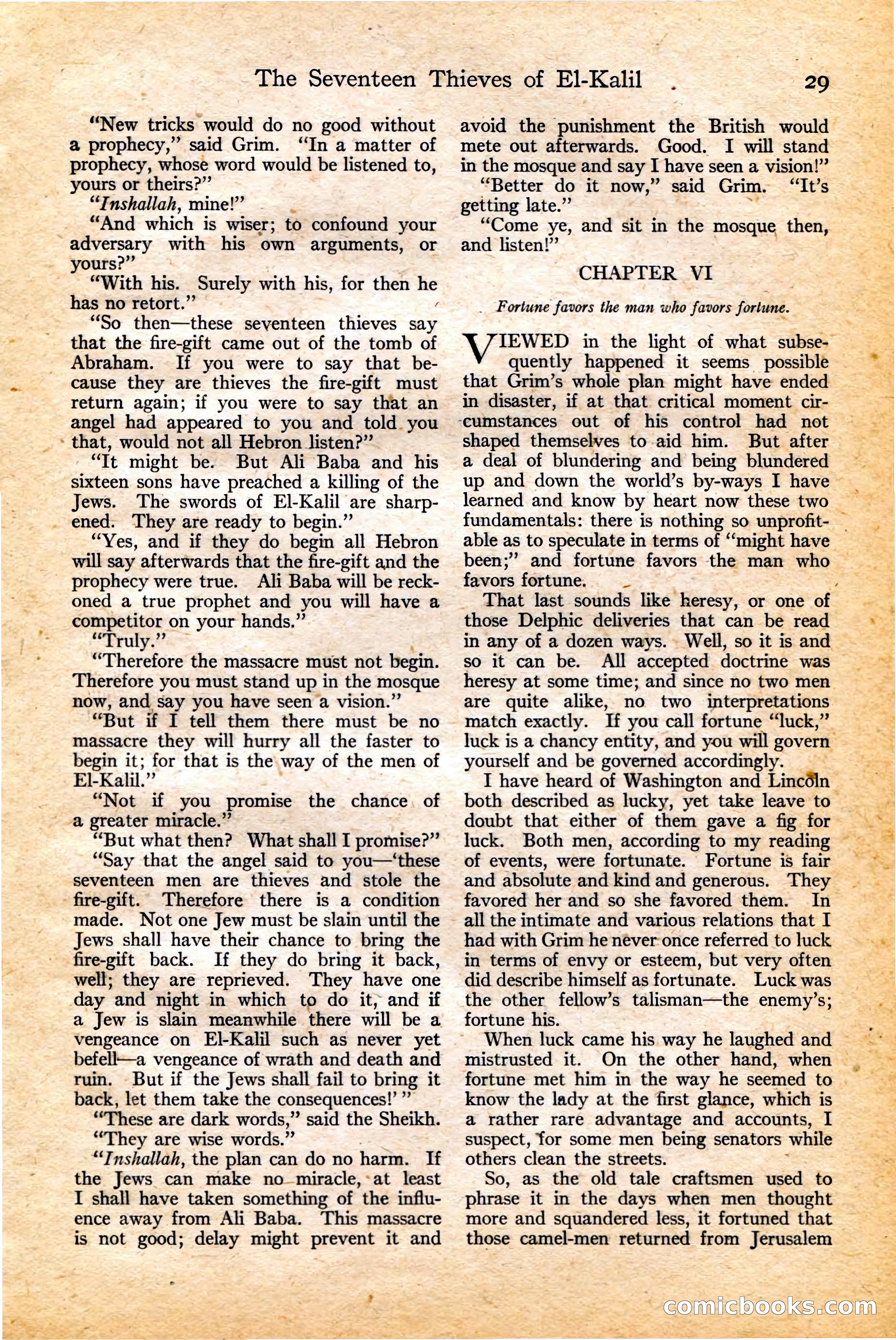
A restored page from Pulp Fiction, 1922. Page through the whole issue in the reader above.
📄 Transcribed text from this page (OCR, searchable)
Machine-transcribed from the original scan — historical spelling and the odd misread are preserved.
-fire-gift. The Seventeen Thieves of El-Kalil “New tricks would do no good without a prophecy,” said Grim. “In a matter of prophecy, whose word would be listened to, yours or theirs?” “Tnshallah, mine!” “And which is wiser; to confound your adversary with his own arguments, or yours?” “With his. has no retort.”’ “So then—these seventeen thieves say that the fire-gift came out of the tomb of Abraham. If you were to say that be- cause they are thieves the fire-gift must return again; if you were to say that an angel had appeared to you and told. you Surely with his, for then he » that, would not all Hebron listen?” “It might be. But Ali Baba and his sixteen sons have preached a killing of the Jews. The swords of El-Kalil are sharp- . ened. They are ready to begin.”’ “Yes, and if they do begin all Hebron will say afterwards that the fire-gift and the prophecy were true. Ali Baba will be reck- oned a true prophet and you will have a competitor on your hands,” “Truly. 99 “Theretore the massacre must not begin. Therefore you must stand up in the mosque now, and say you have seen a vision.’ “But if I tell them there must be no massacre they will hurry all the faster to begin it; for that is the way of the men of El-Kalil.” “Not if you promise the chance. of a greater miracle.” “But what then? What shall I promise?” “Say that the angel said to you—‘these seventeen men are thieves and stole the Therefore there is a condition made. Not one Jew must be slain until the Jews shall have their chance to bring the fire-gift back. If they do bring it back, well; they are reprieved. They have one day ‘and night in which to do it, and if a Jew is slain meanwhile there will be a vengeance on El-Kalil such as never yet befell—a vengeance of wrath and death and ruin. But if the Jews shall fail to bring it back, let them take the consequences!’ ” “These are dark words,” said the Sheikh. “They are wise words.” “Tnshallah, the plan can do no harm. If the Jews can make no-miracle,-at least I shall have taken something of the influ- ence away from Ali Baba. This massacre is not good; delay might prevent it and 29 avoid the punishment the British would mete out afterwards. Good. I will stand in the mosque and say I have seen a vision!” “Better do it now,” said Grim. “Tt’s getting late.” “Come ye, and sit in the mosque then, and listen!” CHAPTER VI . Fortune favors the man who favors fortune. \ 7TEWED in the light of what subse- quently happened it seems possible that Grim’s whole plan might have ended in disaster, if at that critical moment cir- -eumstances out of his control had not shaped themselves to aid him. But after a deal of blundering and being blundered up and down the world’s by-ways I have — learned and know by heart now these two fundamentals: there is nothing so unprofit- — able as to speculate in terms of ‘‘might have been;”’ and fortune favors the man who favors fortune. _ That last sounds like heresy, or one of those Delphic deliveries that can be read In any of a dozen ways. Well, so it is and so it can be. All accepted doctrine was heresy at some time; and since no two men are quite alike, no two interpretations match exactly. If you call fortune “luck,” luck is a chancy entity, and you will govern yourself and be governed accordingly. . I have heard of Washington and Lincéin both described as lucky, yet take leave to” doubt that either of them gave a fig for luck. Both men, according to my reading of events, were fortunate. Fortune is fair and absolute and kind and generous. They favored her and so she favored them. In all the intimate and various relations that I had with Grim he never-once referred to luck in terms of envy or esteem, but very often did describe himself as fortunate. Luck was the other fellow’s talisman—the enemy’s; fortune his. When luck came his way he laughed and ~ On the other hand, when | mistrusted it. fortune met him in the way he seemed to know the lady at the first glance, which is a rather rare advantage and accounts, I suspect, for some men being senators while others clean the streets. So, as the old tale craftsmen used to phrase it in the days when men thought more and squandered less, it fortuned that those camel-men returned from Jerusalem oO —s = > ee 1° Ss et i > - *. =—cOmicbooks:com\