
Pulp Fiction, 1922 · page 54 of 196
Adventure, February 20, 1922 — page 54: what you’re looking at
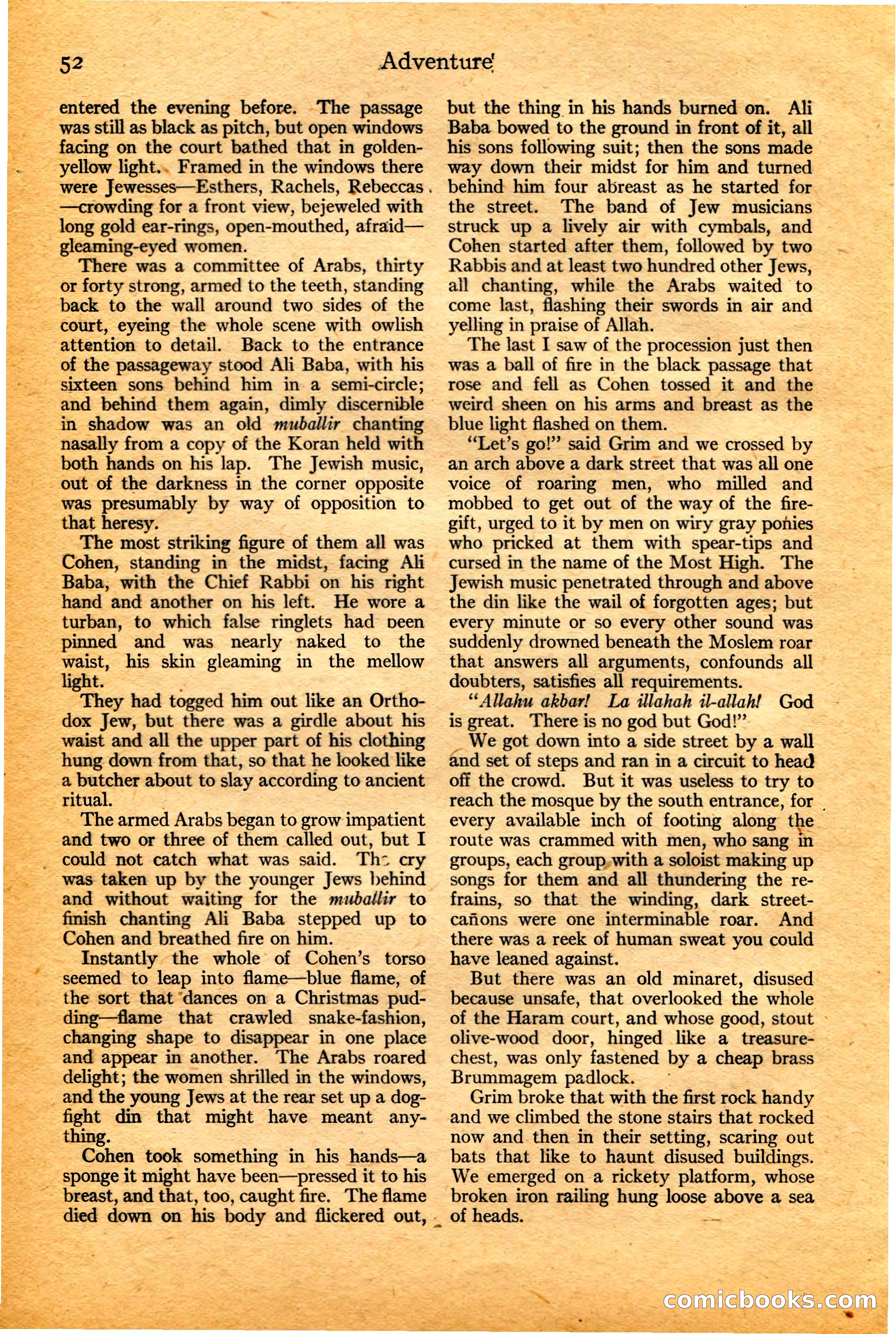
A restored page from Pulp Fiction, 1922. Page through the whole issue in the reader above.
📄 Transcribed text from this page (OCR, searchable)
Machine-transcribed from the original scan — historical spelling and the odd misread are preserved.
Wa Ku) AVA ee que as Sas a tt ee “ts . Ny 4, EAY has Pits Ma) UTS i GAS Fishy “ ey PW ARSE i Ar, TAME a? oF , . ¢ e ’ - , a, bas 5 5 / ' Ren hak SOL x ia Mi | ik % ae, TS Fale NV YOR wed eS: iy ANITA RTL \ Hes s Y n> PAu = ‘ eye sd . Aa W Is 4 ‘ Py " > 4 [ | + Wry Pia vp Wo Hite wf ‘ BST « 7 W ‘ 4 ify , te Par a TN ib AG male b vee ASCII CU I et abi Rr ai hae Ase % t ve # le hea » "“S ‘ ry re 4 + y Tel ¥ > . i) 3 AeA VTUD aly ine uss nae nu ; - fi f ~ entered the evening before. -The passage was still as black as pitch, but open windows facing on the court bathed that in golden- _ yellow light.. Framed in the windows there were Jewesses—Esthers, Rachels, Rebeccas . - —crowding for a front view, bejeweled with long gold ear-rings, open-mouthed, afraid— _ gleaming-eyed women. There was a committee of Arabs, thirty or forty strong, armed to the teeth, standing - back to the wall around two sides of the - court, eyeing the whole scene with owlish attention to detail. Back to the entrance of the passageway stood Ali Baba, with his - sixteen sons behind him in a semi-circle; and behind them again, dimly discernible in shadow was an old muballir chanting nasally from a copy of the Koran held with both hands on his lap. The Jewish music, _ out of the darkness in the corner opposite Was presumably by way of opposition to that heresy. The most striking figure of them all was Cohen, standing in the midst, facing Ali - Baba, with the Chief Rabbi on his right hand and another on his left. He wore a _ turban, to which false ringlets had been _ pinned and was nearly naked to the _ waist, his skin gleaming in the mellow light. They had togged him out like an Ortho- _ dox Jew, but there was a girdle about his waist and all the upper part of his clothing _ hung down from that, so that he looked like a butcher about to slay according to ancient ritual. _ The armed Arabs began to grow impatient siaae two or three of them called out, but I _ could not catch what was said. Th: cry - was taken up by the younger Jews behind and without waiting for the muballir to fmish chanting Ali Baba stepped up to Cohen and breathed fire on him. Instantly the whole of Cohen’s torso ‘seemed to leap into flame—blue flame, of the sort that “dances on a Christmas pud- -ding—flame that crawled snake-fashion, changing shape to disappear in one place and appear in another. The Arabs roared delight; the women shrilled in the windows, _ and the ¢ young Jews at the rear set up a dog- fight din that might have meant any- Cohen took something in his hands—a _ sponge it might have been—pressed it to his -- breast, and that, too, caught fire. The flame _ died down on his body and flickered out, — ae ” ~ a~<» Adventure but the thing in his hands burned on. Ali Baba bowed to the ground in front of it, all his sons following suit; then the sons made way down their midst for him and turned behind him four abreast as he started for the street. The band of Jew musicians struck up a lively air with cymbals, and | Cohen started after them, followed by two Rabbis and at least two hundred other Jews, all chanting, while the Arabs waited to come last, flashing their swords in air and yelling in praise of Allah. The last I saw of the procession just then was a ball of fire in the black passage that rose and fell as Cohen tossed it and the weird sheen on his arms and breast as the blue light flashed on them. “Let’s go!” said Grim and we crossed by an arch above a dark street that was all one voice of roaring men, who milled and mobbed to get out of the way of the fire- gift, urged to it by men on wiry gray ponies who pricked at them with spear-tips and cursed in the name of the Most High. The Jewish music penetrated through and above the din like the wail of forgotten ages; but every minute or so every other sound was suddenly drowned beneath the Moslem roar that answers all arguments, confounds all doubters, satisfies all requirements. “Allahu akbar! La illahah il-allah! God is great. There is no god but God!” We got down into a side street by a wall and set of steps and ran in a circuit to head off the crowd. But it was useless to try to reach the mosque by the south entrance, for _ every available inch of footing along the route was crammed with men, who sang in groups, each group,with a soloist making up songs for them and all thundering the re- frains, so that the winding, dark street- cafions were one interminable roar. And there was a reek of human sweat you could have leaned against. But there was an old minaret, disused because unsafe, that overlooked the whole of the Haram court, and whose good, stout » olive-wood door, hinged like a treasure- chest, was only fastened by a cheap brass Brummagem padlock. ~ Grim broke that with the first rock handy and we climbed the stone stairs that rocked now and then in their setting, scaring out bats that like to haunt disused buildings. We emerged on a rickety platform, whose broken iron railing hung loose above a sea of heads. = ~ Gi o ue 1°) / fe Bim ~S