
Pulp Fiction, 1922 · page 77 of 196
Adventure, February 20, 1922 — page 77: what you’re looking at
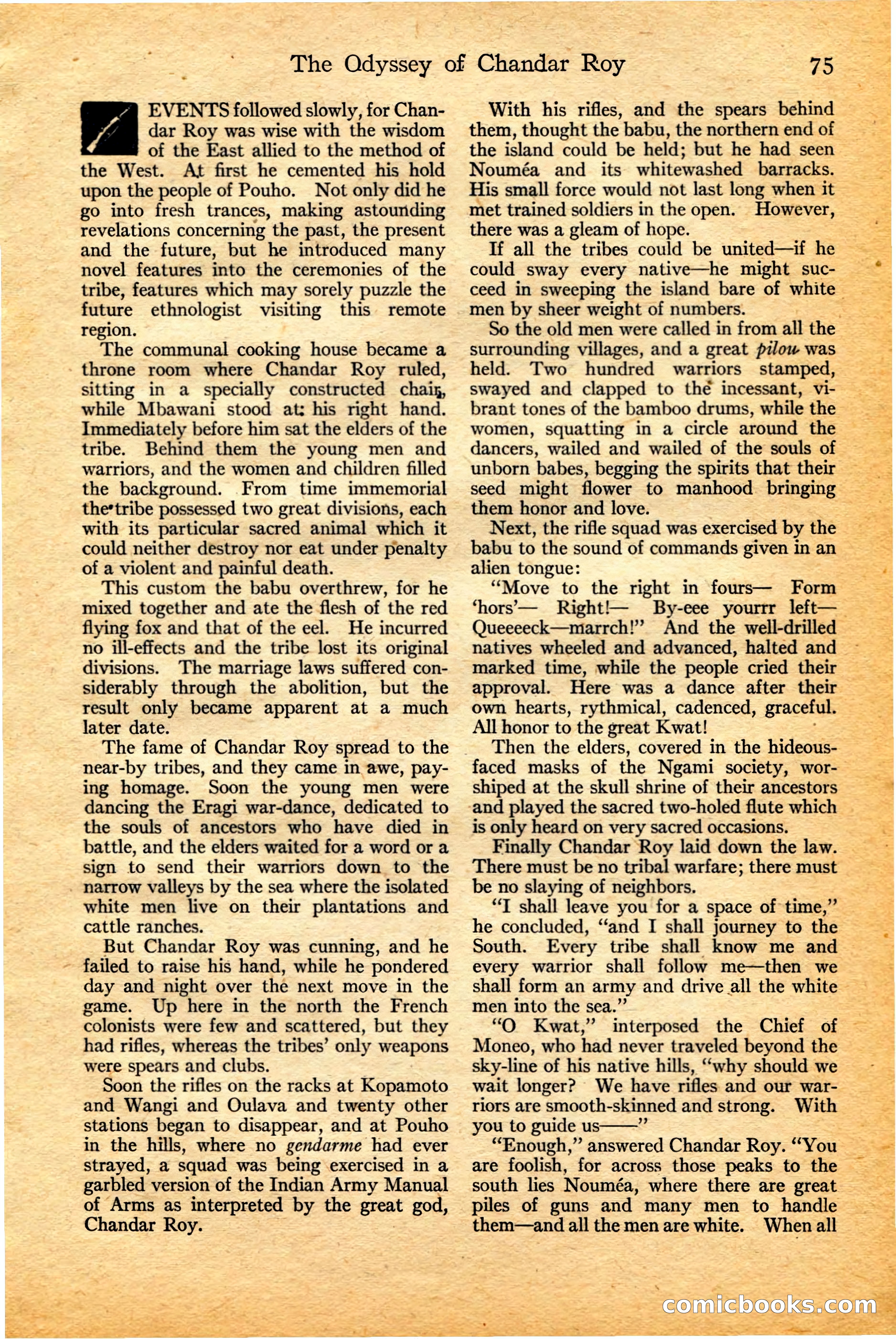
A restored page from Pulp Fiction, 1922. Page through the whole issue in the reader above.
📄 Transcribed text from this page (OCR, searchable)
Machine-transcribed from the original scan — historical spelling and the odd misread are preserved.
The Odyssey of Chandar Roy va EVENTS followed slowly, for Chan- VA dar Roy was wise with the wisdom of the East allied to the method of the West. At first he cemented his hold upon the people of Pouho. Not only did he go into fresh trances, making astounding revelations concerning ‘the past, the present and the future, but he introduced many novel features into the ceremonies of the tribe, features which may sorely puzzle the future ethnologist visiting this remote region. The communal cooking house became a throne room where Chandar Roy ruled, sitting in a specially constructed chaig, while Mbawani stood at: his right hand. Immediately before him sat the elders of the tribe. Behind them the young men and warriors, and the women and children filled the background. From time immemorial the*tribe possessed two great divisions, each with its particular sacred animal which it could neither destroy nor eat under penalty of a violent and painful death. This custom the babu overthrew, for he mixed together and ate the flesh of the red flying fox and that of the eel. He incurred no ill-effects and the tribe lost its original divisions. The marriage laws suffered con- siderably through the abolition, but the result only became apparent at a much later date. The fame of Chandar Roy spread to the near-by tribes, and they came in awe, pay- ing homage. Soon the young men were dancing the Eragi war-dance, dedicated to the souls of ancestors who have died in battle, and the elders waited for a word or a sign to send their warriors down to the _ narrow valleys by the sea where the isolated white men live on their plantations and cattle ranches. But Chandar Roy was cunning, and he - failed to raise his hand, while he pondered day and night over the next move in the game. Up here in the north the French colonists were few and scattered, but they had rifles, whereas the tribes’ only weapons were spears and clubs. Soon the rifles on the racks at Kopamoto and Wangi and Oulava and twenty other stations began to disappear, and at Pouho in the hills, where no gendarme had ever strayed, a squad was being exercised in a garbled version of the Indian Army Manual of Arms as interpreted by the great god, Chandar Roy. 75 With his rifles, and the spears behind them, thought the babu, the northern end of the island could be held; but he had seen Nouméa and its whitewashed barracks. His small force would not last long when it met trained soldiers in the open. However, there was a gleam of hope. If all the tribes could be united—if he — could sway every native—he might suc- ceed in sweeping the island bare of white. men by sheer weight of numbers. So the old men were called in from all the surrounding villages, and a great pilow was held. Two hundred warriors stamped, swayed and clapped to thé incessant, vi- brant tones of the bamboo drums, while the = women, squatting in a circle around the © dancers, wailed and wailed of the souls of unborn babes, begging the spirits that their — seed might flower to manhood bringing = them honor and love. Next, the rifle squad was exercised by the babu to the sound of commands given in an alien tongue: “Move to the right in fours— Form ‘hors’ — _ Right!— Queeeeck—miarrch!”’ And the well-drilled natives wheeled and advanced, halted and marked time, while the people cried their approval. own hearts, rythmical, cadenced, graceful. All honor to the great Kwat! Then the elders, covered in the hideous- faced masks of the Ngami society, wor- shiped at the skull shrine of their ancestors ‘and played the sacred two-holed flute which | is only heard on very sacred occasions. Finally Chandar Roy laid down the law. There must be no tribal warfare; there must be no slaying of neighbors. “T shall leave you for a space of time,” he concluded, “‘and I shall journey to the South. Every tribe shall know me and — every warrior shall follow me—then we By-eee yourrr left—_ Here was a dance after their > ph ay ; - ¢ wy 4 aah DL shall form an army and drive all the white = men into the sea.” “Q Kwat,” interposed the Chief of Moneo, who had never traveled beyond the sky-line of his native hills, “why should we wait longer? We have rifles and our war- riors are smooth-skinned and strong. With you to guide us “Enough,” answered Chandar Roy. “‘You are foolish, for across those peaks to the — south lies Nouméa, where there are great piles of guns and many men to handle them—and all the men are white. When all