
Pulp Fiction, 1911 · page 128 of 196
Adventure Magazine Cover — page 128: what you’re looking at
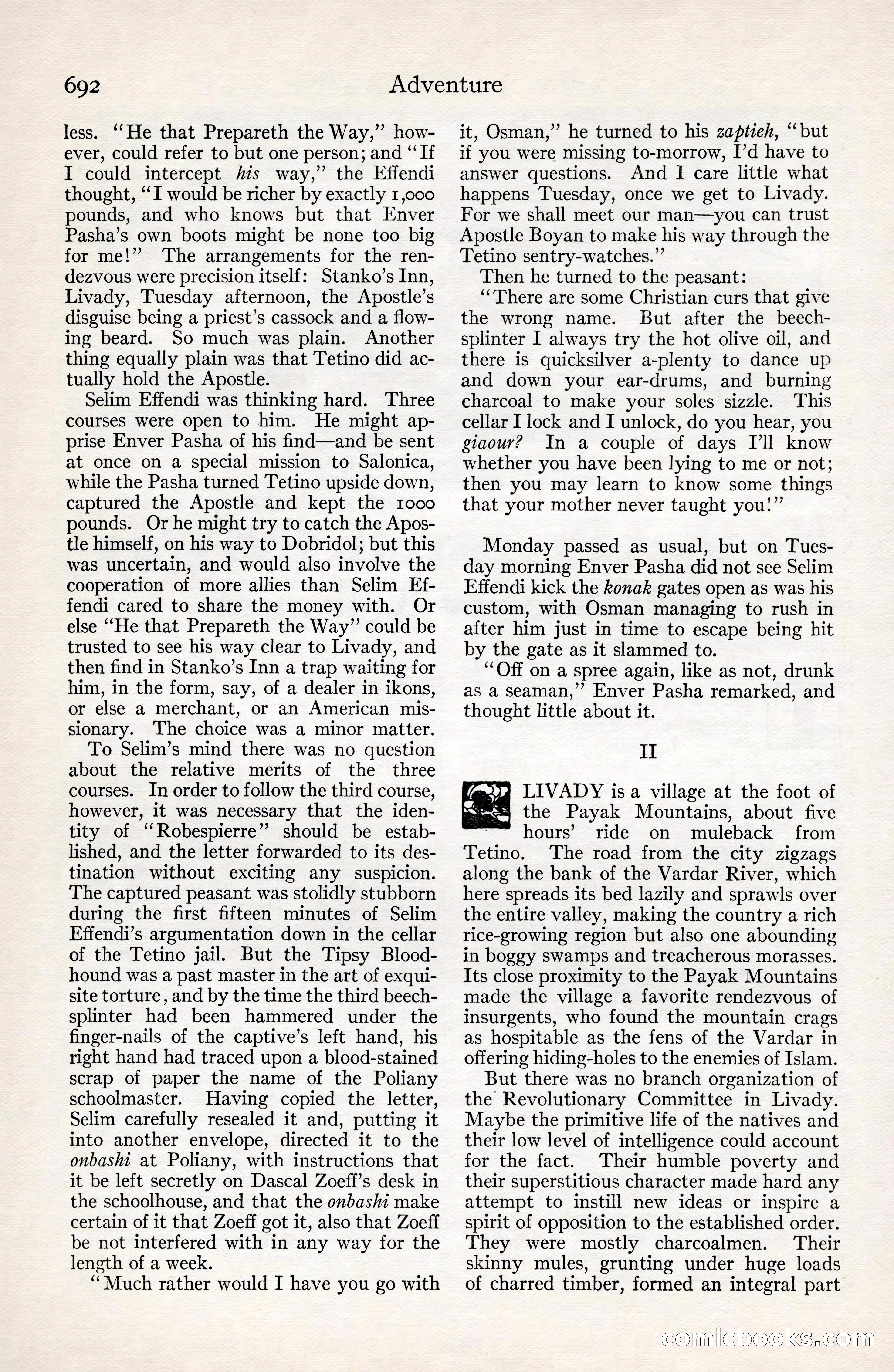
A restored page from Pulp Fiction, 1911. Page through the whole issue in the reader above.
📄 Transcribed text from this page (OCR, searchable)
Machine-transcribed from the original scan — historical spelling and the odd misread are preserved.
692 less. “‘He that Prepareth the Way,” how- ever, could refer to but one person; and “If I could intercept zs way,” the Effendi thought, “I would be richer by exactly 1,000 pounds, and who knows but that Enver Pasha’s own boots might be none too big for me!” The arrangements for the ren- dezvous were precision itself: Stanko’s Inn, Livady, Tuesday afternoon, the Apostle’s disguise being a priest’s cassock and a flow- ing beard. So much was plain. Another thing equally plain was that Tetino did ac- tually hold the Apostle. Selim Effendi was thinking hard. Three courses were open to him. He might ap- prise Enver Pasha of his find—and be sent at once on a special mission to Salonica, while the Pasha turned Tetino upside down, captured the Apostle and kept the 1000 pounds. Or he might try to catch the Apos- tle himself, on his way to Dobridol; but this was uncertain, and would also involve the cooperation of more allies than Selim Ef- fendi cared to share the money with. Or else “He that Prepareth the Way” could be trusted to see his way clear to Livady, and then find in Stanko’s Inn a trap waiting for him, in the form, say, of a dealer in ikons, or else a merchant, or an American mis- sionary. The choice was a minor matter. To Selim’s mind there was no question about the relative merits of the three courses. In order to follow the third course, however, it was necessary that the iden- tity of “Robespierre” should be estab- lished, and the letter forwarded to its des- tination without exciting any suspicion. The captured peasant was stolidly stubborn during the first fifteen minutes of Selim Effendi’s argumentation down in the cellar of the Tetino jail. But the Tipsy Blood- hound was a past master in the art of exqui- site torture, and by the time the third beech- splinter had been hammered under the finger-nails of the captive’s left hand, his right hand had traced upon a blood-stained scrap of paper the name of the Poliany schoolmaster. Having copied the letter, Selim carefully resealed it and, putting it into another envelope, directed it to the onbashi at Poliany, with instructions that it be left secretly on Dascal Zoeff’s desk in the schoolhouse, and that the onbashi make certain of it that Zoeff got it, also that Zoeff be not interfered with in any way for the length of a week. ‘Much rather would I have you go with Adventure it, Osman,” he turned to his zaptieh, “but if you were missing to-morrow, I’d have to answer questions. And I care little what happens Tuesday, once we get to Livady. For we shall meet our man—you can trust Apostle Boyan to make his way through the Tetino sentry-watches.”’ Then he turned to the peasant: ‘There are some Christian curs that give the wrong name. But after the beech- splinter I always try the hot olive oil, and there is quicksilver a-plenty to dance up and down your ear-drums, and burning charcoal to make your soles sizzle. This cellar I lock and I unlock, do you hear, you giaour? In a couple of days I'll know whether you have been lying to me or not; then you may learn to know some things that your mother never taught you!”’ Monday passed as usual, but on Tues- day morning Enver Pasha did not see Selim Effendi kick the konak gates open as was his custom, with Osman managing to rush in after him just in time to escape being hit by the gate as it slammed to. ‘Off on a spree again, like as not, drunk as a seaman,’ Enver Pasha remarked, and thought little about it. II coy LIVADY isa village at the foot of aes the Payak Mountains, about five ; hours’ ride on muleback from Tetino. The road from the city zigzags along the bank of the Vardar River, which here spreads its bed lazily and sprawls over the entire valley, making the country a rich rice-growing region but also one abounding in boggy swamps and treacherous morasses. Its close proximity to the Payak Mountains made the village a favorite rendezvous of insurgents, who found the mountain crags as hospitable as the fens of the Vardar in offering hiding-holes to the enemies of Islam. But there was no branch organization of the Revolutionary Committee in Livady. Maybe the primitive life of the natives and their low level of intelligence could account for the fact. Their humble poverty and their superstitious character made hard any attempt to instill new ideas or inspire a spirit of opposition to the established order. They were mostly charcoalmen. Their skinny mules, grunting under huge loads of charred timber, formed an integral part CORNICLO© S (C@