
Pulp Fiction, 1911 · page 149 of 196
Adventure Magazine Cover — page 149: what you’re looking at
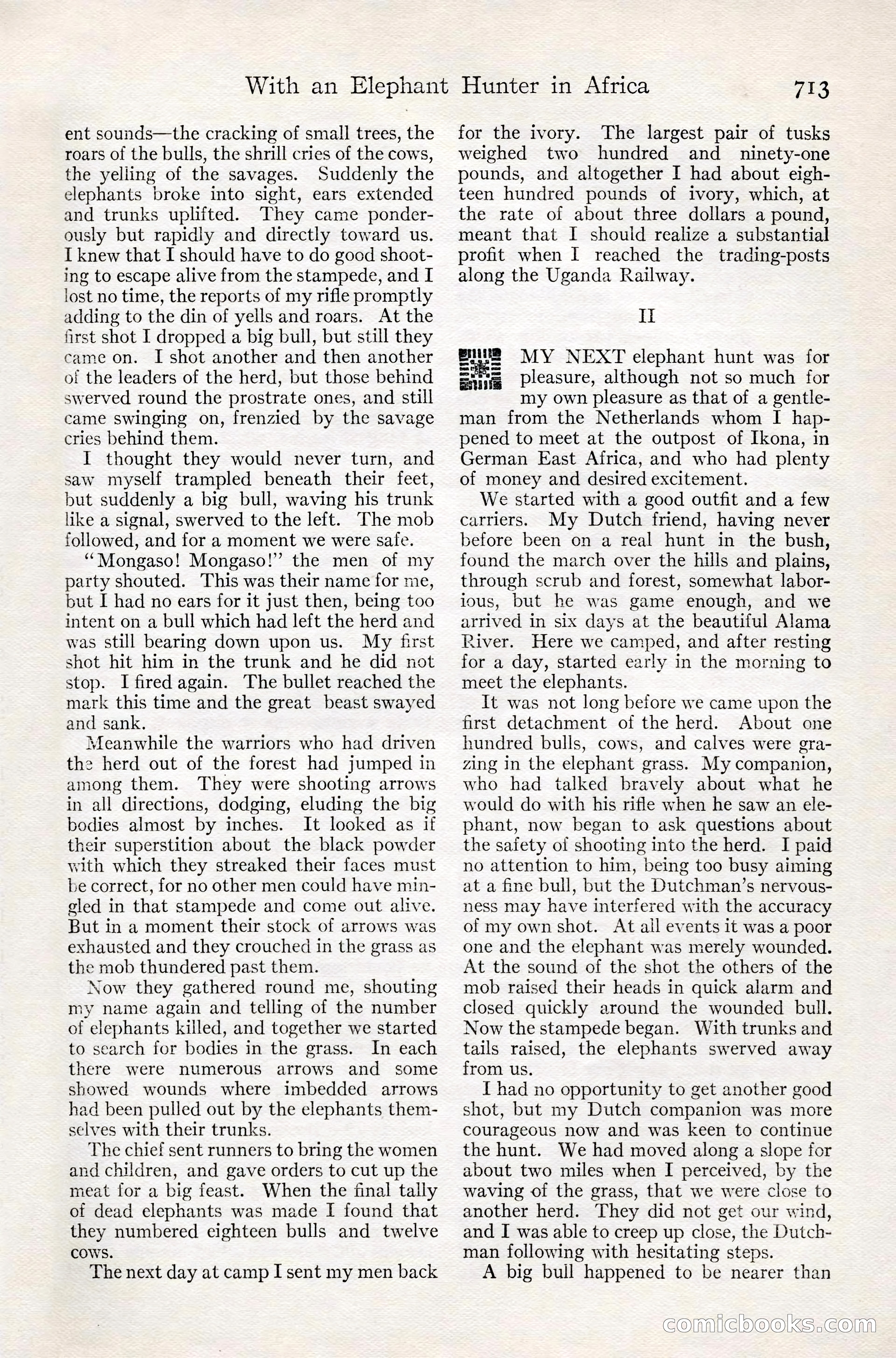
A restored page from Pulp Fiction, 1911. Page through the whole issue in the reader above.
📄 Transcribed text from this page (OCR, searchable)
Machine-transcribed from the original scan — historical spelling and the odd misread are preserved.
With an Elephant Hunter in Africa ent sounds—the cracking of small trees, the roars of the bulls, the shrill cries of the cows, the yelling of the savages. Suddenly the elephants broke into sight, ears extended and trunks uplifted. They came ponder- ously but rapidly and directly toward us. I knew that I should have to do good shoot- ing to escape alive from the stampede, and I lost no time, the reports of my rifle promptly adding to the din of yells and roars. At the first shot I dropped a big bull, but still they came on. I shot another and then another of the leaders of the herd, but those behind swerved round the prostrate ones, and still came swinging on, frenzied by the savage cries behind them. I thought they would never turn, and saw myself trampled beneath their feet, but suddenly a big bull, waving his trunk like a signal, swerved to the left. The mob followed, and for a moment we were sale. ‘““Mongaso! Mongaso!” the men of my party shouted. This was their name for me, but I had no ears for it just then, being too intent on a bull which had left the herd and was still bearing down upon us. My first shot hit him in the trunk and he did not stop. I fired again. The bullet reached the mark this time and the great beast swayed and sank. Meanwhile the warriors who had driven the herd out of the forest had jumped in among them. They were shooting arrows in all directions, dodging, eluding the big bodies almost by inches. It looked as if their superstition about the black powder with which they streaked their faces must be correct, for no other men could have min- gled in that stampede and come out alive. But in a moment their stock of arrows was exhausted and they crouched in the grass as the mob thundered past them. Now they gathered round me, shouting my name again and telling of the number of elephants killed, and together we started to search for bodies in the grass. In each there were numerous arrows and some showed wounds where imbedded arrows had been pulled out by the elephants them- selves with their trunks. The chief sent runners to bring the women and children, and gave orders to cut up the meat for a big feast. When the final tally of dead elephants was made I found that they numbered eighteen bulls and twelve cows. The next day at camp I sent my men back 713 for the ivory. The largest pair of tusks weighed two hundred and _ ninety-one pounds, and altogether I had about eigh- teen hundred pounds of ivory, which, at the rate of about three dollars a pound, meant that I should realize a substantial profit when I reached the trading-posts along the Uganda Railway. Ii eit MY NEXT elephant hunt was for sai Pleasure, although not so much for my own pleasure as that of a gentle- man from the Netherlands whom I hap- pened to meet at the outpost of Ikona, in German East Africa, and who had plenty of money and desired excitement. We started with a good outfit and a few carriers. My Dutch friend, having never before been on a real hunt in the bush, found the march over the hills and plains, through scrub and forest, somewhat labor- ious, but he was game enough, and we arrived in six days at the beautiful Alama River. Here we camped, and after resting for a day, started early in the morning to meet the elephants. It was not long before we came upon the first detachment of the herd. About one hundred bulls, cows, and calves were gra- zing In the elephant grass. My companion, who had talked bravely about what he would do with his rifle when he saw an ele- phant, now began to ask questions about the safety of shooting into the herd. I paid no attention to him, being too busy aiming at a fine bull, but the Dutchman’s nervous- ness may have interfered with the accuracy of my own shot. At all events it was a poor one and the elephant was merely wounded. At the sound of the shot the others of the mob raised their heads in quick alarm and closed quickly around the wounded bull. Now the stampede began. With trunks and tails raised, the elephants swerved away from us. I had no opportunity to get another good shot, but my Dutch companion was more courageous now and was keen to continue the hunt. We had moved along a slope for about two miles when I perceived, by the waving of the grass, that we were close to another herd. They did not get our wind, and I was able to creep up close, the Dutch- man following with hesitating steps. A big bull happened to be nearer than COMCMOOCKKS. CO