
Pulp Fiction, 1911 · page 153 of 196
Adventure Magazine Cover — page 153: what you’re looking at
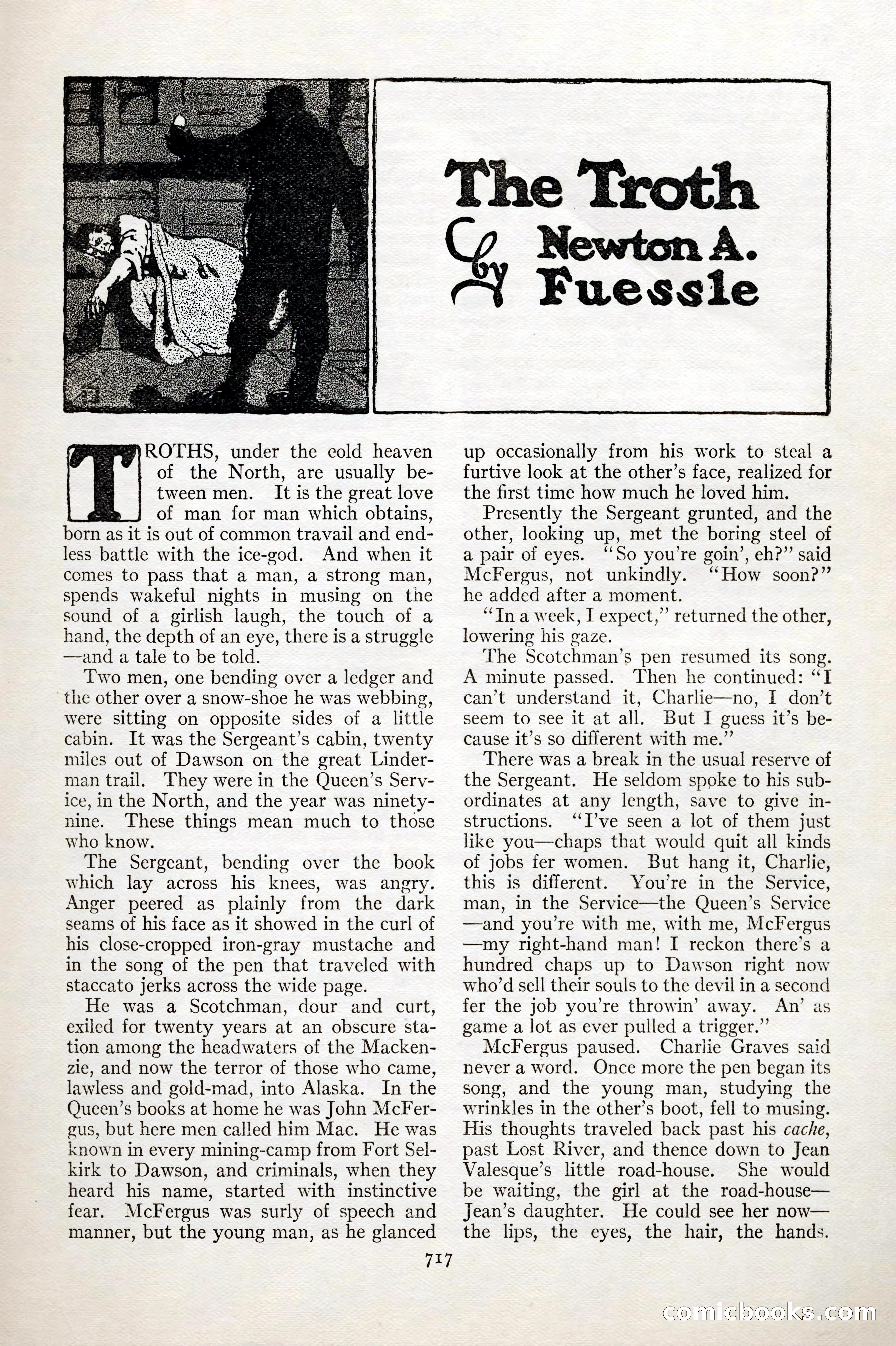
A restored page from Pulp Fiction, 1911. Page through the whole issue in the reader above.
📄 Transcribed text from this page (OCR, searchable)
Machine-transcribed from the original scan — historical spelling and the odd misread are preserved.
¥}ROTHS, under the cold heaven of the North, are usually be- tween men. It is the great love » J of man for man which obtains, born as it is out of common travail and end- less battle with the ice-god. And when it comes to pass that a man, a strong man, spends wakeful nights in musing on the sound of a girlish laugh, the touch of a hand, the depth of an eye, there is a struggle —and a tale to be told. Two men, one bending over a ledger and the other over a snow-shoe he was webbing, were sitting on opposite sides of a little cabin. It was the Sergeant’s cabin, twenty miles out of Dawson on the great Linder- man trail. They were in the Queen’s Serv- ice, in the North, and the year was ninety- nine. These things mean much to those who know. The Sergeant, bending over the book which lay across his knees, was angry. Anger peered as plainly from the dark seams of his face as it showed in the curl of his close-cropped iron-gray mustache and in the song of the pen that traveled with staccato jerks across the wide page. He was a Scotchman, dour and curt, exiled for twenty years at an obscure sta- tion among the headwaters of the Macken- zie, and now the terror of those who came, lawless and gold-mad, into Alaska. In the Queen’s books at home he was John McFer- gus, but here men called him Mac. He was known in every mining-camp from Fort Sel- kirk to Dawson, and criminals, when they heard his name, started with instinctive fear. McFergus was surly of speech and manner, but the young man, as he glanced 717 up occasionally from his work to steal a furtive look at the other’s face, realized for the first time how much he loved him. Presently the Sergeant grunted, and the other, looking up, met the boring steel of a pair of eyes. “So you're goin’, eh?” said McFergus, not unkindly. “How soon?” he added after a moment. “In a week, I expect,” returned the other, lowering his gaze. The Scotchman’s pen resumed its song. A minute passed. Then he continued: “T can’t understand it, Charlie—no, I don’t seem to see it at all. But I guess it’s be- cause it’s so different with me.”’ There was a break in the usual reserve of the Sergeant. He seldom spoke to his sub- ordinates at any length, save to give in- structions. “I’ve seen a lot of them just like you—chaps that would quit all kinds of jobs fer women. But hang it, Charlie, this is different. You’re in the Service, man, in the Service—the Queen’s Service —and you’re with me, with me, McFergus —my right-hand man! I reckon there’s a hundred chaps up to Dawson right now who'd sell their souls to the devil in a second fer the job you’re throwin’ away. An’ as game a lot as ever pulled a trigger.”’ McFergus paused. Charlie Graves said never a word. Once more the pen began its song, and the young man, studying the wrinkles in the other’s boot, fell to musing. His thoughts traveled back past his cache, past Lost River, and thence down to Jean Valesque’s little road-house. She would be waiting, the girl at the road-house— Jean’s daughter. He could see her now— the lips, the eyes, the hair, the hands. CORMMICGLOOOCKSs€O