
Pulp Fiction, 1911 · page 169 of 196
Adventure Magazine Cover — page 169: what you’re looking at
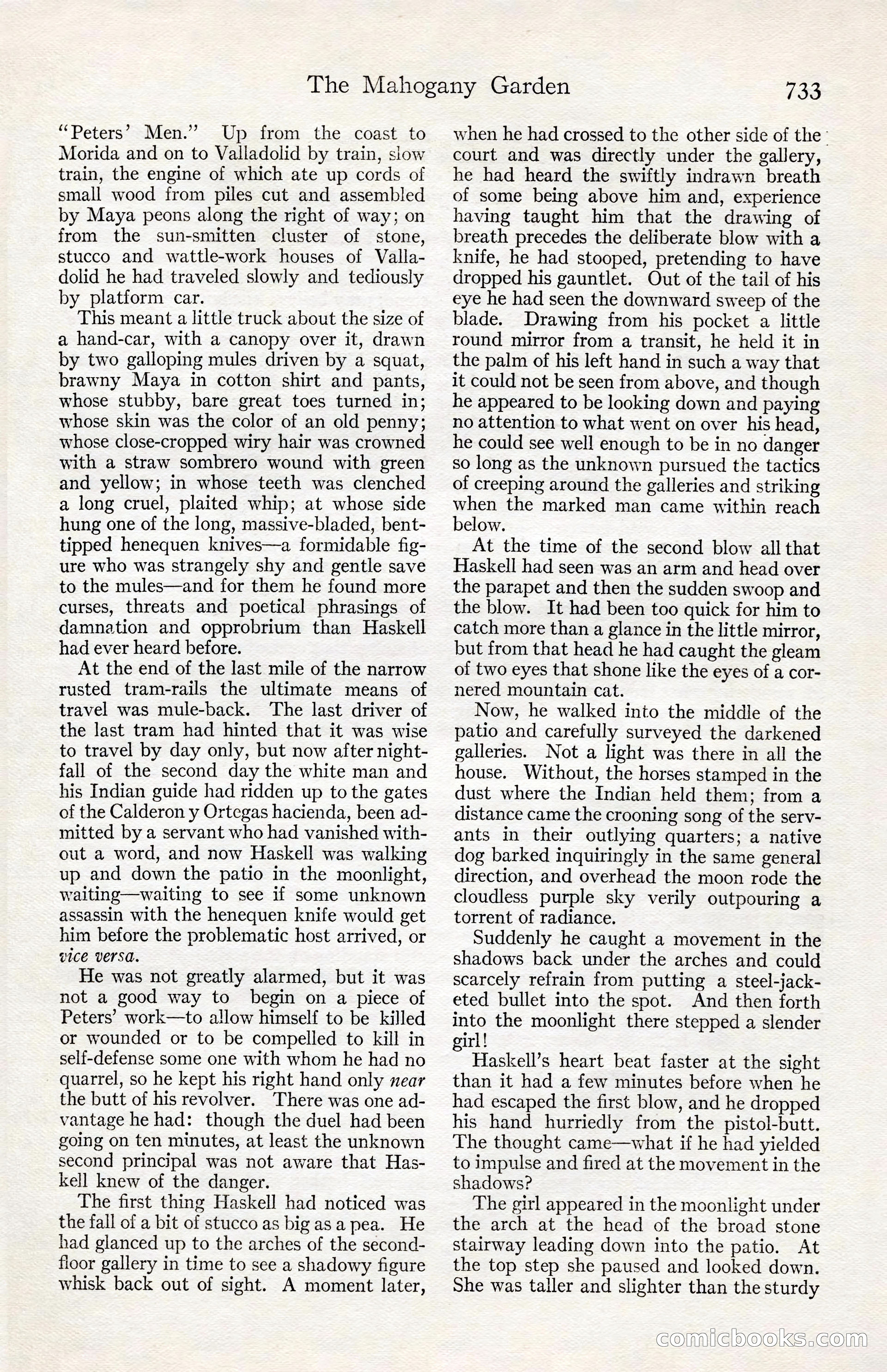
A restored page from Pulp Fiction, 1911. Page through the whole issue in the reader above.
📄 Transcribed text from this page (OCR, searchable)
Machine-transcribed from the original scan — historical spelling and the odd misread are preserved.
The Mahogany Garden ‘Peters’ Men.” Up from the coast to Morida and on to Valladolid by train, slow train, the engine of which ate up cords of small wood from piles cut and assembled by Maya peons along the right of way; on from the sun-smitten cluster of stone, stucco and wattle-work houses of Valla- dolid he had traveled slowly and tediously by platform car. This meant a little truck about the size of a hand-car, with a canopy over it, drawn by two galloping mules driven by a squat, brawny Maya in cotton shirt and pants, whose stubby, bare great toes turned in; whose skin was the color of an old penny; whose close-cropped wiry hair was crowned with a straw sombrero wound with green and yellow; in whose teeth was clenched a long cruel, plaited whip; at whose side hung one of the long, massive-bladed, bent- tipped henequen knives—a formidable fig- ure who was strangely shy and gentle save to the mules—and for them he found more curses, threats and poetical phrasings of damnation and opprobrium than Haskell had ever heard before. At the end of the last mile of the narrow rusted tram-rails the ultimate means of travel was mule-back. The last driver of the last tram had hinted that it was wise to travel by day only, but now after night- fall of the second day the white man and his Indian guide had ridden up to the gates of the Calderon y Ortcgas hacienda, been ad- mitted by a servant who had vanished with- out a word, and now Haskell was walking up and down the patio in the moonlight, waiting—waiting to see if some unknown assassin with the henequen knife would get him before the problematic host arrived, or vice versa. He was not greatly alarmed, but it was not a good way to. begin on a piece of Peters’ work—to allow himself to be killed or wounded or to be compelled to kill in self-defense some one with whom he had no quarrel, so he kept his right hand only near the butt of his revolver. There was one ad- vantage he had: though the duel had been going on ten minutes, at least the unknown second principal was not aware that Has- kell knew of the danger. The first thing Haskell had noticed was the fall of a bit of stucco as bigasa pea. He had glanced up to the arches of the second- floor gallery in time to see a shadowy figure whisk back out of sight. A moment later, 733 when he had crossed to the other side of the’ court and was directly under the gallery, he had heard the swiftly indrawn breath of some being above him and, experience having taught him that the drawing of breath precedes the deliberate blow with a knife, he had stooped, pretending to have dropped his gauntlet. Out of the tail of his eye he had seen the downward sweep of the blade. Drawing from his pocket a little round mirror from a transit, he held it in the palm of his left hand in such a way that it could not be seen from above, and though he appeared to be looking down and paying no attention to what went on over his head, he could see well enough to be in no danger so long as the unknown pursued the tactics of creeping around the galleries and striking when the marked man came within reach below. At the time of the second blow all that Haskell had seen was an arm and head over the parapet and then the sudden swoop and the blow. It had been too quick for him to catch more than a glance in the little mirror, but from that head he had caught the gleam of two eyes that shone like the eyes of a cor- nered mountain cat. Now, he walked into the middle of the patio and carefully surveyed the darkened galleries. Not a light was there in all the house. Without, the horses stamped in the dust where the Indian held them; from a distance came the crooning song of the serv- ants in their outlying quarters; a native dog barked inquiringly in the same general direction, and overhead the moon rode the cloudless purple sky verily outpouring a torrent of radiance. Suddenly he caught a movement in the shadows back under the arches and could scarcely refrain from putting a steel-jack- eted bullet into the spot. And then forth into the moonlight there stepped a slender irl! : Haskell’s heart beat faster at the sight than it had a few minutes before when he had escaped the first blow, and he dropped his hand hurriedly from the pistol-butt. The thought came—what if he had yielded to impulse and fired at the movement in the shadows? The girl appeared in the moonlight under the arch at the head of the broad stone stairway leading down into the patio. At the top step she paused and looked down. She was taller and slighter than the sturdy COMmMICLOOOlkKS. CGO