
Pulp Fiction, 1911 · page 175 of 196
Adventure Magazine Cover — page 175: what you’re looking at
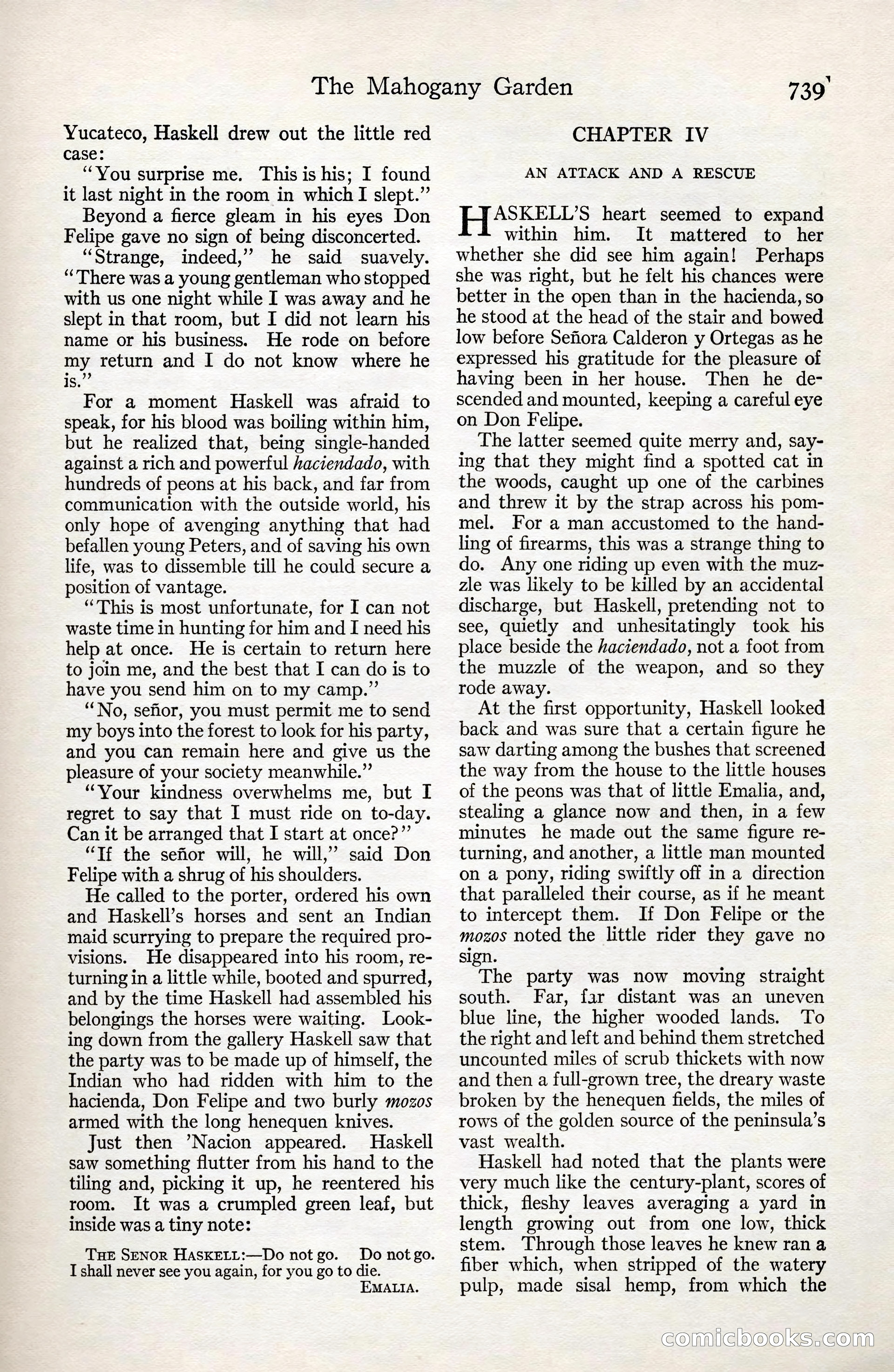
A restored page from Pulp Fiction, 1911. Page through the whole issue in the reader above.
📄 Transcribed text from this page (OCR, searchable)
Machine-transcribed from the original scan — historical spelling and the odd misread are preserved.
The Mahogany Garden Yucateco, Haskell drew out the little red case: “You surprise me. This is his; I found it last night in the room in which I slept.” Beyond a fierce gleam in his eyes Don Felipe gave no sign of being disconcerted. “Strange, indeed,’ he said _ suavely. ‘There was a young gentleman who stopped with us one night while I was away and he slept in that room, but I did not learn his name or his business. He rode on before my return and I do not know where he is.” For a moment Haskell was afraid to speak, for his blood was boiling within him, but he realized that, being single-handed against a rich and powerful haciendado, with hundreds of peons at his back, and far from communication with the outside world, his only hope of avenging anything that had befallen young Peters, and of saving his own life, was to dissemble till he could secure a position of vantage. “This is most unfortunate, for I can not waste time in hunting for him and I need his help at once. He is certain to return here to join me, and the best that I can do is to have you send him on to my camp.”’ “No, sefior, you must permit me to send my boys into the forest to look for his party, and you can remain here and give us the pleasure of your society meanwhile.” “Your kindness overwhelms me, but I regret to say that I must ride on to-day. Can it be arranged that I start at once?”’ “Tf the sefior will, he will,’ said Don Felipe with a shrug of his shoulders. He called to the porter, ordered his own and Haskell’s horses and sent an Indian maid scurrying to prepare the required pro- visions. He disappeared into his room, re- turning in a little while, booted and spurred, and by the time Haskell had assembled his belongings the horses were waiting. Look- ing down from the gallery Haskell saw that the party was to be made up of himself, the Indian who had ridden with him to the hacienda, Don Felipe and two burly mozos armed with the long henequen knives. Just then ’Nacion appeared. Haskell saw something flutter from his hand to the tiling and, picking it up, he reentered his room. It was a crumpled green leaf, but inside was a tiny note: THE SENOR HASKELL:—Do not go. Do notgo. I shall never see you again, for you go to die. EMALIA. 739 CHAPTER IV AN ATTACK AND A RESCUE Eee heart seemed to expand within him. It mattered to her whether she did see him again! Perhaps she was right, but he felt his chances were better in the open than in the hacienda, so he stood at the head of the stair and bowed low before Sefiora Calderon y Ortegas as he expressed his gratitude for the pleasure of having been in her house. Then he de- scended and mounted, keeping a careful eye on Don Felipe. The latter seemed quite merry and, say- ing that they might find a spotted cat in the woods, caught up one of the carbines and threw it by the strap across his pom- mel. For a man accustomed to the hand- ling of firearms, this was a strange thing to do. Any one riding up even with the muz- zle was likely to be killed by an accidental discharge, but Haskell, pretending not to see, quietly and unhesitatingly took his place beside the haciendado, not a foot from the muzzle of the weapon, and so they rode away. At the first opportunity, Haskell looked back and was sure that a certain figure he saw darting among the bushes that screened the way from the house to the little houses of the peons was that of little Emalia, and, stealing a glance now and then, in a few minutes he made out the same figure re- turning, and another, a little man mounted on a pony, riding swiftly off in a direction that paralleled their course, as if he meant to intercept them. If Don Felipe or the mozos noted the little rider they gave no sign. The party was now moving straight south. Far, far distant was an uneven blue line, the higher wooded lands. ‘To the right and left and behind them stretched uncounted miles of scrub thickets with now and then a full-grown tree, the dreary waste broken by the henequen fields, the miles of rows of the golden source of the peninsula’s vast wealth. Haskell had noted that the plants were very much like the century-plant, scores of thick, fleshy leaves averaging a yard in length growing out from one low, thick stem. Through those leaves he knew ran a fiber which, when stripped of the watery pulp, made sisal hemp, from which the CORNICLOO® S q (C@ 5