
Pulp Fiction, 1911 · page 20 of 196
Adventure Magazine Cover — page 20: what you’re looking at
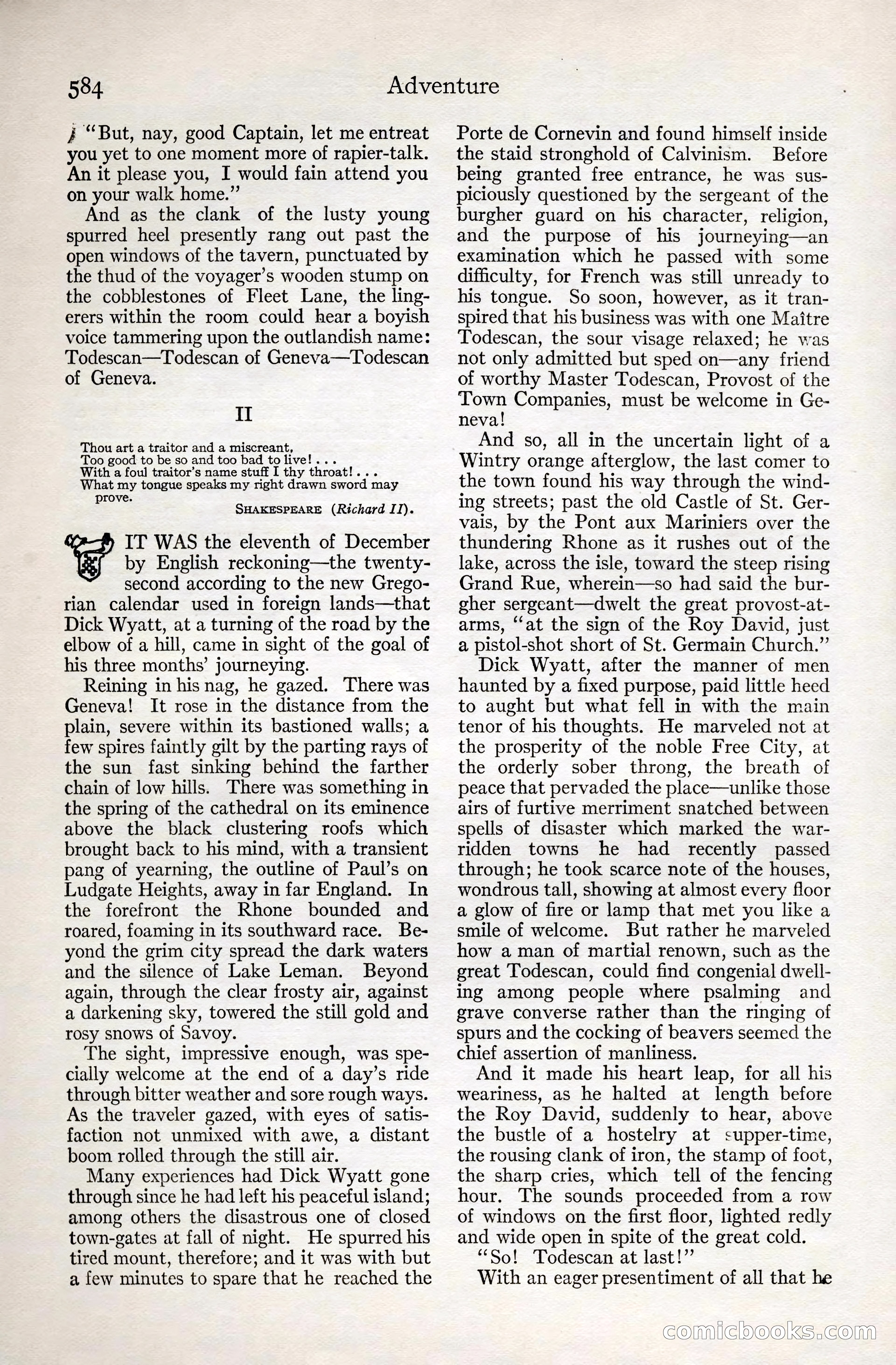
A restored page from Pulp Fiction, 1911. Page through the whole issue in the reader above.
📄 Transcribed text from this page (OCR, searchable)
Machine-transcribed from the original scan — historical spelling and the odd misread are preserved.
534 } “But, nay, good Captain, let me entreat you yet to one moment more of rapier-talk. An it please you, I would fain attend you on your walk home.”’ And as the clank of the lusty young spurred heel presently rang out past the open windows of the tavern, punctuated by the thud of the voyager’s wooden stump on the cobblestones of Fleet Lane, the ling- erers within the room could hear a boyish voice tammering upon the outlandish name: Todescan—Todescan of Geneva—Todescan of Geneva. IT Thou art a traitor and a miscreant, Too good to be so and too bad to live! . With a foul traitor’s name stuff I thy throat! . What my tongue speaks my right drawn sword may prove. : SHAKESPEARE (Richard II). IT WAS the eleventh of December by English reckoning—the twenty- second according to the new Grego- rian calendar used in foreign lands—that Dick Wyatt, at a turning of the road by the elbow of a hill, came in sight of the goal of his three months’ journeying. Reining in his nag, he gazed. There was Geneva! It rose in the distance from the plain, severe within its bastioned walls; a few spires faintly gilt by the parting rays of the sun fast sinking behind the farther chain of low hills. There was something in the spring of the cathedral on its eminence above the black clustering roofs which brought back to his mind, with a transient pang of yearning, the outline of Paul’s on Ludgate Heights, away in far England. In the forefront the Rhone bounded and roared, foaming in its southward race. Be- yond the grim city spread the dark waters and the silence of Lake Leman. Beyond again, through the clear frosty air, against a darkening sky, towered the still gold and rosy snows of Savoy. The sight, impressive enough, was spe- cially welcome at the end of a day’s ride through bitter weather and sore rough ways. As the traveler gazed, with eyes of satis- faction not unmixed with awe, a distant boom rolled through the still air. Many experiences had Dick Wyatt gone through since he had left his peaceful island; among others the disastrous one of closed town-gates at fall of night. He spurred his tired mount, therefore; and it was with but a few minutes to spare that he reached the Adventure Porte de Cornevin and found himself inside the staid stronghold of Calvinism. Before being granted free entrance, he was sus- piciously questioned by the sergeant of the burgher guard on his character, religion, and the purpose of his journeying—an examination which he passed with some difficulty, for French was still unready to his tongue. So soon, however, as it tran- spired that his business was with one Maitre Todescan, the sour visage relaxed; he was not only admitted but sped on—any friend of worthy Master Todescan, Provost of the Town Companies, must be welcome in Ge- neva! And so, all in the uncertain light of a Wintry orange afterglow, the last comer to the town found his way through the wind- ing streets; past the old Castle of St. Ger- vais, by the Pont aux Mariniers over the thundering Rhone as it rushes out of the lake, across the isle, toward the steep rising Grand Rue, wherein—so had said the bur- gher sergeant—dwelt the great provost-at- arms, ‘‘at the sign of the Roy David, just a pistol-shot short of St. Germain Church.” Dick Wyatt, after the manner of men haunted by a fixed purpose, paid little heed to aught but what fell in with the main tenor of his thoughts. He marveled not at the prosperity of the noble Free City, at the orderly sober throng, the breath of peace that pervaded the place—unlike those airs of furtive merriment snatched between spells of disaster which marked the war- ridden towns he had recently passed through; he took scarce note of the houses, wondrous tall, showing at almost every floor a glow of fire or lamp that met you like a smile of welcome. But rather he marveled how aman of martial renown, such as the great Todescan, could find congenial dwell- ing among people where psalming and grave converse rather than the ringing of spurs and the cocking of beavers seemed the chief assertion of manliness. And it made his heart leap, for all his weariness, as he halted at length before the Roy David, suddenly to hear, above the bustle of a hostelry at supper-time, the rousing clank of iron, the stamp of foot, the sharp cries, which tell of the fencing hour. The sounds proceeded from a row of windows on the first floor, lighted redly and wide open in spite of the great cold. “So! Todescan at last!” With an eager presentiment of all that he GCOMmIGDOOKSEEO