
Pulp Fiction, 1911 · page 31 of 196
Adventure Magazine Cover — page 31: what you’re looking at
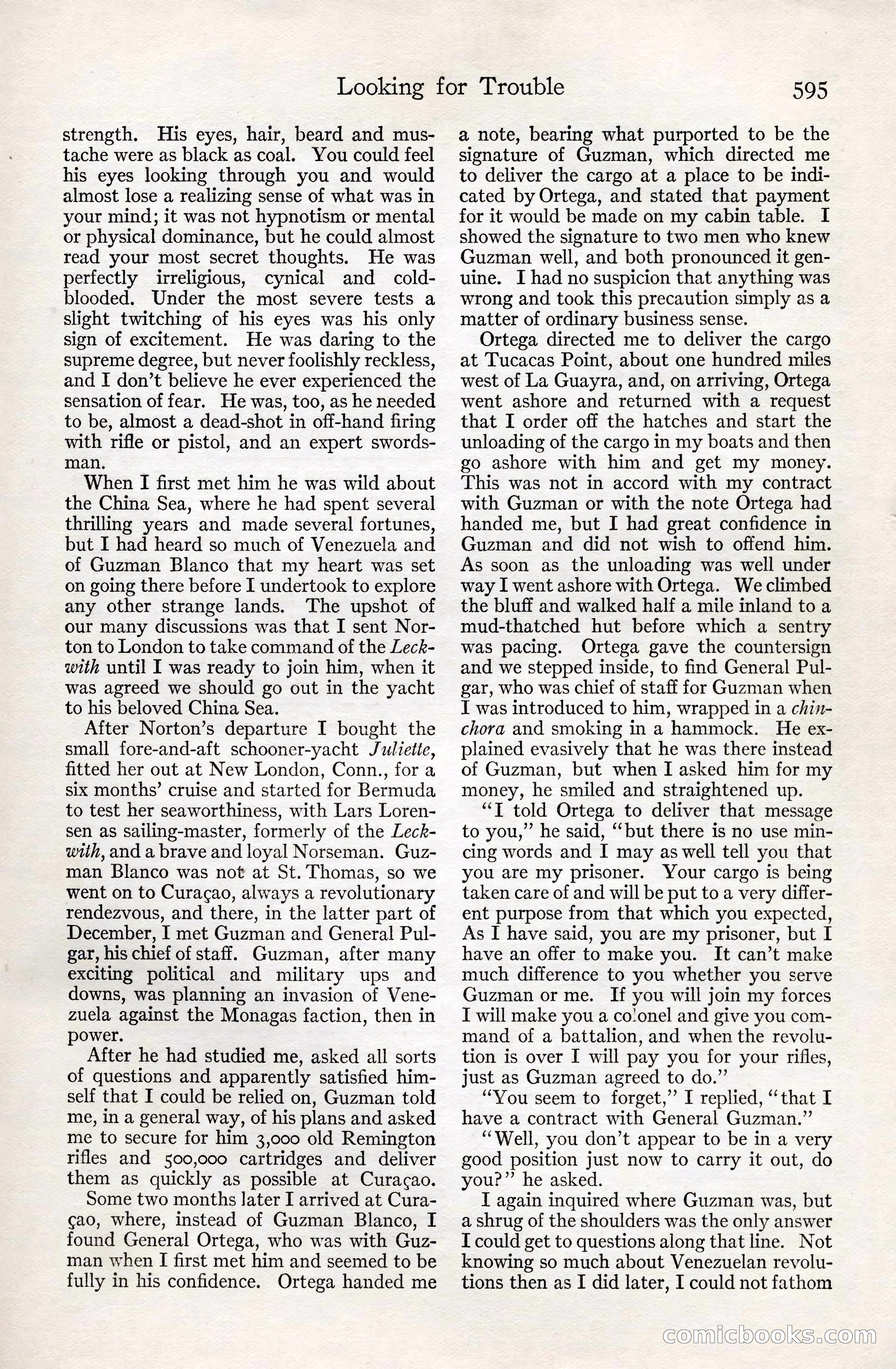
A restored page from Pulp Fiction, 1911. Page through the whole issue in the reader above.
📄 Transcribed text from this page (OCR, searchable)
Machine-transcribed from the original scan — historical spelling and the odd misread are preserved.
Looking for Trouble strength. His eyes, hair, beard and mus- tache were as black as coal. You could feel his eyes looking through you and would almost lose a realizing sense of what was in your mind; it was not hypnotism or mental or physical dominance, but he could almost read your most secret thoughts. He was perfectly irreligious, cynical and _ cold- blooded. Under the most severe tests a slight twitching of his eyes was his only sign of excitement. He was daring to the supreme degree, but never foolishly reckless, and I don’t believe he ever experienced the sensation of fear. He was, too, as he needed to be, almost a dead-shot in off-hand firing with rifle or pistol, and an expert swords- man. When I first met him he was wild about the China Sea, where he had spent several thrilling years and made several fortunes, but I had heard so much of Venezuela and of Guzman Blanco that my heart was set on going there before I undertook to explore any other strange lands. The upshot of our many discussions was that I sent Nor- ton to London to take command of the Leck- with until I was ready to join him, when it was agreed we should go out in the yacht to his beloved China Sea. After Norton’s departure I bought the small fore-and-aft schooner-yacht Juliette, fitted her out at New London, Conn., for a six months’ cruise and started for Bermuda to test her seaworthiness, with Lars Loren- sen as sailing-master, formerly of the Leck- wiih, and a brave and loyal Norseman. Guz- man Blanco was not at St. Thomas, so we went on to Curacao, always a revolutionary rendezvous, and there, in the latter part of December, I met Guzman and General Pul- gar, his chief of staff. Guzman, after many exciting political and military ups and downs, was planning an invasion of Vene- zuela against the Monagas faction, then in power. After he had studied me, asked all sorts of questions and apparently satisfied him- self that I could be relied on, Guzman told me, in a general way, of his plans and asked me to secure for him 3,000 old Remington rifles and 500,000 cartridges and deliver them as quickly as possible at Curacao. Some two months later I arrived at Cura- cao, where, instead of Guzman Blanco, I found General Ortega, who was with Guz- man when [ first met him and seemed to be fully in his confidence. Ortega handed me 595 a note, bearing what purported to be the signature of Guzman, which directed me to deliver the cargo at a place to be indi- cated by Ortega, and stated that payment for it would be made on my cabin table. I showed the signature to two men who knew Guzman well, and both pronounced it gen- uine. I had no suspicion that anything was wrong and took this precaution simply as a matter of ordinary business sense. Ortega directed me to deliver the cargo at Tucacas Point, about one hundred miles west of La Guayra, and, on arriving, Ortega went ashore and returned with a request that I order off the hatches and start the unloading of the cargo in my boats and then go ashore with him and get my money. This was not in accord with my contract with Guzman or with the note Ortega had handed me, but I had great confidence in Guzman and did not wish to offend him. As soon as the unloading was well under way I went ashore with Ortega. We climbed the bluff and walked half a mile inland toa mud-thatched hut before which a sentry was pacing. Ortega gave the countersign and we stepped inside, to find General Pul- gar, who was chief of staff for Guzman when I was introduced to him, wrapped in a chiw- chora and smoking in a hammock. He ex- plained evasively that he was there instead of Guzman, but when I asked him for my money, he smiled and straightened up. “T told Ortega to deliver that message to you,” he said, “but there is no use min- cing words and I may as well tell you that you are my prisoner. Your cargo is being taken care of and will be put to a very differ- ent purpose from that which you expected, As I have said, you are my prisoner, but I have an offer to make you. It can’t make much difference to you whether you serve Guzman or me. If you will join my forces I will make you a co!onel and give you com- mand of a battalion, and when the revolu- tion is over I will pay you for your rifles, just as Guzman agreed to do.”’ “You seem to forget,” I replied, ‘“‘that I have a contract with General Guzman.” “Well, you don’t appear to be in a very good position just now to carry it out, do you?” he asked. I again inquired where Guzman was, but a shrug of the shoulders was the only answer I could get to questions along that line. Not knowing so much about Venezuelan revolu- tions then as I did later, I could not fathom COMICMOOCKKS. EGO