
Pulp Fiction, 1911 · page 33 of 196
Adventure Magazine Cover — page 33: what you’re looking at
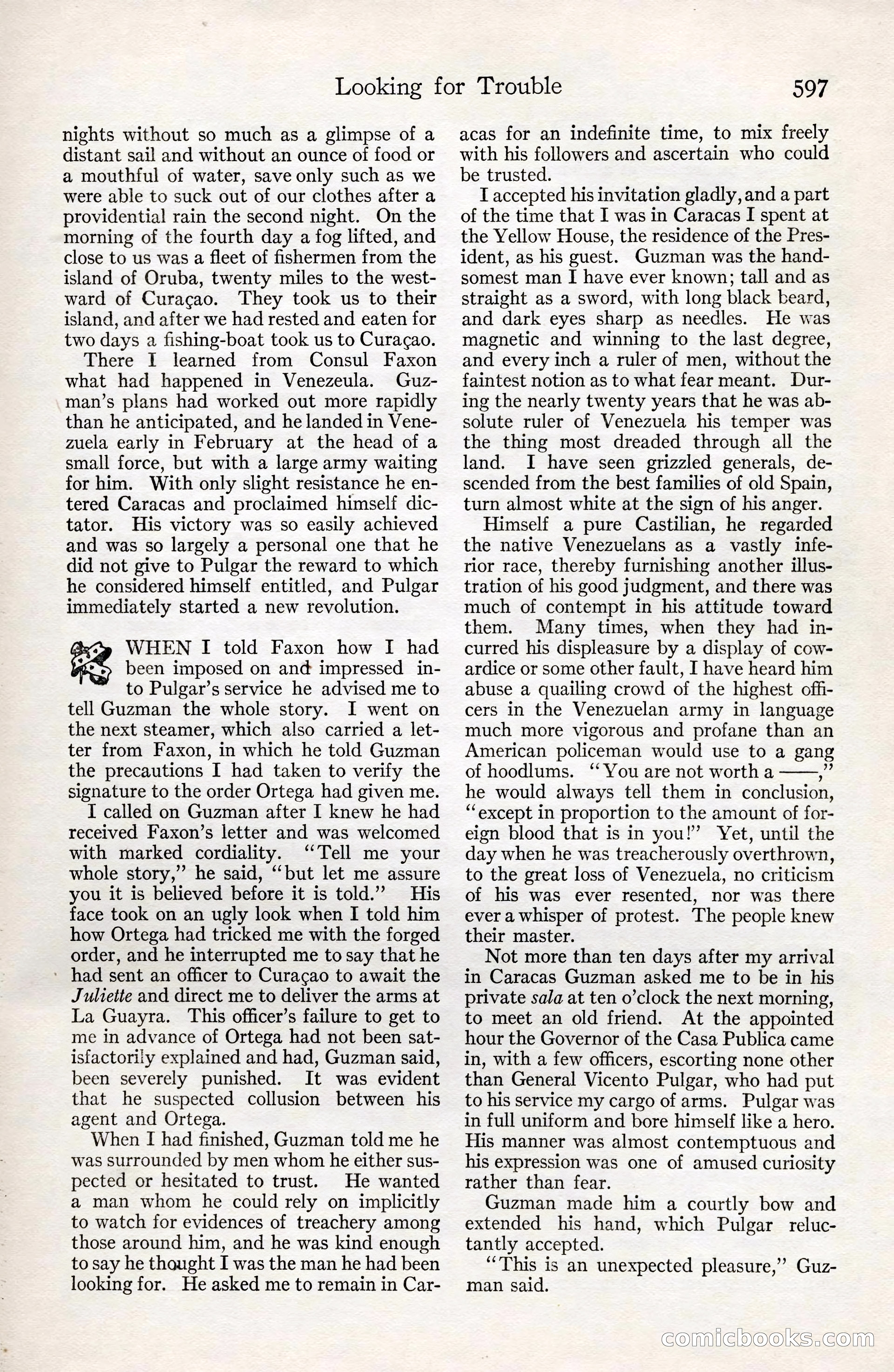
A restored page from Pulp Fiction, 1911. Page through the whole issue in the reader above.
📄 Transcribed text from this page (OCR, searchable)
Machine-transcribed from the original scan — historical spelling and the odd misread are preserved.
Looking for Trouble nights without so much as a glimpse of a distant sail and without an ounce of food or a mouthful of water, save only such as we were able to suck out of our clothes after a providential rain the second night. On the morning of the fourth day a fog lifted, and close to us was a fleet of fishermen from the island of Oruba, twenty miles to the west- ward of Curacao. They took us to their island, and after we had rested and eaten for two days a fishing-boat took us to Curagao. There I learned from Consul Faxon what had happened in Venezeula. Guz- man’s plans had worked out more rapidly than he anticipated, and he landed in Vene- zuela early in February at the head of a small force, but with a large army waiting for him. With only slight resistance he en- tered Caracas and proclaimed himself dic- tator. His victory was so easily achieved and was so largely a personal one that he did not give to Pulgar the reward to which he considered himself entitled, and Pulgar immediately started a new revolution. (de WHEN I told Faxon how I had "> been imposed on and impressed in- ~ to Pulgar’s service he advised me to tell Guzman the whole story. I went on the next steamer, which also carried a let- ter from Faxon, in which he told Guzman the precautions I had taken to verify the signature to the order Ortega had given me. I called on Guzman after I knew he had received Faxon’s letter and was welcomed with marked cordiality. “Tell me your whole story,” he said, ‘‘but let me assure you it is believed before it is told.” His face took on an ugly look when I told him how Ortega had tricked me with the forged order, and he interrupted me to say that he ' had sent an officer to Curacao to await the Juliette and direct me to deliver the arms at La Guayra. This officer’s failure to get to me in advance of Ortega had not been sat- isfactorily explained and had, Guzman said, been severely punished. It was evident that he suspected collusion between his agent and Ortega. When I had finished, Guzman told me he was surrounded by men whom he either sus- pected or hesitated to trust. He wanted a man whom he could rely on implicitly to watch for evidences of treachery among those around him, and he was kind enough to say he thought I was the man he had been looking for. He asked me to remain in Car- 597 acas for an indefinite time, to mix freely with his followers and ascertain who could be trusted. IT accepted his invitation gladly, and a part of the time that I was in Caracas I spent at the Yellow House, the residence of the Pres- ident, as his guest. Guzman was the hand- somest man I have ever known; tall and as straight as a sword, with long black beard, and dark eyes sharp as needles. He was magnetic and winning to the last degree, and every inch a ruler of men, without the faintest notion as to what fear meant. Dur- ing the nearly twenty years that he was ab- solute ruler of Venezuela his temper was the thing most dreaded through all the land. I have seen grizzled generals, de- scended from the best families of old Spain, turn almost white at the sign of his anger. Himself a pure Castilian, he regarded the native Venezuelans as a vastly infe- rior race, thereby furnishing another illus- tration of his good judgment, and there was much of contempt in his attitude toward them. Many times, when they had in- curred his displeasure by a display of cow- ardice or some other fault, I have heard him abuse a quailing crowd of the highest offi- cers in the Venezuelan army in language much more vigorous and profane than an American policeman would use to a gang of hoodlums. “ You are not worth a 4 he would always tell them in conclusion, “except in proportion to the amount of for- eign blood that is in you!’ Yet, until the day when he was treacherously overthrown, to the great loss of Venezuela, no criticism of his was ever resented, nor was there ever a whisper of protest. The people knew their master. Not more than ten days after my arrival in Caracas Guzman asked me to be in his private sala at ten o’clock the next morning, to meet an old friend. At the appointed hour the Governor of the Casa Publica came in, with a few officers, escorting none other than General Vicento Pulgar, who had put to his service my cargo of arms. Pulgar was in full uniform and bore himself like a hero. His manner was almost contemptuous and his expression was one of amused curiosity rather than fear. Guzman made him a courtly bow and extended his hand, which Pulgar reluc- tantly accepted. “This is an unexpected pleasure,” Guz- man said. COmicloool< (©