
Pulp Fiction, 1911 · page 44 of 196
Adventure Magazine Cover — page 44: what you’re looking at
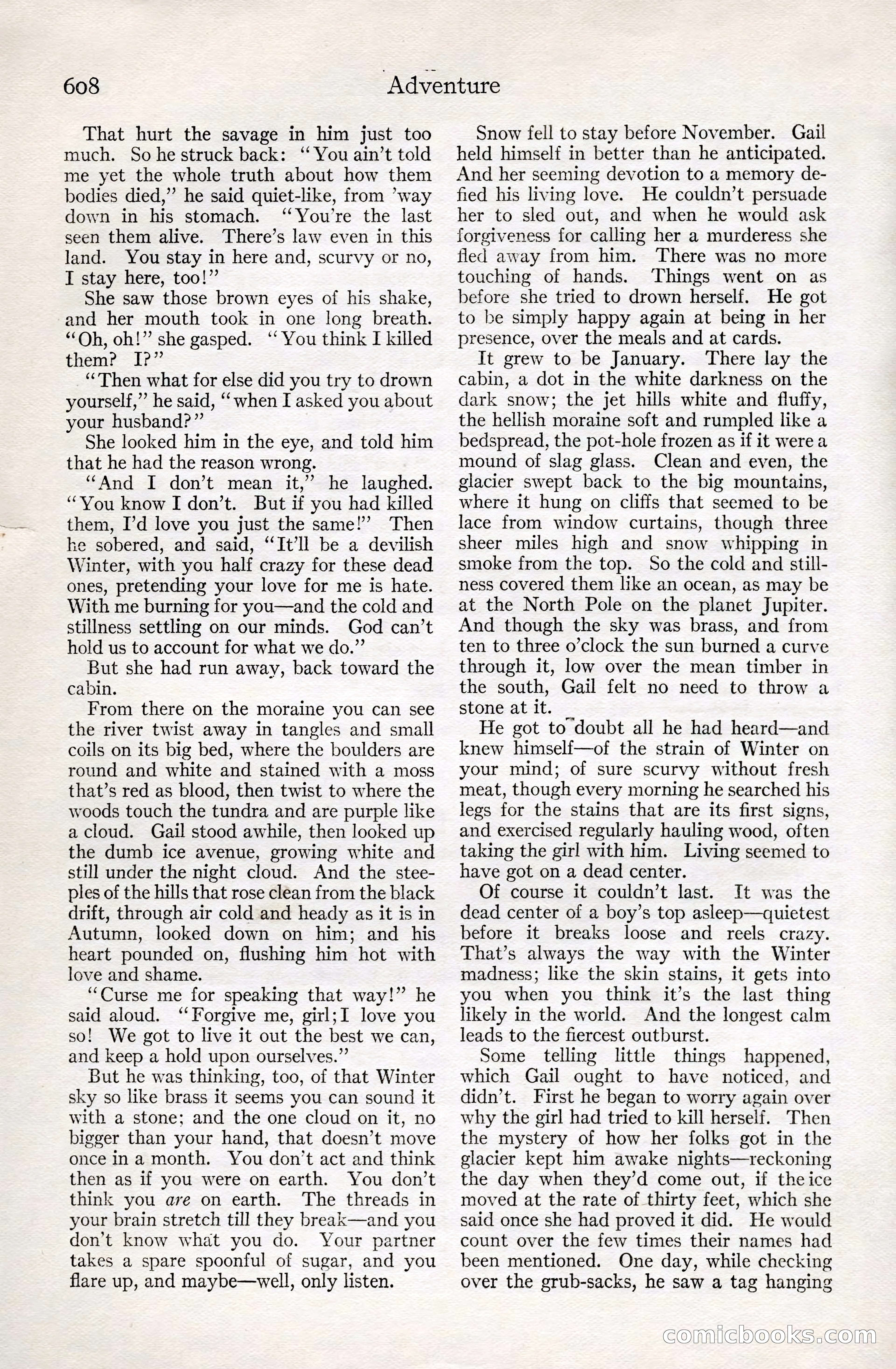
A restored page from Pulp Fiction, 1911. Page through the whole issue in the reader above.
📄 Transcribed text from this page (OCR, searchable)
Machine-transcribed from the original scan — historical spelling and the odd misread are preserved.
608 That hurt the savage in him just too much. So he struck back: ‘‘ You ain’t told me yet the whole truth about how them bodies died,” he said quiet-like, from ’way down in his stomach. “You're the last seen them alive. There’s law even in this land. You stay in here and, scurvy or no, I stay here, too!” She saw those brown eyes of his shake, and her mouth took in one long breath. “Oh, oh!” she gasped. ‘* You think I killed them? I?” “Then what for else did you try to drown yourself,” he said, “when I asked you about your husband?” She looked him in the eye, and told him that he had the reason wrong. “And I don’t mean it,” he laughed. “You know I don’t. But if you had killed them, I’d love you just the same!’ Then he sobered, and said, ‘“‘It’ll be a devilish Winter, with you half crazy for these dead ones, pretending your love for me is hate. With me burning for you—and the cold and stillness settling on our minds. God can’t hold us to account for what we do.”’ But she had run away, back toward the cabin. From there on the moraine you can see the river twist away in tangles and small coils on its big bed, where the boulders are round and white and stained with a moss that’s red as blood, then twist to where the woods touch the tundra and are purple like a cloud. Gail stood awhile, then looked up the dumb ice avenue, growing white and still under the night cloud. And the stee- ples of the hills that rose clean from the black drift, through air cold and heady as it is in Autumn, looked down on him; and his heart pounded on, flushing him hot with love and shame. “Curse me for speaking that way!” he said aloud. ‘Forgive me, girl;I love you so! We got to live it out the best we can, and keep a hold upon ourselves.” But he was thinking, too, of that Winter sky so like brass it seems you can sound it with a stone; and the one cloud on it, no bigger than your hand, that doesn’t move once ina month. You don’t act and think then as if you were on earth. You don’t think you are on earth. The threads in your brain stretch till they break—and you don’t know what you do. Your partner takes a spare spoonful of sugar, and you flare up, and maybe—well, only listen. “Adventure Snow fell to stay before November. Gail held himself in better than he anticipated. And her seeming devotion to a memory de- fied his living love. He couldn’t persuade her to sled out, and when he would ask forgiveness for calling her a murderess she fled away from him. There was no more touching of hands. ‘Things went on as before she tried to drown herself. He got to be simply happy again at being in her presence, over the meals and at cards. It grew to be January. There lay the cabin, a dot in the white darkness on the dark snow; the jet hills white and fluffy, the hellish moraine soft and rumpled like a bedspread, the pot-hole frozen as if it were a mound of slag glass. Clean and even, the glacier swept back to the big mountains, where it hung on cliffs that seemed to be lace from window curtains, though three sheer miles high and snow whipping in smoke from the top. So the cold and still- ness covered them like an ocean, as may be at the North Pole on the planet Jupiter. And though the sky was brass, and from ten to three o’clock the sun burned a curve through it, low over the mean timber in the south, Gail felt no need to throw a stone at it. He got to doubt all he had heard—and knew himself—of the strain of Winter on your mind; of sure scurvy without fresh meat, though every morning he searched his legs for the stains that are its first signs, and exercised regularly hauling wood, often taking the girl with him. Living seemed to have got on a dead center. Of course it couldn’t last. It was the dead center of a boy’s top asleep—quietest before it breaks loose and reels crazy. That’s always the way with the Winter madness; like the skin stains, it gets into you when you think it’s the last thing likely in the world. And the longest calm leads to the fiercest outburst. Some telling little things happened, which Gail ought to have noticed, and didn’t. First he began to worry again over why the girl had tried to kill herself. Then the mystery of how her folks got in the glacier kept him awake nights—reckoning the day when they’d come out, if theice moved at the rate of thirty feet, which she said once she had proved it did. He would count over the few times their names had been mentioned. One day, while checking over the grub-sacks, he saw a tag hanging COMICMOOCKKS. ECO