
Pulp Fiction, 1911 · page 49 of 196
Adventure Magazine Cover — page 49: what you’re looking at
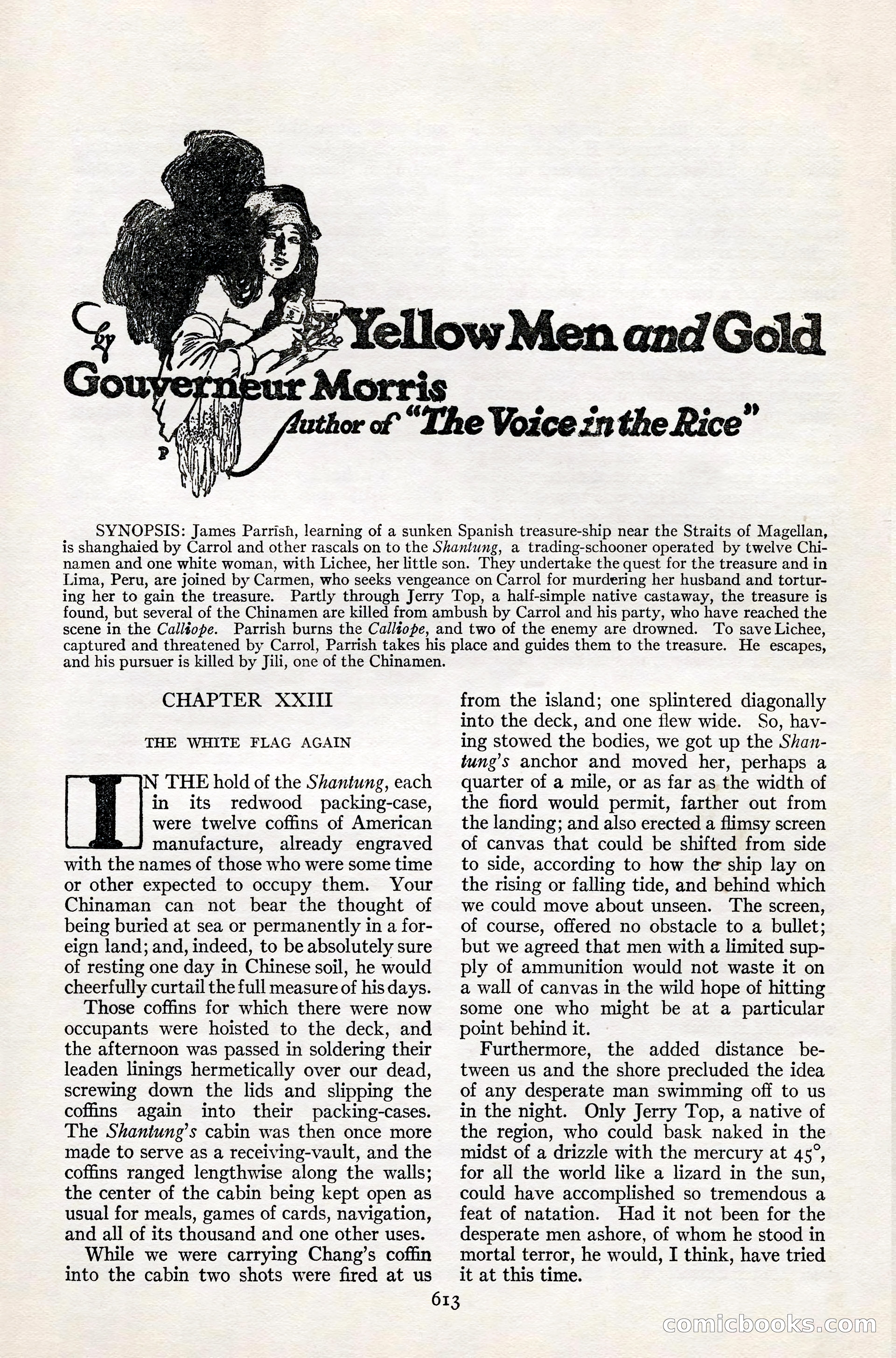
A restored page from Pulp Fiction, 1911. Page through the whole issue in the reader above.
📄 Transcribed text from this page (OCR, searchable)
Machine-transcribed from the original scan — historical spelling and the odd misread are preserved.
Yellow Men and Gold luthor of “The Voice zn the Rice SYNOPSIS: James Parrish, learning of a sunken Spanish treasure-ship near the Straits of Magellan, is shanghaied by Carrol and other rascals on to the Shantung, a trading-schooner operated by twelve Chi- namen and one white woman, with Lichee, her little son. They undertake the quest for the treasure and in Lima, Peru, are joined by Carmen, who seeks vengeance on Carrol for murdering her husband and tortur- ing her to gain the treasure. Partly through Jerry Top, a half-simple native castaway, the treasure is found, but several of the Chinamen are killed from ambush by Carrol and his party, who have reached the scene in the Callsope. Parrish burns the Callsope, and two of the enemy are drowned. To save Lichee, captured and threatened by Carrol, Parrish takes his place and guides them to the treasure. He escapes, and his pursuer is killed by Jili, one of the Chinamen. CHAPTER XXIII THE WHITE FLAG AGAIN N THE hold of the Shantung, each in its redwood packing-case, were twelve coffins of American manufacture, already engraved with the names of those who were some time or other expected to occupy them. Your Chinaman can not bear the thought of being buried at sea or permanently in a for- eign land; and, indeed, to be absolutely sure of resting one day in Chinese soil, he would cheerfully curtail the full measure of his days. Those coffins for which there were now occupants were hoisted to the deck, and the afternoon was passed in soldering their leaden linings hermetically over our dead, screwing down the lids and slipping the coffins again into their packing-cases. The Shantung’s cabin was then once more made to serve as a receiving-vault, and the coffins ranged lengthwise along the walls; the center of the cabin being kept open as usual for meals, games of cards, navigation, and all of its thousand and one other uses. While we were carrying Chang’s coffin into the cabin two shots were fired at us from the island; one splintered diagonally into the deck, and one flew wide. So, hav- ing stowed the bodies, we got up the Skan- tung’s anchor and moved her, perhaps a quarter of a mile, or as far as the width of the fiord would permit, farther out from the landing; and also erected a flimsy screen of canvas that could be shifted from side to side, according to how the ship lay on the rising or falling tide, and behind which we could move about unseen. The screen, of course, offered no obstacle to a bullet; but we agreed that men with a limited sup- ply of ammunition would not waste it on a wall of canvas in the wild hope of hitting some one who might be at a particular point behind it. Furthermore, the added distance be- tween us and the shore precluded the idea of any desperate man swimming off to us in the night. Only Jerry Top, a native of the region, who could bask naked in the midst of a drizzle with the mercury at 45°, for all the world like a lizard in the sun, could have accomplished so tremendous a feat of natation. Had it not been for the desperate men ashore, of whom he stood in mortal terror, he would, I think, have tried it at this time. 613 COMICLOOCKKS. ECO