
Pulp Fiction, 1911 · page 58 of 196
Adventure Magazine Cover — page 58: what you’re looking at
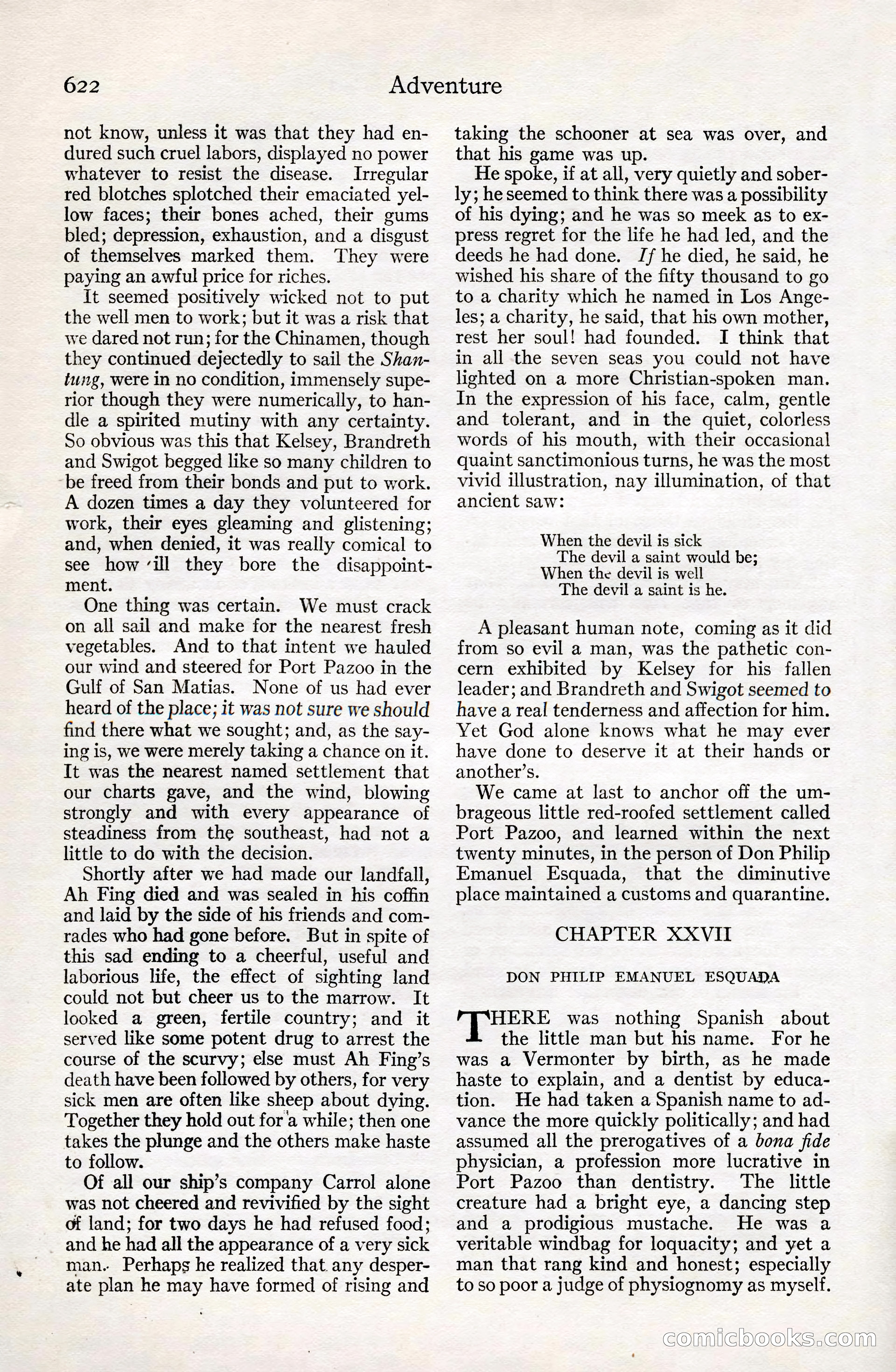
A restored page from Pulp Fiction, 1911. Page through the whole issue in the reader above.
📄 Transcribed text from this page (OCR, searchable)
Machine-transcribed from the original scan — historical spelling and the odd misread are preserved.
622 not know, unless it was that they had en- dured such cruel labors, displayed no power whatever to resist the disease. Irregular red blotches splotched their emaciated yel- low faces; their bones ached, their gums bled; depression, exhaustion, and a disgust of themselves marked them. They were paying an awful price for riches. It seemed positively wicked not to put the well men to work; but it was a risk that we dared not run; for the Chinamen, though they continued dejectedly to sail the Shan- tung, were in no condition, immensely supe- rior though they were numerically, to han- dle a spirited mutiny with any certainty. So obvious was this that Kelsey, Brandreth and Swigot begged like so many children to be freed from their bonds and put to work. A dozen times a day they volunteered for work, their eyes gleaming and glistening; and, when denied, it was really comical to see how ‘ill they bore the disappoint- ment. One thing was certain. We must crack on all sail and make for the nearest fresh vegetables. And to that intent we hauled our wind and steered for Port Pazoo in the Gulf of San Matias. None of us had ever heard of the place; it was not sure we should find there what we sought; and, as the say- ing is, we were merely taking a chance on it. It was the nearest named settlement that our charts gave, and the wind, blowing strongly and with every appearance of steadiness from the southeast, had not a little to do with the decision. Shortly after we had made our landfall, Ah Fing died and was sealed in his coffin and laid by the side of his friends and com- rades who had gone before. But in spite of this sad ending to a cheerful, useful and laborious life, the effect of sighting land could not but cheer us to the marrow. It looked a green, fertile country; and it served like some potent drug to arrest the course of the scurvy; else must Ah Fing’s death have been followed by others, for very sick men are often like sheep about dying. Together they hold out fora while; then one takes the plunge and the others make haste to follow. Of all our ship’s company Carrol alone was not cheered and revivified by the sight of land; for two days he had refused food; and he had all the appearance of a very sick man. Perhaps he realized that. any desper- ate plan he may have formed of rising and Adventure taking the schooner at sea was over, and that his game was up. He spoke, if at all, very quietly and sober- ly; he seemed to think there was a possibility of his dying; and he was so meek as to ex- press regret for the life he had led, and the deeds he had done. Jf he died, he said, he wished his share of the fifty thousand to go to a charity which he named in Los Ange- les; a charity, he said, that his own mother, rest her soul! had founded. I think that in all the seven seas you could not have lighted on a more Christian-spoken man. In the expression of his face, calm, gentle and tolerant, and in the quiet, colorless words of his mouth, with their occasional quaint sanctimonious turns, he was the most vivid illustration, nay illumination, of that ancient saw: When the devil is sick The devil a saint would be; When the devil is well The devil a saint is he. A pleasant human note, coming as it did from so evil a man, was the pathetic con- cern exhibited by Kelsey for his fallen leader; and Brandreth and Swigot seemed to have a real tenderness and affection for him. Yet God alone knows what he may ever have done to deserve it at their hands or another’s. We came at last to anchor off the um- brageous little red-roofed settlement called Port Pazoo, and learned within the next twenty minutes, in the person of Don Philip Emanuel Esquada, that the diminutive place maintained a customs and quarantine. CHAPTER XXVII DON PHILIP EMANUEL ESQUADA fs was nothing Spanish about the little man but his name. For he was a Vermonter by birth, as he made haste to explain, and a dentist by educa- tion. He had taken a Spanish name to ad- vance the more quickly politically; and had assumed all the prerogatives of a bona fide physician, a profession more lucrative in Port Pazoo than dentistry. The little creature had a bright eye, a dancing step and a prodigious mustache. He was a veritable windbag for loquacity; and yet a man that rang kind and honest; especially to so poor a judge of physiognomy as myself. COMmMICLOOCKKS. EGO S|