
Pulp Fiction, 1911 · page 85 of 196
Adventure Magazine Cover — page 85: what you’re looking at
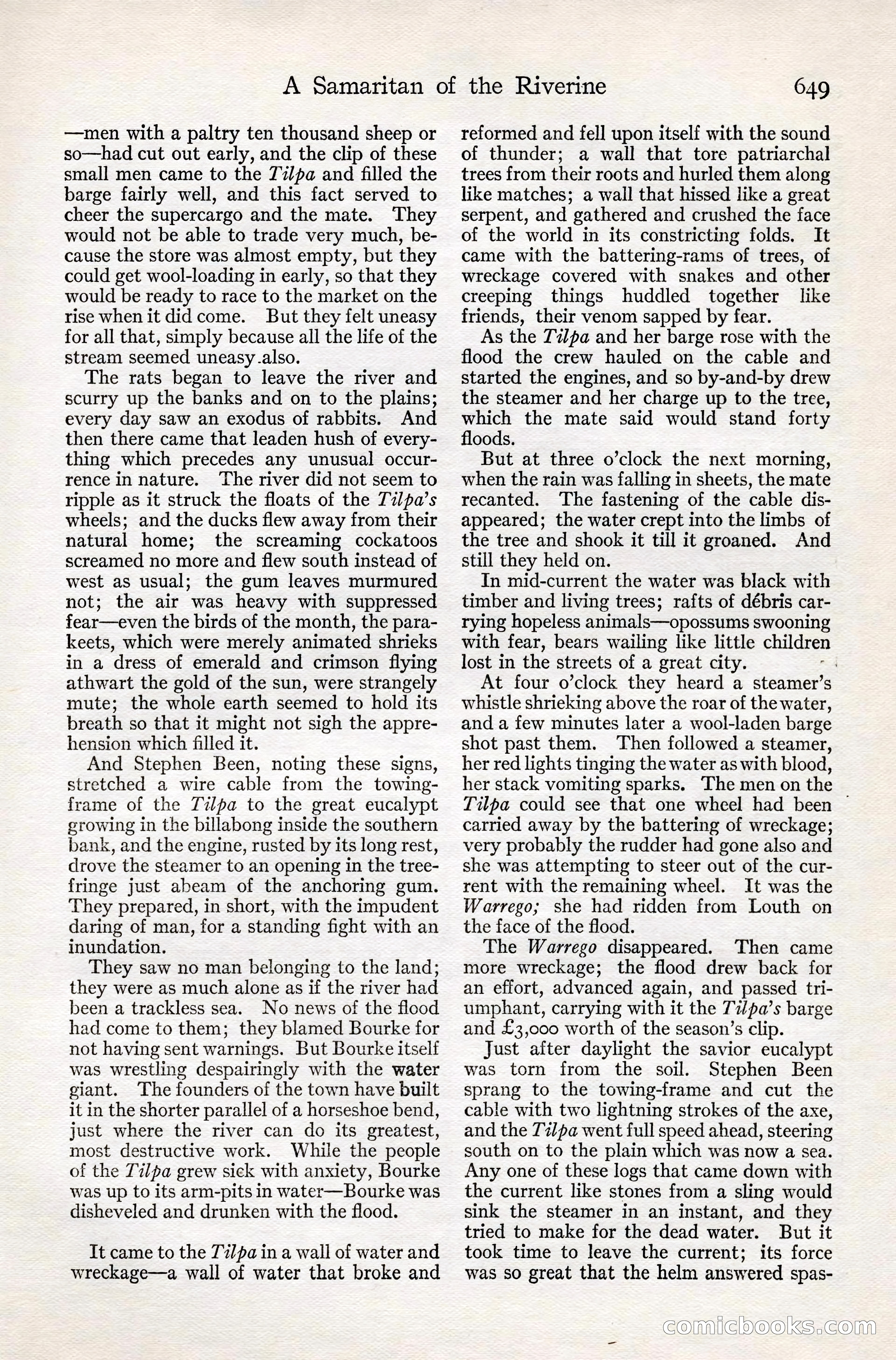
A restored page from Pulp Fiction, 1911. Page through the whole issue in the reader above.
📄 Transcribed text from this page (OCR, searchable)
Machine-transcribed from the original scan — historical spelling and the odd misread are preserved.
A Samaritan of the Riverine —men with a paltry ten thousand sheep or so—had cut out early, and the clip of these small men came to the Z7/pa and filled the barge fairly well, and this fact served to cheer the supercargo and the mate. They would not be able to trade very much, be- cause the store was almost empty, but they could get wool-loading in early, so that they would be ready to race to the market on the rise when it didcome. But they felt uneasy for all that, simply because all the life of the stream seemed uneasy.also. The rats began to leave the river and scurry up the banks and on to the plains; every day saw an exodus of rabbits. And then there came that leaden hush of every- thing which precedes any unusual occur- rence in nature. The river did not seem to ripple as it struck the floats of the T7lpa’s wheels; and the ducks flew away from their natural home; the screaming cockatoos screamed no more and flew south instead of west as usual; the gum leaves murmured not; the air was heavy with suppressed fear—even the birds of the month, the para- keets, which were merely animated shrieks in a dress of emerald and crimson flying athwart the gold of the sun, were strangely mute; the whole earth seemed to hold its breath so that it might not sigh the appre- hension which filled it. And Stephen Been, noting these signs, stretched a wire cable from the towing- frame of the Tzlpa to the great eucalypt growing in the billabong inside the southern bank, and the engine, rusted by its long rest, drove the steamer to an opening in the tree- fringe just abeam of the anchoring gum. They prepared, in short, with the impudent daring of man, for a standing fight with an inundation. They saw no man belonging to the land; they were as much alone as if the river had been a trackless sea. No news of the flood had come to them; they blamed Bourke for not having sent warnings. But Bourke itself was wrestling despairingly with the water giant. The founders of the town have built it in the shorter parallel of a horseshoe bend, just where the river can do its greatest, most destructive work. While the people of the Tilpa grew sick with anxiety, Bourke was up to its arm-pits in water—Bourke was disheveled and drunken with the flood. It came to the 72/pa in a wall of water and wreckage—a wall of water that broke and 649 reformed and fell upon itself with the sound of thunder; a wall that tore patriarchal trees from their roots and hurled them along like matches; a wall that hissed like a great serpent, and gathered and crushed the face of the world in its constricting folds. It came with the battering-rams of trees, of wreckage covered with snakes and other creeping things huddled together like friends, their venom sapped by fear. As the Tilpa and her barge rose with the flood the crew hauled on the cable and started the engines, and so by-and-by drew the steamer and her charge up to the tree, which the mate said would stand forty floods. But at three o’clock the next morning, when the rain was falling in sheets, the mate recanted. The fastening of the cable dis- appeared; the water crept into the limbs of the tree and shook it till it groaned. And still they held on. In mid-current the water was black with timber and living trees; rafts of débris car- rying hopeless animals—opossums swooning with fear, bears wailing like little children lost in the streets of a great city. At four o’clock they heard a steamer’s whistle shrieking above the roar of the water, and a few minutes later a wool-laden barge shot past them. Then followed a steamer, her red lights tinging the water as with blood, her stack vomiting sparks. The men on the Tilpa could see that one wheel had been ~ carried away by the battering of wreckage; very probably the rudder had gone also and she was attempting to steer out of the cur- rent with the remaining wheel. It was the Warrego; she had ridden from Louth on the face of the flood. The Warrego disappeared. ‘Then came more wreckage; the flood drew back for an effort, advanced again, and passed tri- umphant, carrying with it the Tzlpa’s barge and £3,000 worth of the season’s clip. Just after daylight the savior eucalypt was torn from the soil. Stephen Been sprang to the towing-frame and cut the cable with two lightning strokes of the axe, and the T7/pa went full speed ahead, steering south on to the plain which was now a sea. Any one of these logs that came down with the current like stones from a sling would sink the steamer in an instant, and they tried to make for the dead water. But it took time to leave the current; its force was so great that the helm answered spas- GOmiGcdooksEeco