
Pulp Fiction, 1911 · page 93 of 196
Adventure Magazine Cover — page 93: what you’re looking at
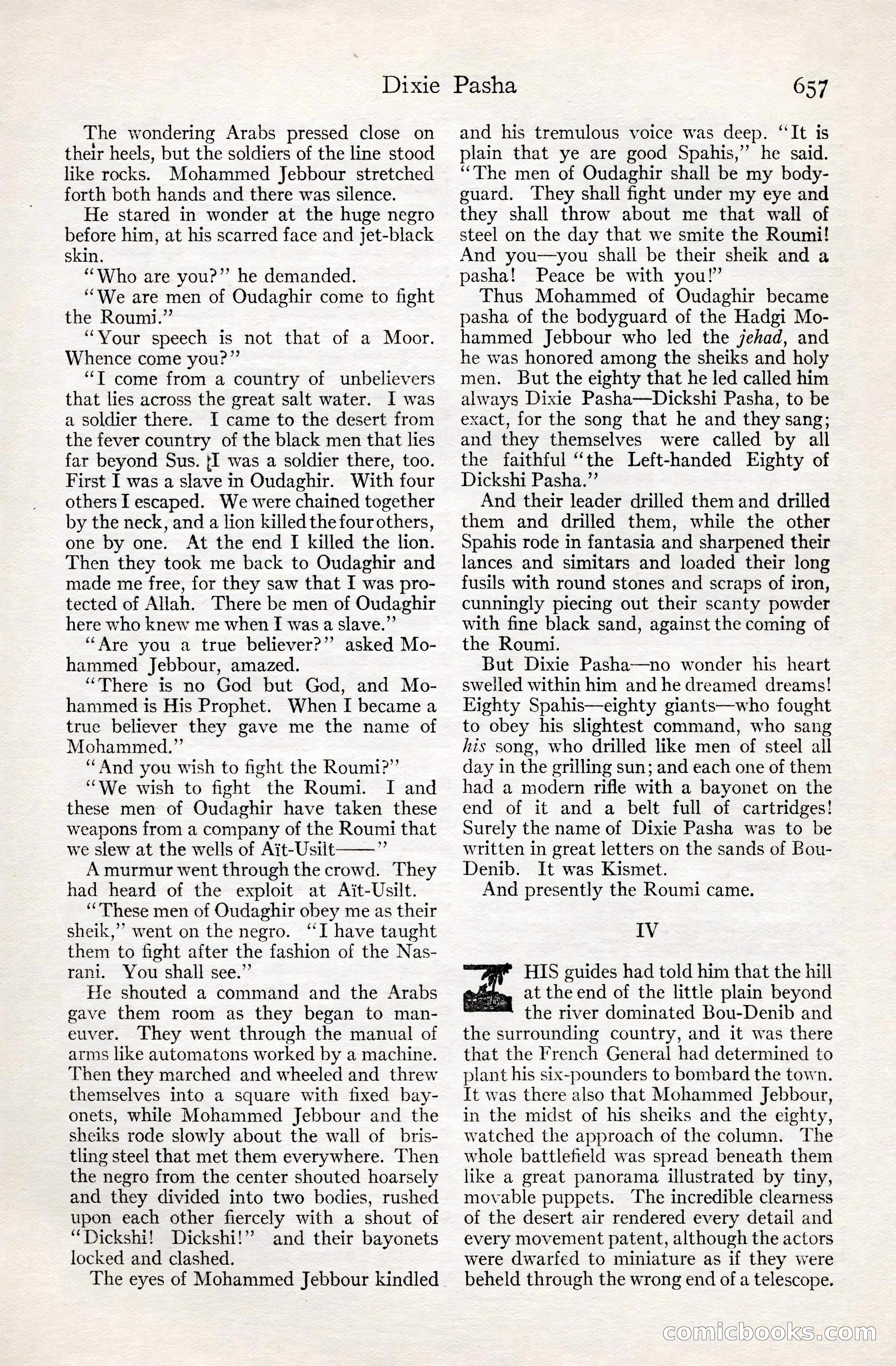
A restored page from Pulp Fiction, 1911. Page through the whole issue in the reader above.
📄 Transcribed text from this page (OCR, searchable)
Machine-transcribed from the original scan — historical spelling and the odd misread are preserved.
Dixie The wondering Arabs pressed close on their heels, but the soldiers of the line stood like rocks. Mohammed Jebbour stretched forth both hands and there was silence. He stared in wonder at the huge negro before him, at his scarred face and jet-black skin. ‘““Who are you?” he demanded. ‘““We are men of Oudaghir come to fight the Roumi.” “Your speech is not that of a Moor. Whence come you?” “T come from a country of unbelievers that lies across the great salt water. I was a soldier there. I came to the desert from the fever country of the black men that lies far beyond Sus. }I was a soldier there, too. First I was a slave in Oudaghir. With four others I escaped. We were chained together by the neck, and a lion killed the four others, one by one. At the end [I killed the lion. Then they took me back to Oudaghir and made me free, for they saw that I was pro- tected of Allah. There be men of Oudaghir here who knew me when I was a slave.” “Are you a true believer?” asked Mo- hammed Jebbour, amazed. “There is no God but God, and Mo- hammed is His Prophet. When I became a true believer they gave me the name of Mohammed.” “And you wish to fight the Roumi?”’ “We wish to fight the Roumi. I and these men of Oudaghir have taken these weapons from a company of the Roumi that we slew at the wells of Ait-Usilt Ee A murmur went through the crowd. They had heard of the exploit at Ait-Usilt. “These men of Oudaghir obey me as their sheik,’ went on the negro. “I have taught them to fight after the fashion of the Nas- rani. You shall see.” He shouted a command and the Arabs gave them room as they began to man- euver. They went through the manual of arms like automatons worked by a machine. Then they marched and wheeled and threw themselves into a square with fixed bay- onets, while Mohammed Jebbour and the sheiks rode slowly about the wall of bris- tling steel that met them everywhere. Then the negro from the center shouted hoarsely and they divided into two bodies, rushed upon each other fiercely with a shout of “Dickshi! Dickshi!” and their bayonets locked and clashed. The eyes of Mohammed Jebbour kindled Pasha 657 and his tremulous voice was deep. “It is plain that ye are good Spahis,”’ he said. “The men of Oudaghir shall be my body- guard. They shall fight under my eye and they shall throw about me that wall of steel on the day that we smite the Roumi! And you—you shall be their sheik and a pasha! Peace be with you!” Thus Mohammed of Oudaghir became pasha of the bodyguard of the Hadgi Mo- hammed Jebbour who led the jehad, and he was honored among the sheiks and holy men. But the eighty that he led called him always Dixie Pasha—Dickshi Pasha, to be exact, for the song that he and they sang; and they themselves were called by all the faithful “the Left-handed Eighty of Dickshi Pasha.” And their leader drilled them and drilled them and drilled them, while the other Spahis rode in fantasia and sharpened their lances and simitars and loaded their long fusils with round stones and scraps of iron, cunningly piecing out their scanty powder with fine black sand, against the coming of the Roumi. But Dixie Pasha—no wonder his heart swelled within him and he dreamed dreams! Eighty Spahis—eighty giants—who fought to obey his slightest command, who sang his song, who drilled like men of steel all day in the grilling sun; and each one of them had a modern rifle with a bayonet on the end of it and a belt full of cartridges! Surely the name of Dixie Pasha was to be written in great letters on the sands of Bou- Denib. It was Kismet. And presently the Roumi came. IV HIS guides had told him that the hill at the end of the little plain beyond : the river dominated Bou-Denib and the surrounding country, and it was there that the French General had determined to plant his six-pounders to bombard the town. It was there also that Mohammed Jebbour, in the midst of his sheiks and the eighty, watched the approach of the column. The whole battlefield was spread beneath them like a great panorama illustrated by tiny, movable puppets. The incredible clearness of the desert air rendered every detail and every movement patent, although the actors were dwarfed to miniature as if they were beheld through the wrong end of a telescope. CORMICLO© SS (C@ 5}