
Pulp Fiction, 1911 · page 136 of 196
Adventure, June 1911 — page 136: what you’re looking at
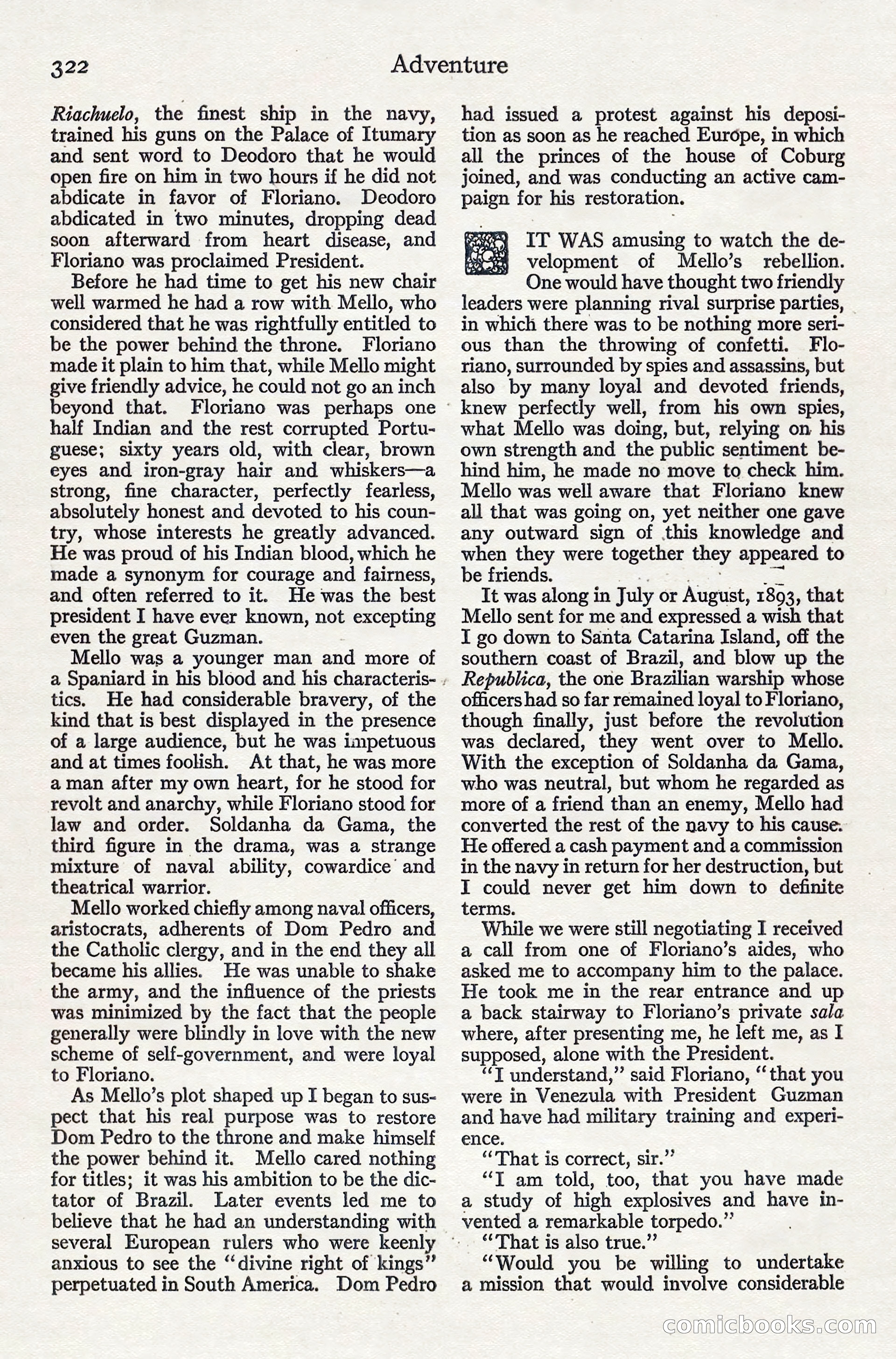
A restored page from Pulp Fiction, 1911. Page through the whole issue in the reader above.
📄 Transcribed text from this page (OCR, searchable)
Machine-transcribed from the original scan — historical spelling and the odd misread are preserved.
429 Riachuelo, the finest ship in the navy, trained his guns on the Palace of Itumary and sent word to Deodoro that he would open fire on him in two hours if he did not abdicate in favor of Floriano. Deodoro abdicated in two minutes, dropping dead soon afterward from heart disease, and Floriano was proclaimed President. Before he had time to get his new chair well warmed he had a row with Mello, who considered that he was rightfully entitled to be the power behind the throne. Floriano made it plain to him that, while Mello might give friendly advice, he could not go an inch beyond that. half Indian and the rest corrupted Portu- guese; sixty years old, with clear, brown eyes and iron-gray hair and whiskers—a strong, fine character, perfectly fearless, absolutely honest and devoted to his coun- try, whose interests he greatly advanced. He was proud of his Indian blood, which he made a synonym for courage and fairness, and often referred to it. He was the best president I have ever known, not excepting even the great Guzman. Mello was a younger man and more of a Spaniard in his blood and his characteris- . tics. He had considerable bravery, of the kind that is best displayed in the presence of a large audience, but he was impetuous and at times foolish. At that, he was more aman after my own heart, for he stood for revolt and anarchy, while Floriano stood for law and order. Soldanha da Gama, the third figure in the drama, was a strange mixture of naval ability, cowardice and theatrical warrior. Mello worked chiefly among naval officers, aristocrats, adherents of Dom Pedro and the Catholic clergy, and in the end they all became his allies. He was unable to shake the army, and the influence of the priests was minimized by the fact that the people generally were blindly in love with the new scheme of self-government, and were loyal to Floriano. As Mello’s plot shaped up I began to sus- pect that his real purpose was to restore Dom Pedro to the throne and make himself the power behind it. Mello cared nothing for titles; it was his ambition to be the dic- tator of Brazil. Later events led me to believe that he had an understanding with several European rulers who were keenly © anxious to see the “divine right of kings”’ perpetuated in South America. Dom Pedro Floriano was perhaps one ~ Adventure had issued a protest against his deposi- tion as soon as he reached Europe, in which all the princes of the house of Coburg joined, and was conducting an active cam- paign for his restoration. velopment of Mello’s_ rebellion. One would have thought two friendly leaders were planning rival surprise parties, in which there was to be nothing more seri- ous than the throwing of confetti. Flo- riano, surrounded by spies and assassins, but also by many loyal and devoted friends, knew perfectly well, from his own spies, what Mello was doing, but, relying on his own strength and the public sentiment be- hind him, he made no move to check him. Mello was well aware that Floriano knew all that was going on, yet neither one gave any outward sign of this knowledge and when they were together they appeared to be friends. It was along in July or August, 1893, that Mello sent for me and expressed a wish that I go down to Santa Catarina Island, off the southern coast of Brazil, and blow up the Republica, the one Brazilian warship whose officers had so far remained loyal to Floriano, though finally, just before the revolution was declared, they went over to Mello. With the exception of Soldanha da Gama, who was neutral, but whom he regarded as more of a friend than an enemy, Mello had converted the rest of the navy to his cause. He offered a cash payment and a commission in the navy in return for her destruction, but I could never get him down to definite terms. While we were still negotiating I received a call from one of Floriano’s aides, who asked me to accompany him to the palace. He took me in the rear entrance and up a back stairway to Floriano’s private sala where, after presenting me, he left me, as I supposed, alone with the President. “T understand,” said Floriano, “that you were in Venezula with President Guzman and have had military training and experi- ence. “That is correct, sir.”’ “T am told, too, that you have made a study of high explosives and have in- vented a remarkable torpedo.” “That is also true.” “Would you be willing to undertake a mission that would involve considerable COnICLOokKs (©